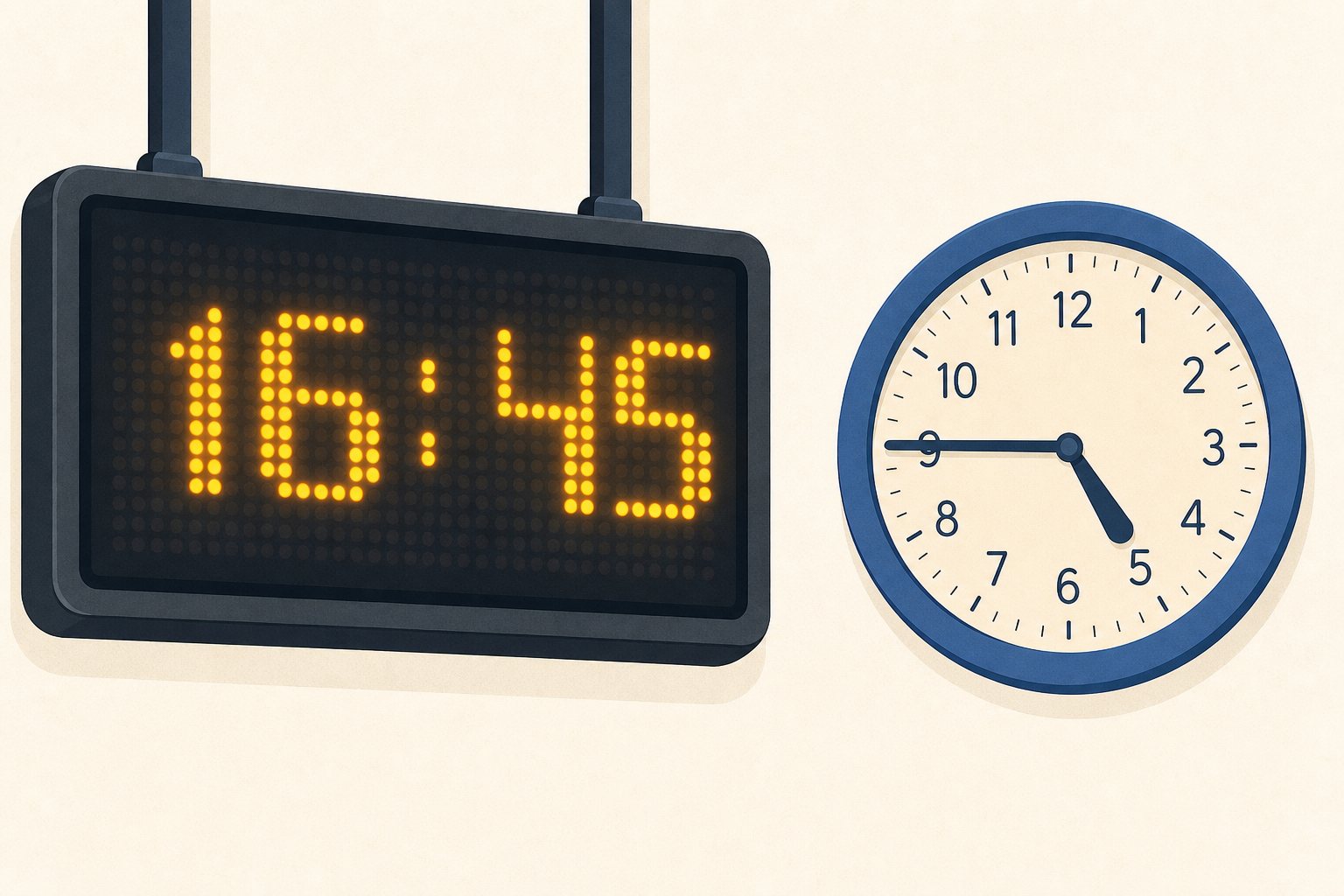
Here is a train-station departure board reading 16:45, and beside it a kitchen clock reading quarter to five in the afternoon (it is after dinner, not before breakfast).
Are these two clocks showing the same time, or two different times? What makes you think so?
Take three hands-up answers, not open call-outs. The split you want to surface: some pupils will read 16:45 as completely separate from 'quarter to five', others will spot the link. Don't resolve it yet — that is what Watch and Notice does.
Watch the clock set to twenty past seven in the morning. In the morning the hours stay the same, so we just write it with a leading zero: 07:20.
Now twenty-four-hour time keeps counting past midday instead of starting again at one. So one o'clock in the afternoon becomes thirteen, and 1:15 p.m. becomes 13:15.
Late evening keeps the same idea: nine plus twelve is twenty-one, so 9:50 p.m. is written 21:50.
These two catch everyone out. Midnight (12:00 a.m.) is written 00:00. Midnight starts a brand-new day, so the count goes back to zero — that is why it is 00:00, not 24:00. But noon (12:00 p.m.) is right in the middle of the day, so it stays as 12:00.
Point at the inner 13–24 ring and the digital readout on each clock as you walk through them.
Today we work through these times together on the clock: 8:30 a.m., 3:45 p.m., 11:10 p.m. and 6:05 a.m. One pupil at a time sets each one on the board. Everyone else works out the 24-hour form in your head and we say it aloud together to check before the clock confirms it.
This round is for talking it through together — one pupil sets the clock at the board while the rest of the class works out the 24-hour form in their heads and confirms aloud.
Call one pupil up per time. Have them set the clock, then the class states the 24-hour form before the digital readout is read aloud to confirm. Watch for the p.m. slip — pupils who forget to add twelve will say 3:45 instead of 15:45. Revoice the rule each time: 'after midday, add twelve'. Rotate four pupils so the morning-stays / afternoon-add pattern is seen both ways.
In your maths copy, draw a two-column table headed 12-hour and 24-hour. Write each of these times in both forms, one row under the other:
Then underline every row where you had to add twelve.
Walk the room glancing at the leading zeros and the underlined afternoon rows — this is whole-class copybook practice, not marking. The common slip is writing 7:20 a.m. as 7:20 with no leading zero.
Today we convert these five times. The first four are already shown in 24-hour form, so for each one say what it is in 12-hour form: 08:05, 14:30, 23:59 and 00:15. The last one goes the other way: 'twenty to midnight' — say what that is in 24-hour form. The midnight and midday ones catch people out, so we will say each one aloud before we check it.
This round is the practice bank — pupils take turns at the board, check each answer, and the class confirms before moving on. Keep the board work brisk rather than over-explaining.
The bank rises in difficulty: 08:05 is a straight morning read (8:05 a.m.), 14:30 needs the subtract-twelve move back to 2:30 p.m., 23:59 is a tricky late-evening one (11:59 p.m.), and 00:15 is the midnight special case (a quarter past midnight, NOT a quarter past noon). The final item — 'twenty to midnight' — goes the other direction, asking pupils to reason from words to 23:40. Watch for pupils reading 00:15 as 12:15 p.m.; revoice 'zero-zero hours is midnight'.
Why do airports and railways use the 24-hour clock instead of a.m. and p.m.? What problem could it cause if a train timetable just said '5:00'?
Listen for pupils naming the ambiguity of a.m./p.m. — '5:00' could be morning or evening, but '17:00' can only mean one thing. Revoice a strong answer: 'so the 24-hour clock never leaves any doubt about which 5 o'clock you mean'. Head off the idea that 24-hour time is 'harder' — it is actually clearer because the hour number does all the work.
Next we use these time skills to work out elapsed time — how long something lasts when it runs across hours and even across midnight.
Keep the recap brisk. The bridge to the next lesson is that knowing 24-hour time makes elapsed-time calculations much cleaner.
You're previewing this lesson. Get full access to this lesson and hundreds more — each one ready to teach, with interactive activities, printable resources and pupil progress tracking built in.