 Look at these five leaves from Irish hedges, lawns and school gardens. How would you tell a friend which one is which — without pointing?
Scientists use a special tool called a branching key. Today we will complete one as a class and use it to name a mystery leaf.
A branching key is a path of yes-or-no questions that leads to a name. A feature is something you can see that helps tell one thing apart from another.
Here is one for something easy: the things in a pencil case. A pencil, a rubber, a ruler and a scissors.
Question 1: is it longer than your hand?
Yes: the ruler.
No: the pencil, the rubber and the scissors.
Question 2, for the no group: does it have a point?
Yes: the pencil and the scissors.
No: the rubber.
Every question splits the pile in two. Every path ends on a name. That is all a key is.
Soon you will build one for our leaves. That one is yours.
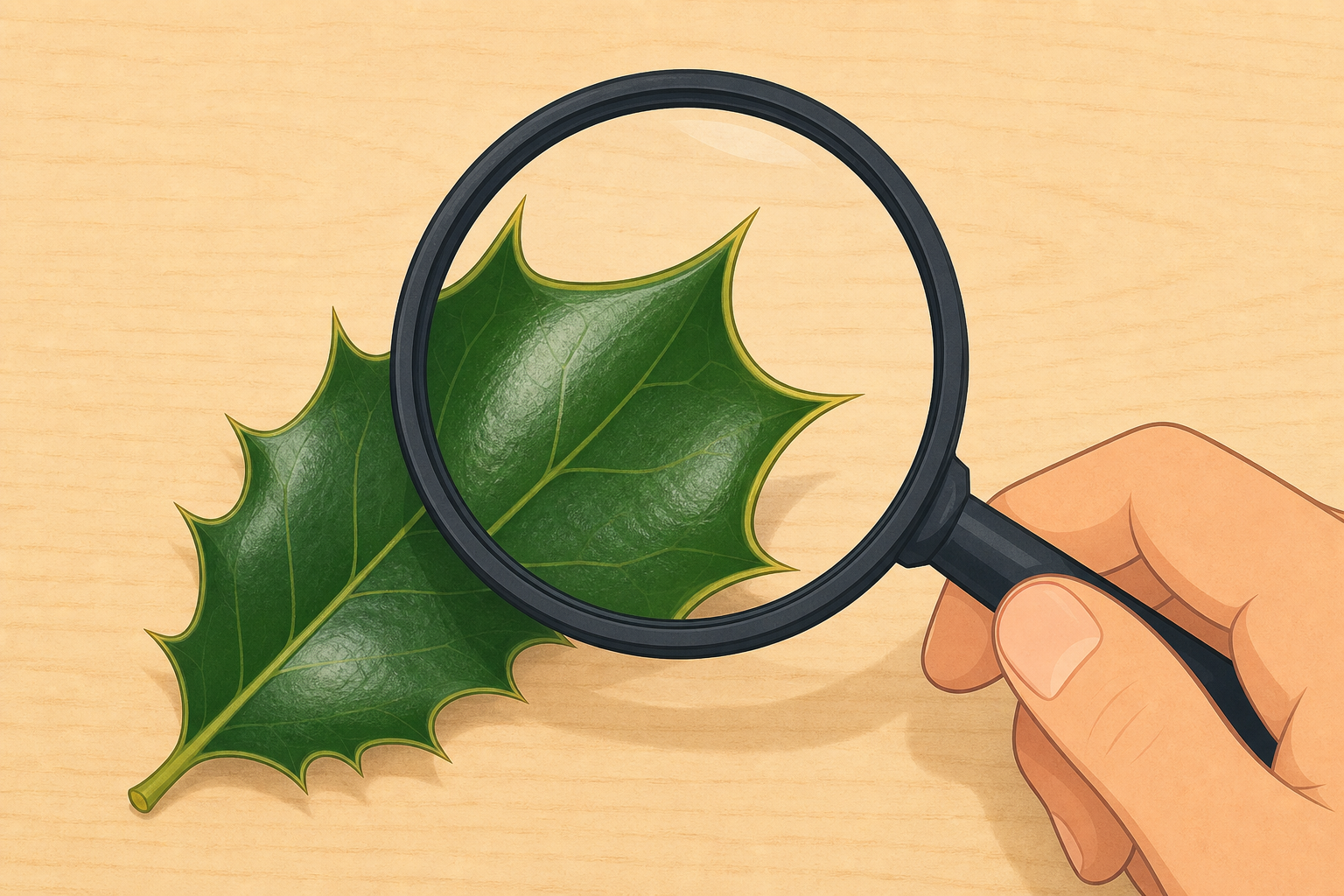
 In groups, look closely at five leaves: oak, holly, dandelion, daisy and fern. Use a hand magnifier. What features can you see?
On your Investigation Journal page, note one clear feature for each leaf — edge, shape, or how it is divided.
We will complete a yes-or-no branching key for our five leaves. Look at the interactive activity on the board.
The questions are:
- Does it have prickly edges?
- Is it divided into many small leaflets? (many small parts along a stem, like the fern)
- Does it have deep wavy lobes?
- Is the edge deeply jagged or toothed?
For each leaf, answer the questions in order. The first yes tells you its feature box: prickly edges, many small leaflets, deep wavy lobes, or a jagged or toothed edge. A leaf that gets no every time goes in smooth plain edge. When every leaf is in a box, we say which leaf is which: holly, fern, oak, dandelion or daisy.
Leaf branching key
Your group gets a mystery leaf. Do not look at the name. Follow your branching key step by step — yes or no at each question — and decide which leaf it is.
Write your answer and one reason on your Investigation Journal page. Be ready to explain your path to the class.
Unlock the full learning experience
You're previewing this lesson. Get full access to this lesson and hundreds more — each one ready to teach, with interactive activities, printable resources and pupil progress tracking built in.
This lesson is copyright of 123Learn.ie 2017 - 2025. Unauthorised use, copying or distribution is not allowed.