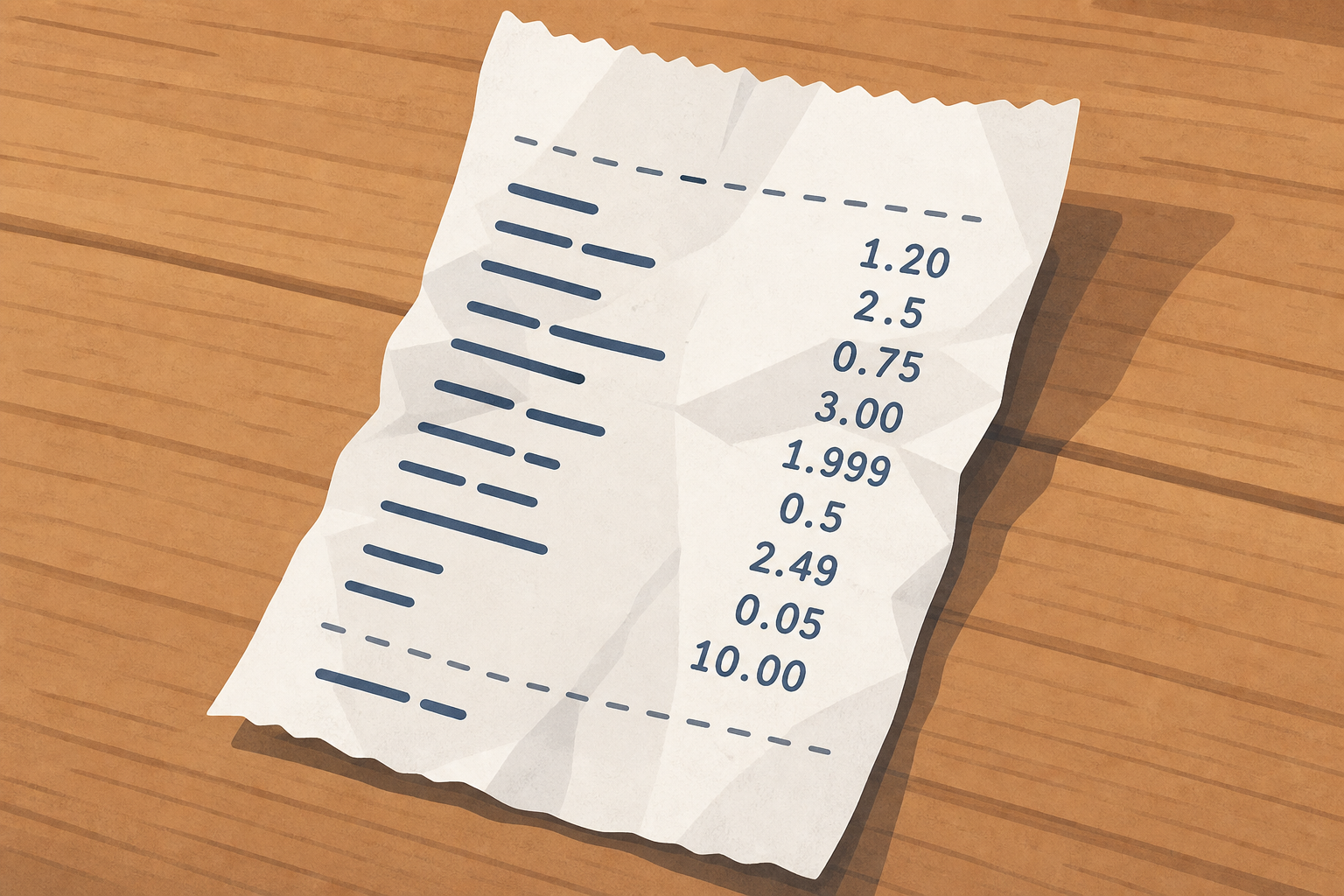
Here is a sum to look at: 3.4 + 0.275. Quick question for you: if we just lined up the very last digits of each number and added straight down, what would go wrong? Is it right to put the 4 above the 5?
Take two or three hands-up answers, not open call-outs. You are fishing for the misconception that pupils want to right-align the digits the way they do with whole numbers. Don't correct yet — let the wrong idea sit, then say let's see what the columns tell us and move to the model step. Five seconds of quiet think-time before any hands go up.

Watch how we line up the decimal points first, then fill 3.4 out to 3.400 so every column has a digit. Now we add column by column from the right.
Watch this one carefully — when we add the hundredths, six and four make ten, so we write the zero and carry one across into the tenths. See how that little carry sits right above the next column.
This is a take-away. We fill 8.5 out to 8.500, then borrow across the tenths and hundredths so we have enough to subtract the thousandths.
Here the borrow has to travel all the way through the zeros before we can subtract.
Do not rush. The trailing-zero habit is the whole lesson.
Let's work this one through together on the board: 5.6 + 2.34. We line up the points first, fill the gap with a zero so 5.6 becomes 5.60, then add one column at a time from the right.
This round is for talking it through together — a pupil works at the board and the class agrees or corrects out loud.
Call a pupil up. Insist the first move is line up the points and fill the gap with a zero — do not let anyone start adding until the columns are square. Have the rest of the class watch and call out if a zero is missing. Watch for pupils who put the answer's decimal point in the wrong place; the point in the answer sits directly under the points above it.
If time allows, write two more on the board by hand and call up another pupil each time, keeping the same first move: 7.025 + 0.9 (fill 0.9 out to 0.900) and 9.4 − 2.18 (a take-away — fill 9.4 out to 9.40 and borrow across the tenths).
In your maths copy, rewrite each of these calculations with the decimal points lined up one under the other and the gaps filled with zeros. Then work each one out column by column and underline your final answer.
Walk the room glancing for two things only: are the decimal points lined up, and are the gaps filled with zeros? This is whole-class copybook practice, not marking — no individual correction, just nudge any pupil whose columns are crooked.
Today we tackle these subtractions together at the board: 7.2 − 3.485, then 15.0 − 6.074, then a thinking one — find a decimal that subtracts from 9.5 to leave exactly 3.275.
This round is the practice bank — a pupil works each one at the board, the class checks the answer, and everyone confirms before moving on. Keep the board work brisk rather than over-explaining.
The borrowing through zeros in 15.0 − 6.074 catches people out; have the class predict before the pupil at the board works it. The final challenge is the stretch — the missing number is what you take from 9.5 to land on 3.275, so the class can reason it as 9.5 − 3.275 = 6.225 and then check that 9.5 − 6.225 really does leave 3.275. Strong pupils who finish early can mouth the next column or simply watch; they do not have desk work in this step.
Think back to the very first sum. Why does forgetting the trailing zeros change the answer? What goes wrong if you line up the last digits instead of the decimal points?
Listen for pupils naming the place value reason — a missing zero means a column has no digit, so the wrong digits get added together. Revoice a strong answer: so the zeros keep every column honest. Head off the lingering whole-number habit of right-aligning the digits.
Next we move on to multiplying multi-digit whole numbers, breaking each factor into place-value parts and using the area model to see every partial product.
A quick verbal recap is enough here. Re-state the three-step habit — line up, fill with zeros, work column by column — as the thing to carry into the activity book practice.
You're previewing this lesson. Get full access to this lesson and hundreds more — each one ready to teach, with interactive activities, printable resources and pupil progress tracking built in.