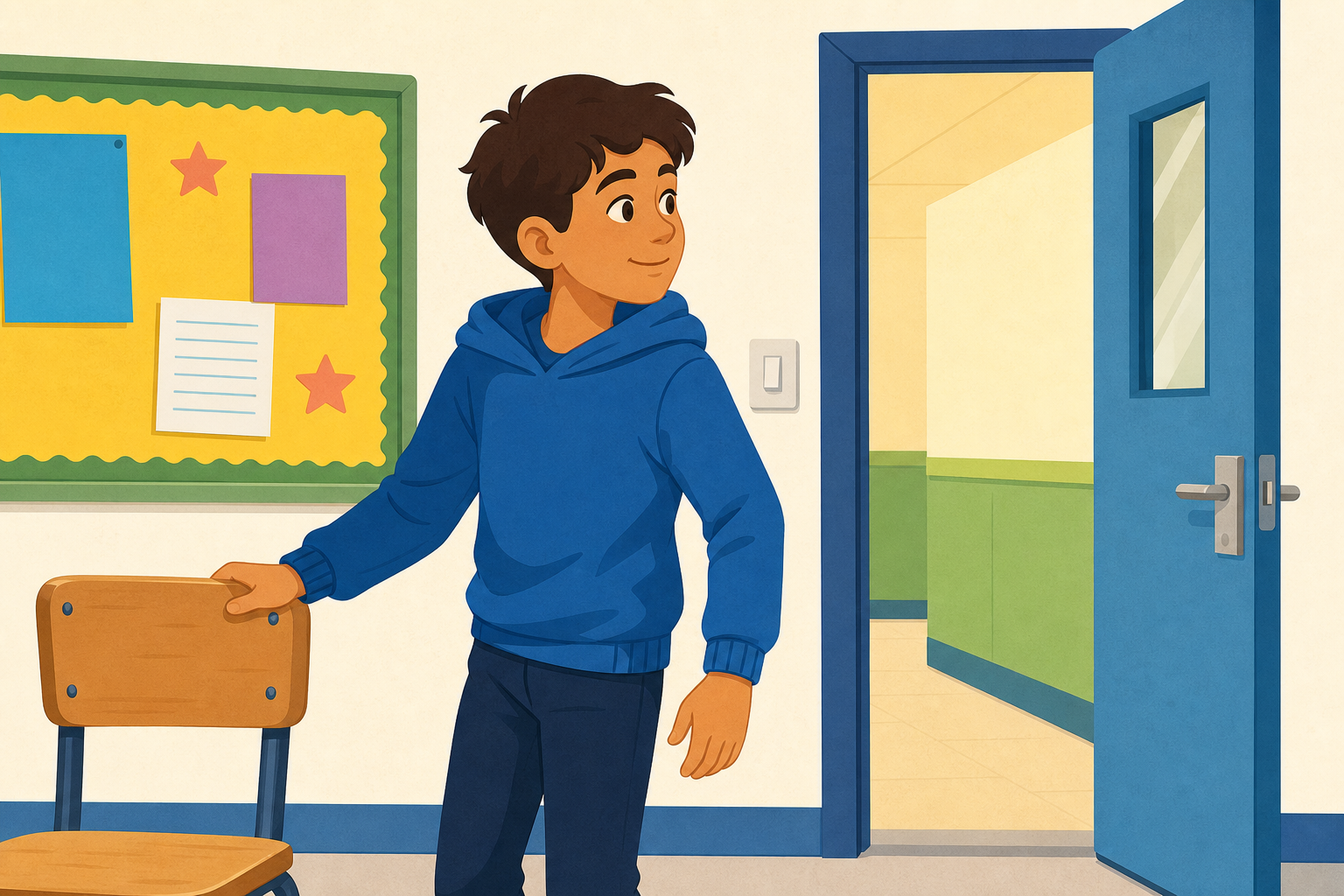
Stand up beside your chair and face the front of the room. Now turn so you are facing the door.
You just made an angle. The turn you did has a name. What kind of turn was it: a small turn, a quarter turn, or a big turn? Was it more or less than turning the whole way back to face the front?
Have the whole class stand and turn together once, then take two or three hands-up answers naming the size of the turn. Resist defining anything yet — the point is only to feel that a turn has a size. You just made an angle is the line to land.
Watch the angle tool on the screen. The two lines meet at a point called the vertex. This is a right angle, a quarter turn. It is exactly 90°. It is the same square corner you find at the corner of a book.
Now the orange line moves closer to the bottom line. The turn is smaller than a quarter turn. An angle smaller than a right angle is called acute.
This time the orange line opens out wider than a quarter turn but not all the way to a straight line. An angle between a right angle and a straight line is called obtuse.
Now the orange line opens the whole way out so the two lines make one straight line. That is a half turn, 180°. We call it a straight angle.
Walk each snapshot in turn and point at the readout naming the angle.
Keep returning to amount of turn, not how long the orange line is.
Today we'll explore the angle tool together on the board. We will drag the orange line and stop at different turns. Each time we stop, we name the angle: right, acute, obtuse, or straight.
Then, standing in place beside our chairs, we make the same turns with our bodies: a small turn for acute, a quarter turn for right, a big turn for obtuse, a half turn for straight.
This round is for talking it through together — pupils take turns at the board and the class agrees or corrects out loud.
Drag the orange ray and pause at an acute, a right, an obtuse and a straight angle in turn. Each time, ask the class to call the name before you confirm with the readout. Bring individual pupils up to set the next angle.
Then run the body-turn sequence in place beside the chair — no need to clear the room. Pupils face a chosen 'north' (the front of the room), reset to north between every call, and turn the named amount on the spot. Watch for pupils who turn by the right amount but in the wrong sense — both are fine for naming the angle.
In your maths copy, sketch one example each of the four angle types: a right angle, an acute angle, an obtuse angle, and a straight angle.
Label each one with its degree range:
Mark your right angle with a small square at the vertex (the point where the two lines meet) so anyone can see it is a quarter turn.
Walk the room glancing at the small-square mark on the right angle and that the obtuse is drawn wider than the right angle — this is whole-class copybook practice, not marking.
Stay in your seat. Together we set the angle tool on the board to different turns and name each one: a right angle, an acute angle, an obtuse angle and a straight angle. After each one, scan the room from your seat and call out a real example you can spot.
We keep a shared find-list on the board and tick each angle type off together as the class spots it. Remember: an angle that is almost straight but not quite is still an obtuse angle, just a very wide one. The trickiest find of all is setting that almost-straight angle on the tool.
This round is the practice bank — pupils take turns at the board, check each answer, and the class confirms before moving on. Keep the board work brisk rather than over-explaining.
Run the angle-tool challenges on the IWB: set the ray to a target angle, pupils name it, then press Check. Bring individual pupils up for each one. Between board rounds, send the class's eyes around the room from their seats to spot a real example of the angle type just named (window corner for a right angle, an open scissors for acute, a propped-open laptop lid for obtuse, the edge of the table for straight). Keep a shared tick-list on the board — there is no personal sheet.
Here are two angles. Both are turned the same amount, but one is drawn with short lines and one with long lines.
Look at them side by side. Are they the same angle or different? Why do we measure an angle by the amount of turn, and not by how long the lines are?
Both snapshots show 60°, so pupils see the equal turn with unequal line lengths. Listen for pupils saying the long-lined angle 'looks bigger'. Revoice the correct reasoning: the lines can be any length we like — what makes the angle is how far one line has turned from the other. If a pupil names a real example (a clock hand is short, a road is long, both can make a right angle), pick it up and repeat it for the class.
Next we will use a protractor to measure exactly how many degrees an angle is, and to draw angles of our own.
Keep this brisk. The named four types and 'amount of turn, not line length' are the takeaways to leave on the board.
You're previewing this lesson. Get full access to this lesson and hundreds more — each one ready to teach, with interactive activities, printable resources and pupil progress tracking built in.