Mathematics
Advanced
50 mins
Teacher/Student led
+80 XP
What you need:
IWB/Projector/Large Screen
Metre stick

Big Investigation: How Tall Is the School?

Investigate how tall your school building is by using three measurement strategies: shadows, counting, and comparison. Combine your estimates and judge which method you trust most.
Teacher Class Feed

Load previous activity

    1 - Getting Started ~4 mins

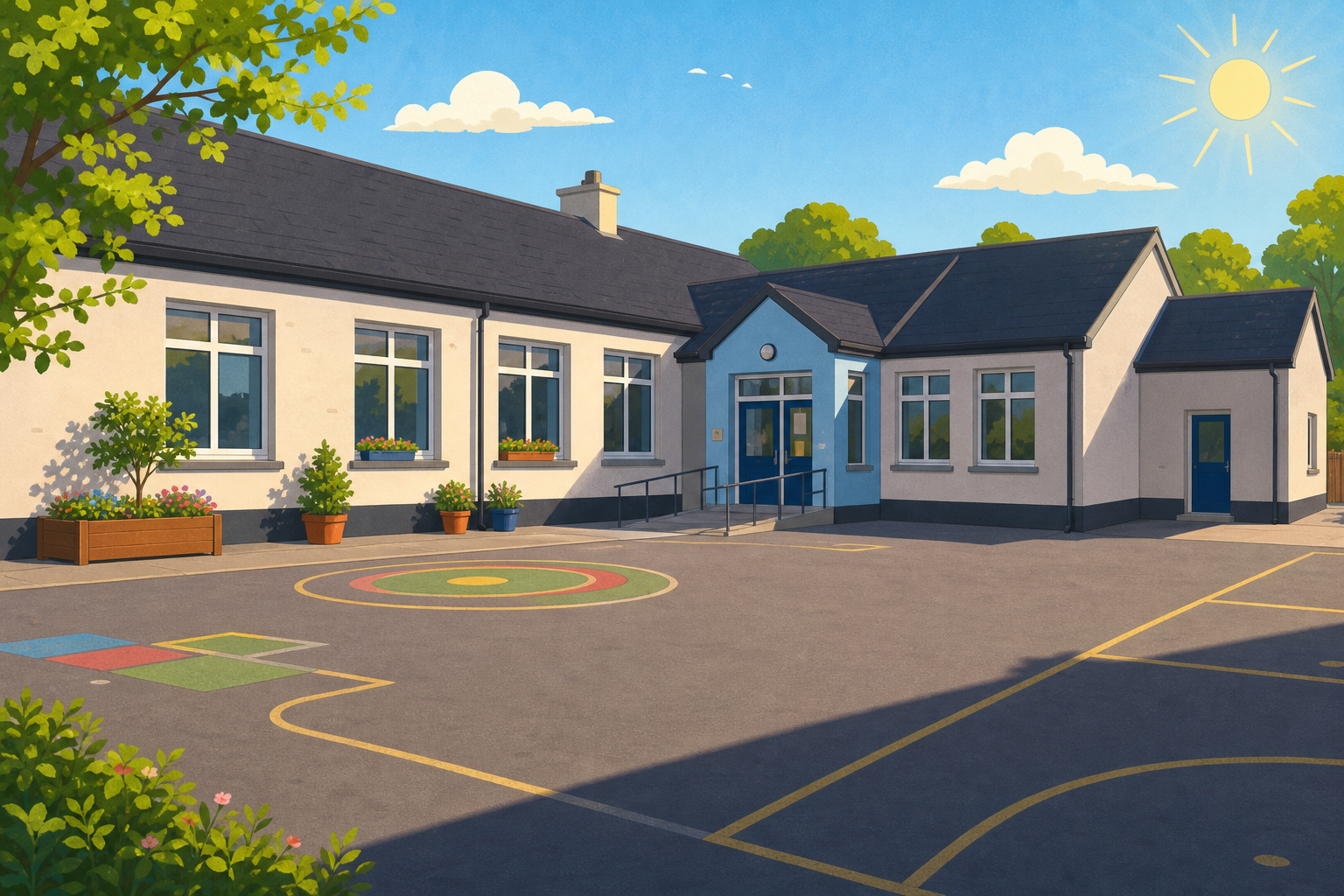
    Look at our school building from the yard. How tall do you think it is, from the ground to the very top of the roof? Now here is the tricky part: nobody has a ladder long enough, and you certainly cannot climb up there with a metre stick. So how could we find out the real height without ever reaching the top?
    2 - Watch and Notice ~9 mins

    Method 1: Shadow and stick (our main method)

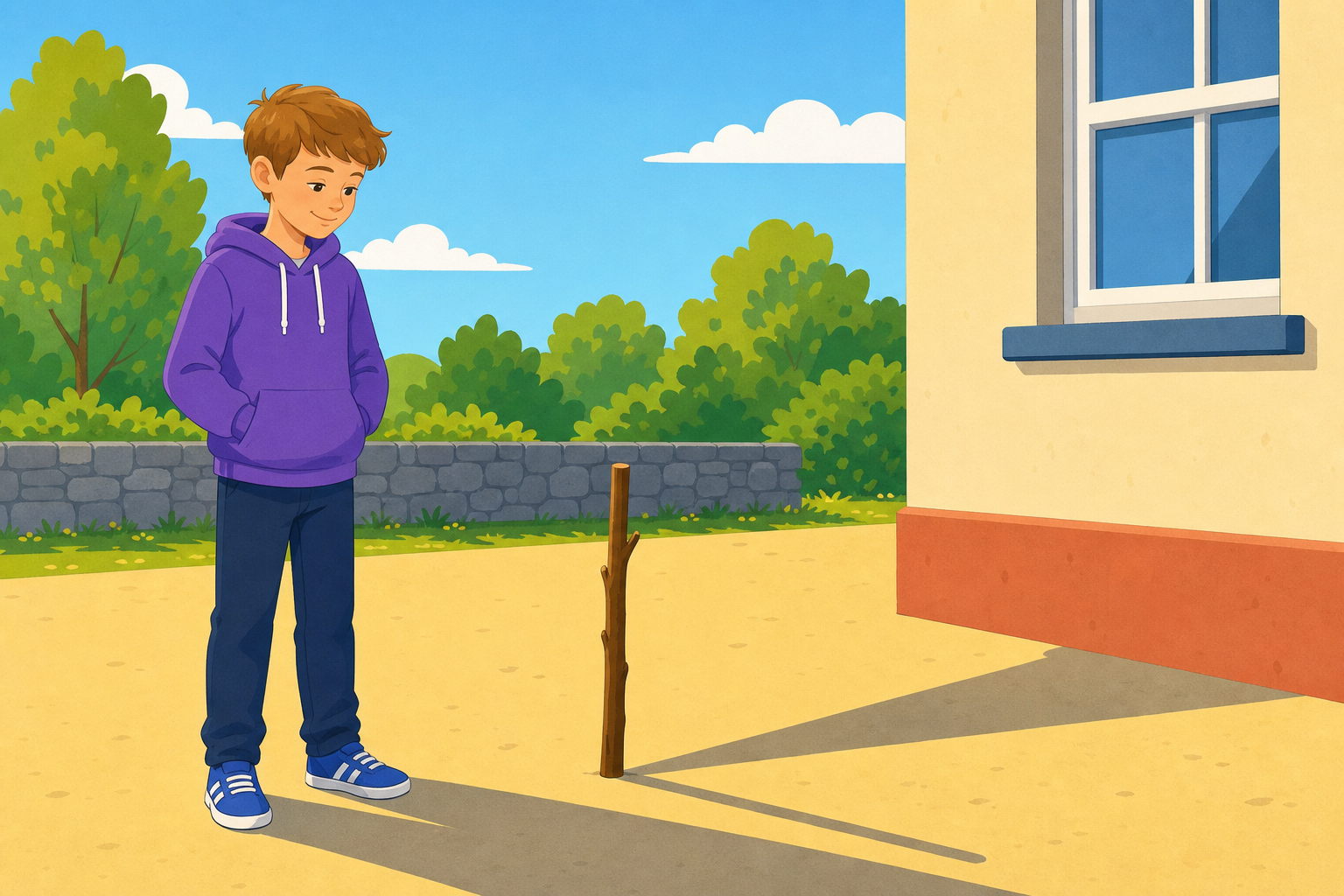
    On a sunny day, everything casts a shadow. Hold a 1 m stick straight up: it casts a 0.6 m shadow. At that very same moment, the school casts a 6 m shadow.

    Here is why this works. The sun is so far away that its light hits the stick and the school at exactly the same slant at the same moment. So the stick and its shadow make one triangle, and the school and its shadow make another triangle of the very same shape, just bigger. Because the two triangles are the same shape, the shadows grow in step with the heights: a thing that is twice as tall always casts a shadow twice as long.

    Key point

    A ratio just compares two sizes: how many times bigger one is than the other. The school's shadow is 10 times longer than the stick's shadow, so the school must be 10 times taller than the stick. That makes it about 10 m tall. Take a few seconds to check: 0.6 m × 10 = 6 m, and 1 m × 10 = 10 m. The shadows and the heights both grow by the same 10 times.

    Two quick ways to cross-check

    Counting bricks. A typical brick course is about 7 to 8 cm high. If you count roughly 140 courses up the wall, that is about 140 × 7 cm980 cm9.8 m. Very close to 10 m.

    Counting storeys. Each storey is roughly 3 m tall. Count how many storeys the school has and multiply by about 3 m to get a rough height.

    Comparing to a known height. Stand a pupil whose height you know beside or near the feature, and judge how many of that pupil would stack up to reach the top. If a 1.4 m pupil fits about 7 times, that is roughly 1.4 m × 79.8 m.

    Tip

    The shadow-and-stick method is our main method. The other three are quick cross-checks. When several of them land close together, that agreement is what tells us we can trust the height.

    3 - Set up Your Estimate Table in Your Copy ~2 mins

    COPYBOOK MOMENT

    In your maths copy, draw a four-column table and head the columns Feature, Method used, Estimate (m), and How sure (1 to 5). You will fill it in outside as you work. Leave at least five rows under the headings.

    4 - Try It Together ~11 mins

    Going outside

    Whole class together. Take the class to a flat sunlit space where a tall feature (the building wall, a flagpole, or a goalpost) casts a clear shadow on the ground. One metre stick, one measuring tape, and chalk or masking tape to mark shadow tips.

    Materials

    • metre stick
    • measuring tape
    • chalk or masking tape
    • clipboard
    • pencil

    Plan

    1. Stand the metre stick straight up on flat ground and chalk-mark the tip of its shadow. Measure the stick's shadow from its base to the chalk mark, and write it down. Straight away, chalk-mark the tip of the building's shadow and measure from the wall base to that mark. Work it out together: building height = (stick height ÷ stick shadow) × building shadow. Write the answer in metres in your copy and ring it.
    If you can’t go out: indoor alternative

    If it is cloudy, run the lesson indoors using the brick-count or storey-count method: count brick courses (or storeys) on a wall you can see, multiply by the height of one (about 7 to 8 cm a course, or roughly 3 m a storey), and convert to metres.

    5 - Class Challenge ~12 mins

    Now pick one feature around the school that you cannot reach with a ruler, and estimate its height two different ways, aiming for two estimates that agree to within 10% of each other. Then lightly estimate two more features, one method each, so you have practised more than one strategy.

    How tall is your main feature, and can you make two estimates of it that agree to within 10%?

    Choose one feature no ruler can reach — a flagpole, a tall wall face, a basketball hoop or a tree — and estimate it two different ways: shadow-and-stick for a sunlit upright feature; count repeated units (brick courses, fence panels) for a wall; or compare to a known-height pupil for a tree. Aim for the two estimates to agree to within 10%. Then make one quick estimate each of two other features. Record every estimate, the method used, and how sure you are.

    Record: the four-column copybook table (Feature, Method used, Estimate in m, How sure 1-5)

    Share back: each group reads out the height of its main feature, names the two methods it used, and says whether the two estimates agreed within 10%

    6 - What Did We Notice? ~3 mins

    MATHS TALK

    Which strategy gave you the estimate you trust most: the shadow-and-stick, the counting method, or comparing to a known height? Did any two of your estimates land close together? When two methods agree, why does that make you more sure than one method on its own?

    7 - What's Next ~3 mins

    What we did today

    • We found the height of something we could never reach, using shadows, counting and comparison.
    • We learned that shadows are in the same ratio as heights when the sun is in the same place.
    • We saw that two estimates agreeing to within 10% is what lets us trust a measurement.

    Coming up

    Coming up

    Next we put our maths to work on a real design: planning and costing things for ourselves, where measurement, money and reasoning all come together.

    Pupil practice
    Module 9 · Mathematical Modeling and End-of-year Review Mixed
    Lesson 114 · Big Investigation: How Tall Is the School?
    Download Activity Book page (PDF)
    End of lesson
    123learn · Online learning platform

    Unlock the full learning experience

    You're previewing this lesson. Get full access to this lesson and hundreds more — each one ready to teach, with interactive activities, printable resources and pupil progress tracking built in.

    Hundreds of curriculum-aligned lessons
    Interactive activities in every lesson
    Printable resources & progress tracking
    Copyright Notice
    This lesson is copyright of 123Learn.ie 2017 - 2025. Unauthorised use, copying or distribution is not allowed.
    🍪 Our website uses cookies to make your browsing experience better. By using our website you agree to our use of cookies. Learn more
