Mathematics
Intermediate
40 mins
Teacher/Student led
+80 XP
What you need:
IWB/Projector/Large Screen

Choosing and Converting Metric Units of Length

Learn to choose the right metric unit of length for any object and convert between millimetres, centimetres, metres and kilometres using powers of ten.
Teacher Class Feed

Load previous activity

    1 - Getting Started ~4 mins

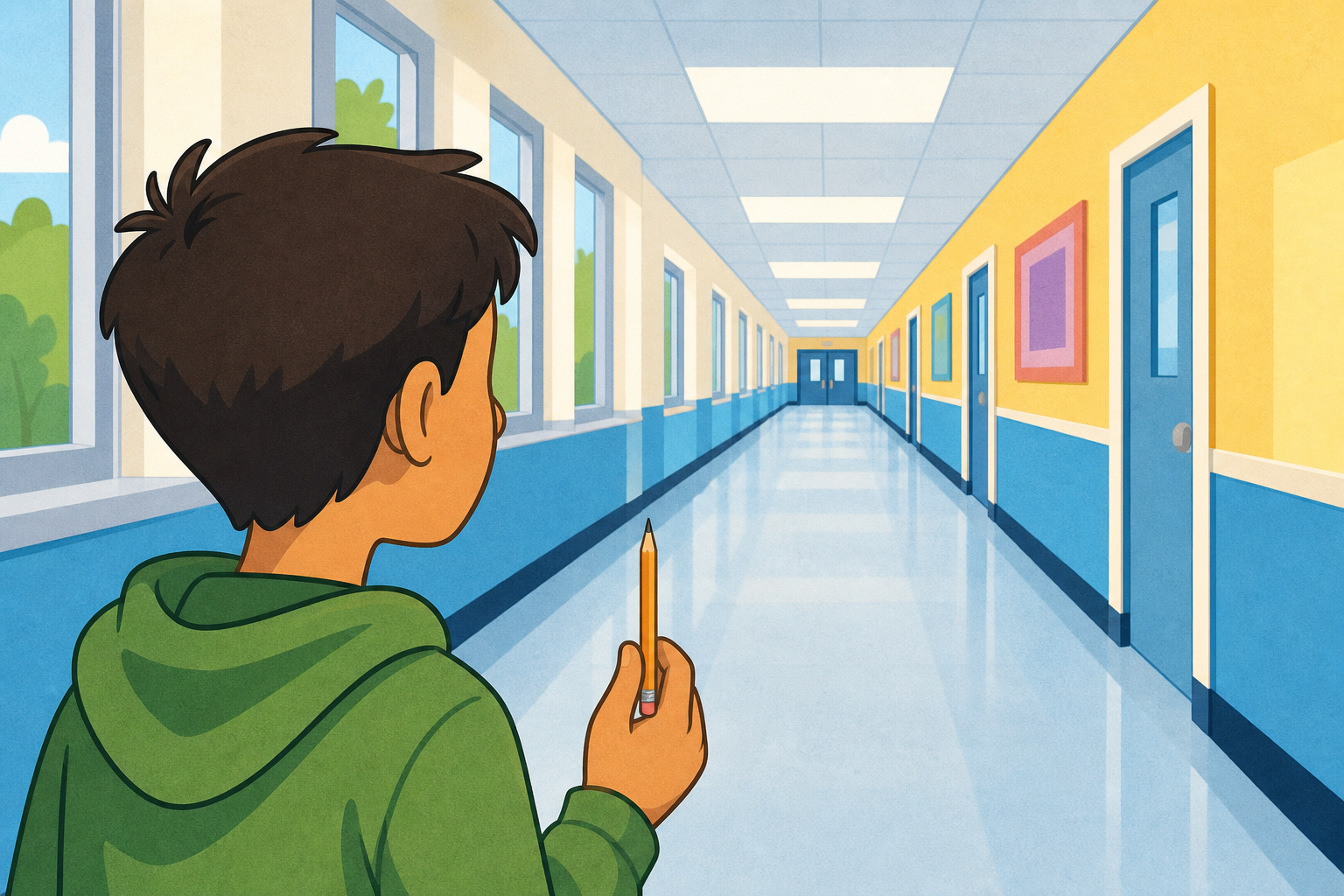
    Imagine I told you the corridor outside our classroom is 30,000 millimetres long, and your pencil is one fifty-thousandth of a kilometre long. Both of those are true! But would you ever actually say them that way?

    Which unit would you really choose for the corridor? Which for your pencil? And why does picking the wrong one make a number look silly?

    2 - Watch and Notice ~9 mins

    Illustration for Watch and NoticeWe line up the units as a ladder — km, m, cm, mm — and each rung is ten times the one below it. As we convert, the decimal point stays where it is; it is the digits that step into new columns. The point only appears to move.

    2.5 m to 250 cm

    Watch as the converter turns 2.5 metres into centimetres. There are 100 cm in every metre, so the digits step two places and we land on 250 cm.

    1750 mm to 1.75 m

    Now watch 1750 millimetres become metres. There are 1000 mm in a metre, so the digits step three places the other way, giving 1.75 m.

    3.4 km to 3400 m

    Watch 3.4 kilometres become metres. Each kilometre holds 1000 m, so 3.4 km is 3400 m.

    1200 cm to 0.012 km in two jumps

    This last one takes two jumps down the ladder. First 1200 cm becomes 12 m (100 cm in a metre, so divide by 100). Then 12 m becomes 0.012 km (1000 m in a kilometre, so divide by 1000). Watch each jump in turn.

    3 - Try It Together ~7 mins

    We work through three conversions together on the converter. For each one, the whole class decides first: are we going up the ladder or down, and do we multiply or divide? Say your answer aloud so we can agree or correct it. One pupil comes up to drive the converter while everyone else watches the digits and checks the result.

    Watch out

    Each conversion uses different units, so the pupil at the board changes both the start unit and the end unit before converting: 4.2 m to centimetres, then 6500 mm to metres, then 0.75 km to metres.

    Convert these lengths together

    4 - Write the Lengths Two Ways in Your Copy ~3 mins

    COPYBOOK MOMENT

    In your maths copy, write each of these lengths in two different units, side by side. Underline the unit you would actually choose to measure that real object.

    • your pencil
    • the classroom door height
    • the school yard length
    • the road to the nearest shop

    For example: pencil — 18 cm or 180 mm (underline cm). If your teacher has handed out the printable conversion-ladder worksheet, use it to keep your two units lined up in their columns.

    5 - Class Challenge ~9 mins

    Now we tackle fresh conversions, getting trickier as we go: 7.3 m to centimetres, 4200 mm to metres, 0.62 km to metres, and then the stretch — express 1250 cm in kilometres using the two-jump route we saw earlier.

    Convert the length

    6 - What Did We Notice? ~3 mins

    MATHS TALK

    Why does the decimal point seem to move three places between millimetres and metres, but only two places between centimetres and metres? What is happening to the digits each time?

    7 - What's Next ~3 mins

    Key Takeaways

    • We choose the metric unit that gives a sensible-sized number for the real object.
    • Converting between mm, cm, m and km means multiplying or dividing by powers of ten.
    • There are 1000 mm in a metre, so the digits step three places between mm and m.

    Coming Up

    Coming up

    Next we move from measuring along a line to measuring all the way around a shape, when we work out the perimeter of regular and irregular shapes.

    Pupil practice
    Module 5 · Measures: Length, Area, Volume, Mass and Capacity Measures
    Lesson 47 · Choosing and Converting Metric Units of Length
    Download Activity Book page (PDF)
    End of lesson
    123learn · Online learning platform

    Unlock the full learning experience

    You're previewing this lesson. Get full access to this lesson and hundreds more — each one ready to teach, with interactive activities, printable resources and pupil progress tracking built in.

    Hundreds of curriculum-aligned lessons
    Interactive activities in every lesson
    Printable resources & progress tracking
    Copyright Notice
    This lesson is copyright of 123Learn.ie 2017 - 2025. Unauthorised use, copying or distribution is not allowed.
    🍪 Our website uses cookies to make your browsing experience better. By using our website you agree to our use of cookies. Learn more
