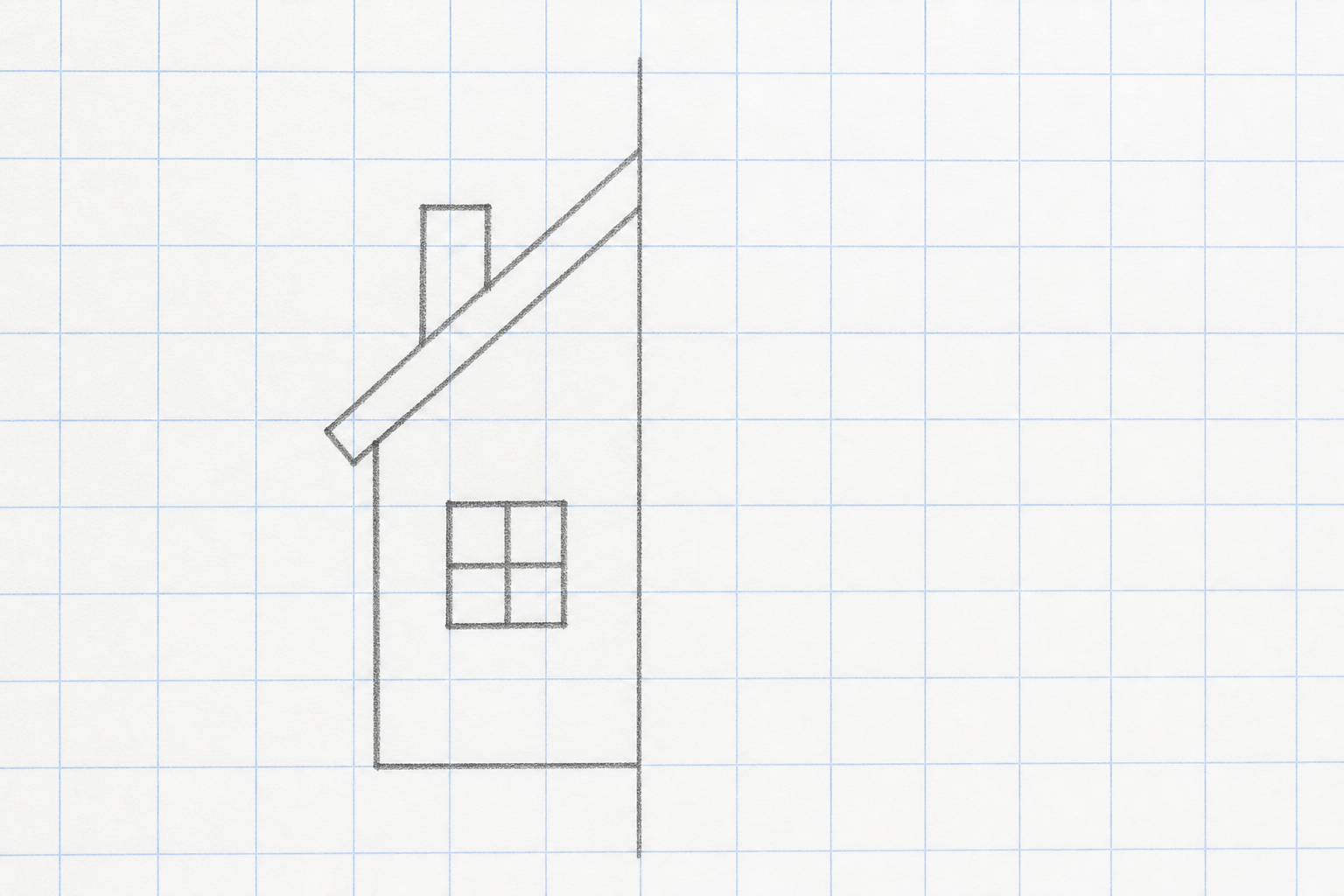
Here is half of a simple house, drawn right beside a straight line. Imagine a mirror standing up on that line. What would the missing half of the house look like in the mirror? Would the door move? Would the roof slope the other way?
Display half a simple symmetrical house beside a vertical line on the IWB as pupils settle. Take three hands-up answers, not open call-outs. Do not draw the second half yet, that is the work of the lesson.
Watch as we complete four pictures across the mirror line. Each time, look at how far every shaded square sits from the line, then notice that its match lands the very same distance on the other side.
Three squares on one side, three matching squares the same distance away on the other.
The steps climb on one side, then climb the opposite way in the mirror.
The arrow flips in the mirror, so now it points the other way, and every square lands the same distance from the line.
The trunk sits on the line and the leaves match on both sides.
Each display tool shows both halves at once and statically: the prefilled half on one side and its finished reflection already mirrored across the line. Nothing animates or appears on tap, so trace the counting with your finger square by square rather than waiting for a reveal.
Today we work this together on the board: a few squares are shaded on one side of the mirror line. We will shade the matching squares on the other side, counting how far each one sits from the line before we place its partner. When we finish the first picture, we will clear the board and try one fresh pattern with a new volunteer.
This round is for talking it through together — pupils take turns at the board and the class agrees or corrects out loud.
Start with the four squares already seeded. Invite a pupil to shade one matching square; the class checks the distance from the line is equal before moving to the next. Once that picture is complete, clear the board, seed one new small pattern of your own, and run it the same way with a different volunteer. Two pictures with class checking comfortably fills the time. Watch for the common slip of counting from the edge of the grid instead of from the mirror line — head it off by always returning to the line first.
In your maths copy on squared paper, draw a vertical mirror line. Shade a small pattern of four squares on the left. Then shade its mirror image on the right, counting the squares from the line each time so every match lands the same distance away.
Walk the room glancing at whether pupils count from the mirror line rather than the grid edge — this is whole-class copybook practice, not marking.
Today we work through these reflections together: first a 3-square picture, then a 5-square one, then a picture that touches the mirror line. Last of all, we reflect across a horizontal mirror line. A horizontal line lies flat across the page instead of standing up, so this time we count the squares up and down from the line rather than left and right.
This round is the practice bank — pupils take turns at the board, check each answer, and the class confirms before moving on. Keep the board work brisk rather than over-explaining.
Pause on the picture that touches the line: ask whether the square on the line moves or stays put. On the final challenge, swap to a horizontal mirror line so pupils transfer the same counting idea up and down rather than left and right.
How does counting squares from the mirror line help you place each matching square exactly? When the picture touched the line, what happened to that square — did it move, or stay put?
Listen for pupils naming the equal distance from the line as the key check. Revoice a strong answer: so we always count back to the line, not to the edge of the page. Head off the idea that a square on the line gets a separate match — it sits on the line, so it stays put.
Next we will reflect a whole shape across a line, so the shape flips over and faces the opposite way.
Recap by asking one pupil to say, in their own words, how to find where a matching square goes.
You're previewing this lesson. Get full access to this lesson and hundreds more — each one ready to teach, with interactive activities, printable resources and pupil progress tracking built in.