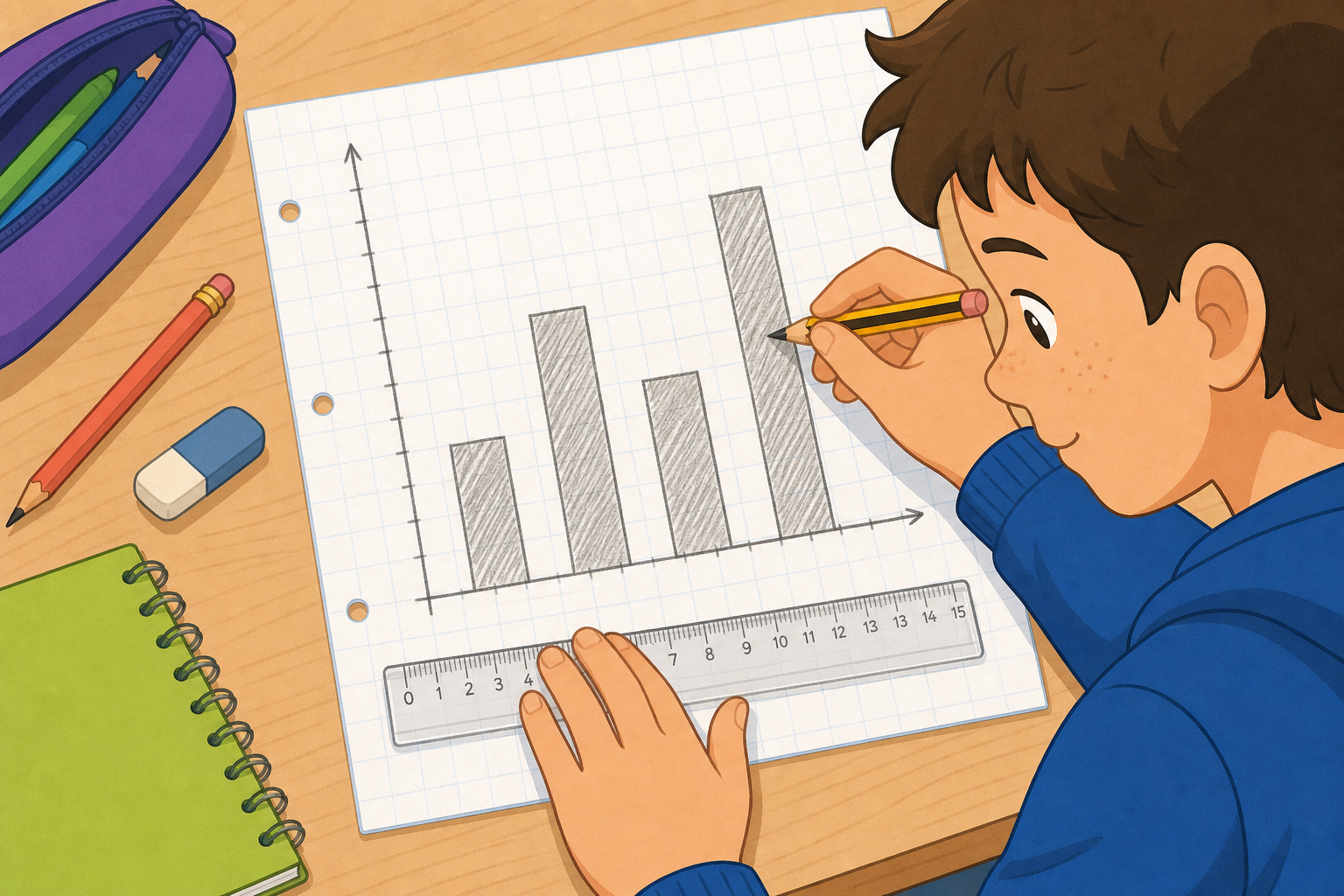
Here is a bar chart showing the favourite sports of one class. It does its job for one group. But what if we wanted to show our class and the class next door on the very same chart, so we could compare them at a glance?
How could we fit two groups onto one set of axes without it turning into a mess?
Display a simple single-group bar chart as pupils settle. Take two or three hands-up ideas only, not open call-outs. Don't reveal the multiple-bar answer yet — that lands in the next step. Listen for the idea of "two bars beside each other" and revoice it warmly.
First, watch this ordinary bar chart. One bar per sport, one group. Notice how the scale up the side goes up in steps you can read off easily.
Now watch this one. For every lunch choice there are two bars side by side, coloured differently. A small key in the corner tells us which colour is 6th Class and which is 5th Class. This is a multiple bar chart, and it lets us compare the two classes choice by choice.
Last, look at this chart where the side scale climbs in 5s. The biggest bar is near 18, so counting one-by-one would be slow. Steps of 5 keep the chart tidy and still let us read every bar.
Now we put a really useful idea on the board. Look at this chart comparing two classes on after-school clubs. For each club, both bars sit side by side, so we can measure the gap between them. For art the two bars are almost level, so the gap is small. For coding the blue bar is far taller than the orange one, so that gap is large. When we look right across the chart and ask where the two classes differ most, the answer is the category with the biggest gap. Here that is coding. Notice this finds a category, not a group: the two classes simply differ most for coding.
Walk each chart aloud, one at a time.
The new vocabulary for today is key, two bars per category, and the biggest difference as the largest gap between a category's two bars.
Today we build a multiple bar chart together, starting from an empty grid. Our data compares two classes on how they travel to school: walk, cycle, car. The chart begins blank, and as the class reads out each number we set that bar's height, colour the two groups differently, and add a key so anyone could read it.
In 6th Class, ten pupils walk, six cycle and eight come by car. In 5th Class, seven walk, four cycle and twelve come by car.
This round is for talking it through together — the chart starts empty and pupils take turns at the board to set each bar while the class agrees or corrects out loud.
Build the 6th Class bars first, then the 5th Class series, so the side-by-side pairing builds up visibly. Each time a bar goes up, ask the class to read its height off the scale before confirming. Watch for the slip of reading the wrong colour — point back to the key. Keep it brisk; rotate three or four pupils to the board.
In your maths copy, sketch a multiple bar chart for the two-class travel data. Use a clear scale up the side and draw two bars side by side for each way of travelling. Label both axes, and add a small key to show which colour is which class.
Walk the room glancing at the scale steps, the side-by-side pairing and whether a key is present — this is whole-class copybook practice, not marking. Many pupils forget the key; a quiet prompt at the desk is enough.
Today we work through four multiple bar charts together, building each one and then reading it carefully before we check.
This round is the practice bank — pupils take turns at the board, check each answer, and the class confirms before moving on. Keep the board work brisk rather than over-explaining.
For the first three charts, the reading question is "in which category do the two groups differ most?" — the largest gap between a pair of bars. For the final before-and-after chart, the question is "which subject changed most?" because it is one group measured twice. Make that distinction explicit out loud. Watch for pupils reading the wrong colour; point back to the key each time.
Why does a multiple bar chart need a key, when a single bar chart does not? And when we compare two groups, what exactly do we look at on the chart to find where they differ most?
Listen for pupils saying the key is what tells the two colours apart — without it, two bars of unknown colour mean nothing. Revoice: "so the key turns coloured bars into named groups." For the second question, listen for "the gap between the two bars" rather than just the tallest bar; revoice that the biggest difference is the largest gap between a category's two bars, not the biggest single value, and that for before-and-after data this same gap tells us what changed most.
Next we move from bars to lines: trend graphs that show how one quantity changes over time, and what the slope of the line tells us.
Keep this brisk — a 60-second recap, then a one-line forward look to trend graphs. No need to set up the next lesson's data here.
You're previewing this lesson. Get full access to this lesson and hundreds more — each one ready to teach, with interactive activities, printable resources and pupil progress tracking built in.