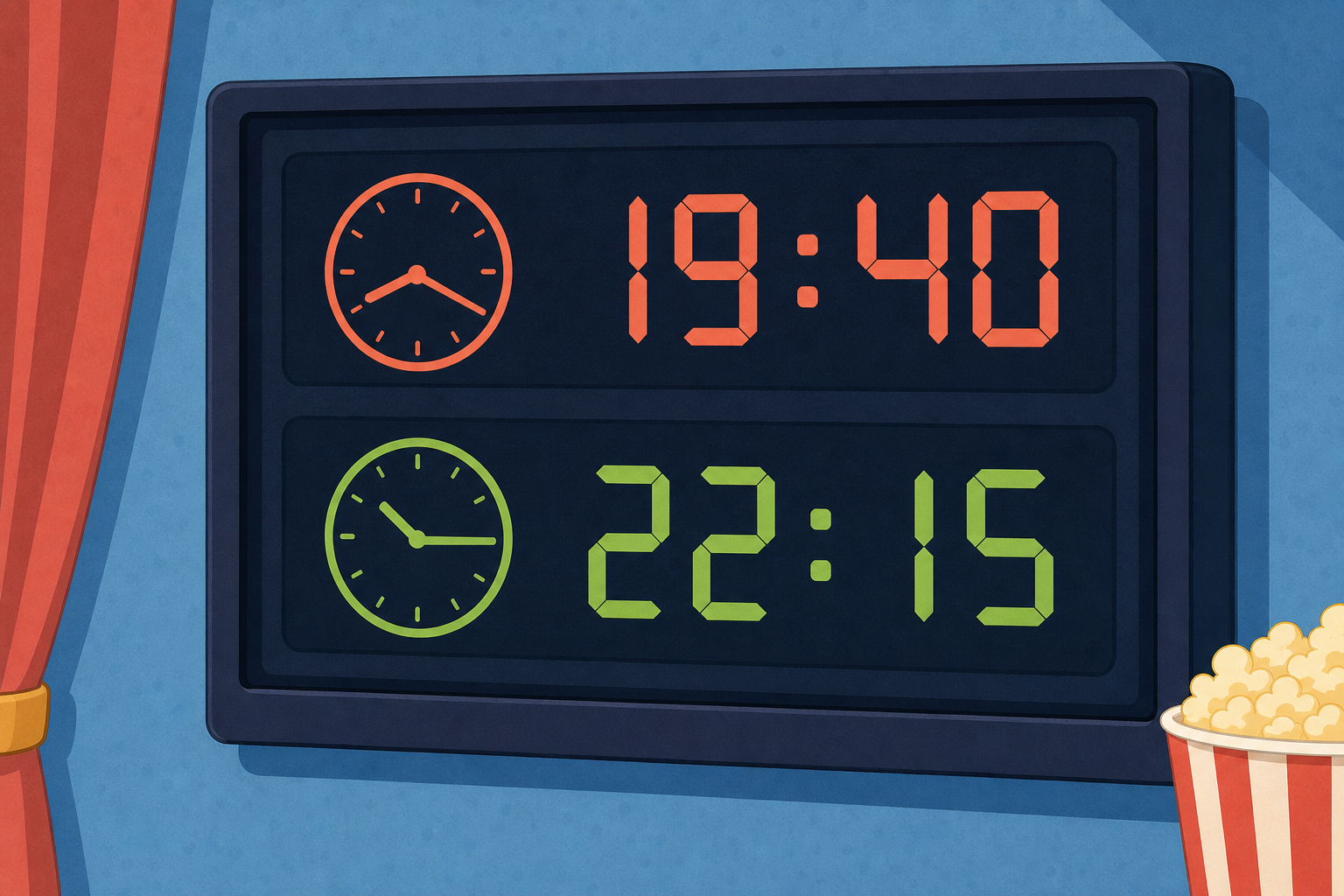
A film starts at 19:40 and ends at 22:15. How long is the film? And here is the catch: you cannot just subtract the digits, because the minutes do not line up neatly. So how would you work it out?
Take three hands-up answers, not open call-outs. Give five seconds of quiet think-time first.
Listen for any pupil who tries 22 − 19 and 15 − 40 and gets stuck on the minutes — that stuck feeling is exactly the hook. Don't resolve it yet; the counting-up method in the next step does that.

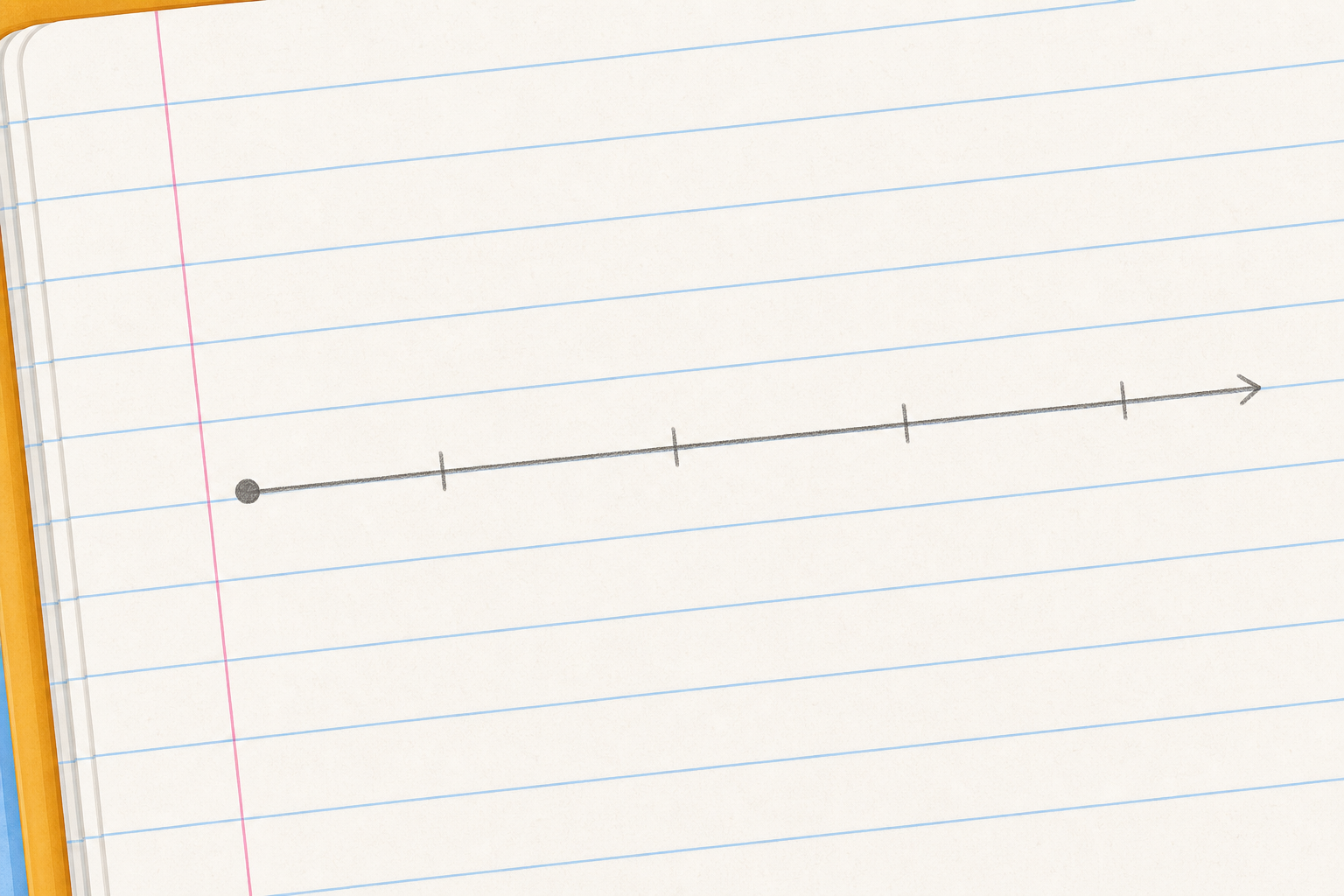
Watch the jumps on the number line. We hop 20 minutes up to 20:00, then 2 hours to 22:00, then 15 more minutes to 22:15. Adding the hops gives 2 hours 35 minutes.
Now watch a daytime one. A 5-minute hop to 09:00, then 4 hours to 13:00, then 10 minutes to 13:10. That is 4 hours 15 minutes. Notice it is the same counting-up shape as the first one.
This one crosses midnight. We jump 1 hour 30 minutes up to midnight first, then 6 hours 15 minutes on into the new day. Counting in hours and minutes, 1 h 30 min and 6 h 15 min make 7 hours 45 minutes overnight.
This one spans days, so we work it on the board. From 09:00 Monday to 09:00 Wednesday is 2 whole days. One day is 24 hours, so 24 + 24 = 48 hours. Then from 09:00 to 14:00 on Wednesday is 5 more hours. So 48 + 5 = 53 hours in total.
Walk each example aloud, one at a time, pointing at each arc as it lands. Keep pupils with you by pausing between examples for a quick question — take two hands-up answers, then move on.
Today we work these out together on the line: how long from 17:50 to 21:20, and how long from 21:45 to 04:30 the next morning. We will place the start, count up to the next whole hour, then on in hours, then on the last minutes. For the overnight one, remember the first hop reaches midnight, so stop there before counting into the new day.
This round is for talking it through together — pupils take turns at the board and the class agrees or corrects out loud.
For 17:50 to 21:20: expect +10 min to 18:00, +3 h to 21:00, +20 min to 21:20 = 3 h 30 min. For the overnight 21:45 to 04:30: prompt for the jump to midnight first (+2 h 15 min), then +4 h 30 min = 6 h 45 min. If a pupil tries to count straight through midnight, pause and ask what time comes after 23:59?
Rotate three or four pupils to the board so different hands set different hops.
In your maths copy, for each elapsed-time example draw a short bridging number line and write the hops you counted, for example 20 min, then 2 h, then 15 min. Record the total beside it.
Walk the room glancing at whether the first hop lands on a whole hour and whether overnight ones jump to midnight first — this is whole-class copybook practice, not marking.
Today we work through these together on the line: 14:25 to 16:50, then 06:40 to 12:15, then the overnight 23:10 to 07:05. The minutes and the midnight crossing are where it gets tricky, so we will say each hop aloud before we check it.
Then, on the board, we will work one that spans days: 10:00 Tuesday to 18:00 Thursday. Two whole days is 24 + 24 = 48 hours, then 18:00 − 10:00 on Thursday adds 8 more hours, so 48 + 8 = 56 hours.
This round is the practice bank — pupils take turns at the board, check each answer, and the class confirms before moving on. Keep the board work brisk rather than over-explaining.
On-line answers: 14:25 to 16:50 = 2 h 25 min; 06:40 to 12:15 = 5 h 35 min; 23:10 to 07:05 = 7 h 55 min (jump to midnight first). The midnight crossing is the trickiest beat on the line — give it the most talk-and-check time.
The two-day problem is worked on the board, not on the number line: 10:00 Tue to 18:00 Thu = 56 h. Build it the same way as the multi-day example earlier — 24 + 24 = 48 h for the two whole days, then add the 8 extra hours so pupils see how 56 is made.
Why does counting up beat just subtracting the digits when the minutes have to borrow? And what is the one extra move we always make when a time crosses midnight?
Listen for pupils naming the jump to the next whole hour as the move that avoids borrowing, and the jump to midnight first as the overnight rule. Revoice a strong answer: so we never count straight through midnight, we always stop there and start the new day.
Next we read real timetables and schedules, and look at how the clock shifts when we travel into a different time zone.
Recap the three takeaways quickly. The timetable lesson reuses today's counting-up method to work out journey durations, so flag that the elapsed-time skill carries straight over and the method keeps the same name.
You're previewing this lesson. Get full access to this lesson and hundreds more — each one ready to teach, with interactive activities, printable resources and pupil progress tracking built in.