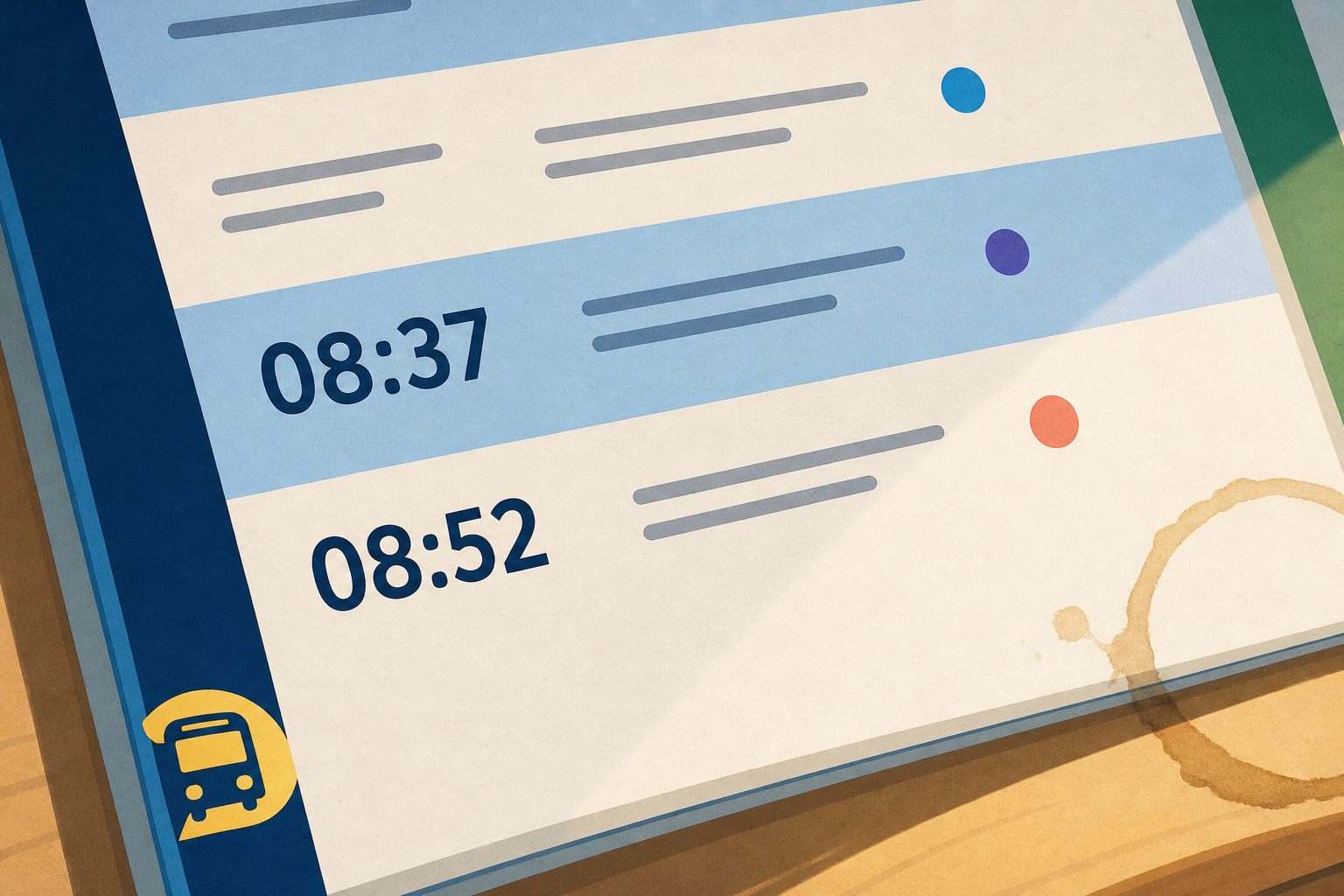
Here are two bus times from a Dublin Bus timetable. One bus leaves your stop at 8:47 and the very next one reaches the school gate at 9:25.
How long is that journey? Don't work it out fully yet, just have a guess in your head: is it more or less than half an hour?
Display the two times, 8:47 and 9:25, side by side. Take three hands-up guesses on "more or less than half an hour" before any calculating. Give five seconds of quiet think-time first.
Elapsed time just means how long passed between leaving and arriving. The clever trick is to count on in two hops: first up to the next o'clock, then on to the arrival time.
Let's build the first hop, from 8:47 up to 9:00. Count on in small jumps: 47, then 50 is 3 minutes, then 55 is 5 minutes more, then 60 (which is 9:00) is another 5. That is 3 + 5 + 5 = 13 minutes to reach 9 o'clock. Now the second hop, from 9:00 on to 9:25, is 25 minutes. So 13 + 25 = 38 minutes in total.
Picture it on a number line: a small hop of 13 minutes lands us on the 9 o'clock mark, then a bigger hop of 25 minutes lands us on 9:25. Two hops, one friendly stop in the middle.
This time both times sit inside the same hour, so there is just one easy hop: from 15 minutes past to 55 minutes past is 40 minutes.
A nice clean half-hour. From half past six to seven o'clock is exactly 30 minutes.
Walk the three examples one at a time.
Stress that the o'clock is the friendly stop we count up to first.
Today we work these journey times out together. I'll set a start time on the clock, then call out an arrival time, and you count on to find how long the journey lasted.
Remember the two hops: up to the next o'clock first, then on to the end.
This round is for talking it through together — pupils take turns at the board and the class agrees or corrects out loud.
Work through this prepared set, calling each arrival once the start is set. The clock opens on 9:20.
For each one, set the start, call the arrival, and have one pupil drag the hands forward while the class counts the two hops aloud. Revoice a strong answer: so 10 minutes got us to the hour, then 10 more — that's 20 minutes. Watch for pupils who count the o'clock twice; the hop to the hour and the hop from the hour share the o'clock once, not twice.
Elapsed time is how long passed between leaving and arriving. In your maths copy, work each of these three problems on a sketched number line. Mark the start time and the end time, count up to the next hour, then on to the end. Write the total minutes underneath.
Walk the room glancing at whether pupils split the count at the o'clock — this is whole-class copybook practice, not marking. Catch anyone who writes one long jump instead of two. The three answers are 30, 40 and 35 minutes.
Today we work through these bus-journey times together. For each one, count on in two hops and predict how long the journey took before we move the hands. Then set the clock to the arrival time and use the elapsed readout to check whether your count was right.
Some cross the next o'clock, so count carefully in two hops.
This round is the practice bank — pupils take turns at the board, but the class predicts the journey length out loud first, then moves the hands to confirm. Keep the board work brisk rather than over-explaining.
The clock opens on each departure time. Have the class count the two hops and call the total before a pupil drags the hands; the readout then confirms or corrects. Watch the two that cross the o'clock (8:50 and 11:48) — these are where the bridge matters most. Confirm each elapsed total aloud as a class.
What did you think when a journey crossed the next o'clock? Did counting in two hops make it easier, or harder? When does the o'clock-first trick really earn its keep?
Listen for pupils naming the o'clock as the friendly stop that splits a tricky count into two easy ones. Revoice a strong answer: so the hour is the place we always count up to first, then carry on. Head off the slip of counting the o'clock minute twice.
Next we stretch the same counting-on idea across whole hours and even across midnight, so we can work out how long a flight or a long train journey takes.
Recap the two-hop method one more time. Flag for yourself that the next lesson extends elapsed time across several hours and across midnight, building directly on today's bridge-through-the-hour idea.
You're previewing this lesson. Get full access to this lesson and hundreds more — each one ready to teach, with interactive activities, printable resources and pupil progress tracking built in.