Mathematics
Advanced
40 mins
Teacher/Student led
+75 XP

What you need:
IWB/Projector/Large Screen

End-of-primary Strands Recap: a Five-strand Tour

Revisit one anchor idea from each of the five maths strands you have studied this year: number, measures, shape and space, data and chance, and algebra. Spot where the same maths idea shows up in two different strands.
Teacher Class Feed

Load previous activity

    1 - Getting Started ~4 mins

    Here is a wall with all five maths strands you have studied this year: number, measures, shape and space, data and chance, and algebra. Looking back over the whole year, which strand do you feel most confident in now? And which one surprised you, maybe a topic you thought you would hate but ended up enjoying?

    2 - Watch and Notice ~9 mins

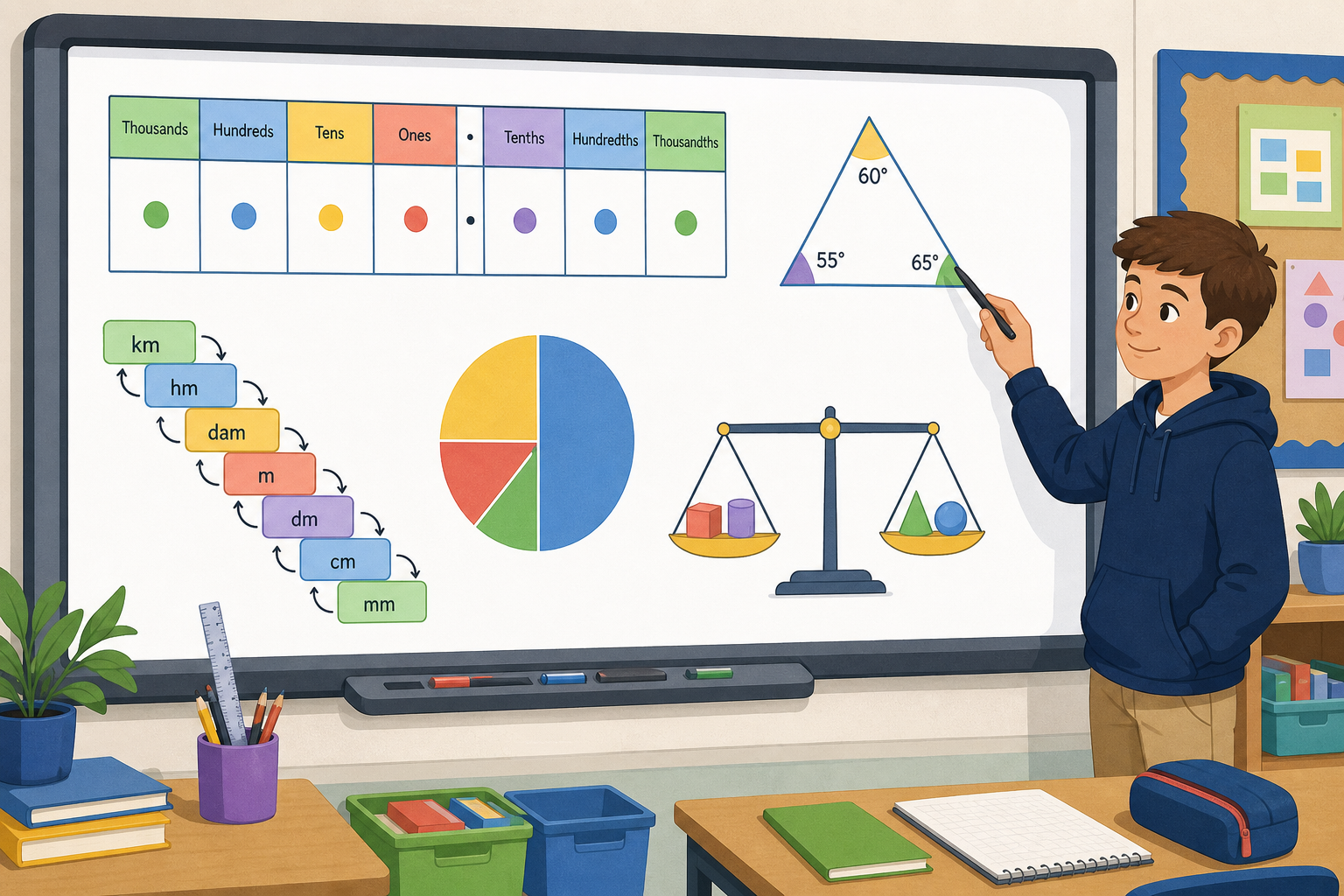
    Illustration for Watch and Notice

    Number: 0.345

    Watch the place-value chart. The number 0.345 has three tenths, four hundredths and five thousandths. Each column to the right is ten times smaller than the one before it.

    Measures: 3.4 km to metres

    Now let's look at the unit converter. To turn 3.4 km into metres we multiply by 1,000, because every step down the metric ladder is a power of ten. So 3.4 km is 3,400 m.

    Shape: a triangle's angles

    Here is a triangle with angles 50 degrees and 70 degrees shown. The three angles of any triangle always add to 180 degrees, so the missing angle must be 60 degrees.

    Data: a pie chart

    This pie chart splits a class survey into slices. Each slice is a fraction of the whole, and you can read it as a fraction, a decimal or a percentage. A slice that is exactly half the pie is 50 per cent. Notice: the percentages you learned in the number strand are exactly what you use to read this pie chart, so that is the same idea showing up in two strands.

    Algebra: 2x + 3 = 11

    Last of all, here are the balance scales showing 2x + 3 = 11. An equation stays balanced as long as we do the same thing to both sides. I'll work the two moves on the board: first take 3 from each side, which leaves 2x = 8; then halve both sides, which gives x = 4. Each move keeps both pans level, so the answer holds.

    3 - Try It Together ~11 mins

    Now we tour the five strands together, about two minutes each. A different pupil drives the tool for each strand at the board while the rest of the class predicts what it will show and calls out the answer to check.

    Number: 0.345

    A pupil reads 0.345 on the place-value chart column by column — units, tenths, hundredths, thousandths — saying each digit's value: three tenths, four hundredths, five thousandths. The class checks each column against the chart.

    Measures: 3.4 km to metres

    A pupil uses the unit converter to change 3.4 km into metres. Predict first: every step down the metric ladder is times ten, so km to m is times 1,000 — that is 3,400 m.

    Shape: a triangle's angles

    A pupil reads the two given angles, 50 degrees and 70 degrees. The class works out the third: the three angles add to 180 degrees, so the missing angle is 60 degrees.

    Data: a pie chart

    A pupil reads one slice of the pie chart as a fraction, then as a percentage. Remember: that percentage is exactly the idea you met in the number strand — one maths idea showing up in two strands.

    Algebra: 2x + 3 = 11

    The balance scales show 2x + 3 = 11. Work the two moves on the board: take 3 from each side to leave 2x = 8, then halve both sides to get x = 4. Each move keeps both pans level, so the answer holds.

    4 - One Line Per Strand in Your Copy ~3 mins

    COPYBOOK MOMENT

    In your maths copy, write one line for each of the five strands, with that anchor's key fact. For example:

    • Number: 0.345 is three tenths, four hundredths, five thousandths
    • Measures: to change km to m, multiply by 1,000
    • Shape: a triangle's angles add to 180 degrees
    • Data: a pie slice can be a fraction, a decimal and a percentage
    • Algebra: keep an equation balanced by doing the same to both sides

    When your five lines are done, underline the strand you found stickiest across the year.

    5 - Class Challenge ~8 mins

    Key point

    Today you pick three of the five strands. For each one you chose, complete one recap task in your copy. We will take answers on the board strand by strand.

    Pick three strands and solve one recap task from each.

    1. Number: write 0.7, 0.345 and 0.5 in order from smallest to biggest.
    2. Measures: change 2.5 km into metres.
    3. Shape: a triangle has angles of 40 degrees and 90 degrees. Find the third angle.
    4. Data: a pie chart slice is one quarter of the pie. Write it as a percentage.
    5. Algebra: solve 2x + 3 = 11.
    6. Stretch (algebra): solve 3x − 2 = 13.

    Ways to start:

    • Start with the strand you feel most confident in.
    • Read the place value of each digit before you order any decimals.

    Stretch:

    • Solve a task from a fourth strand once your three are done.
    Answers & strategies (teacher)
    1. Number: write 0.7, 0.345 and 0.5 in order from smallest to biggest. — 0.345, 0.5, 0.7
    2. Measures: change 2.5 km into metres. — 2,500 m
    3. Shape: a triangle has angles of 40 degrees and 90 degrees. Find the third angle. — 50 degrees
    4. Data: a pie chart slice is one quarter of the pie. Write it as a percentage. — 25%
    5. Algebra: solve 2x + 3 = 11. — x = 4
    6. Stretch (algebra): solve 3x − 2 = 13. — x = 5

    6 - What Did We Notice? ~3 mins

    MATHS TALK

    Where did you spot the same maths idea turning up in two different strands this year? Think about percentages, or decimals, or the times-ten rule, and where else you used it.

    7 - What's Next ~2 mins

    Today we revisited

    • One anchor idea from each of the five strands you studied all year.
    • How the same maths idea, like a percentage or the times-ten rule, shows up in more than one strand.
    • Which strand you most want to keep sharp as primary maths ends.

    Coming up

    Coming up

    Next we put these skills together in an open project: working out how big the school yard really is, using measurement, area and scale all at once.

    Pupil practice
    Module 11 · End-of-primary Modelling and Review Mixed
    Lesson 115 · End-of-primary Strands Recap: a Five-strand Tour
    Download Activity Book page (PDF)
    End of lesson
    123learn · Online learning platform

    Unlock the full learning experience

    You're previewing this lesson. Get full access to this lesson and hundreds more — each one ready to teach, with interactive activities, printable resources and pupil progress tracking built in.

    Hundreds of curriculum-aligned lessons
    Interactive activities in every lesson
    Printable resources & progress tracking
    Copyright Notice
    This lesson is copyright of 123Learn.ie 2017 - 2025. Unauthorised use, copying or distribution is not allowed.
    🍪 Our website uses cookies to make your browsing experience better. By using our website you agree to our use of cookies. Learn more