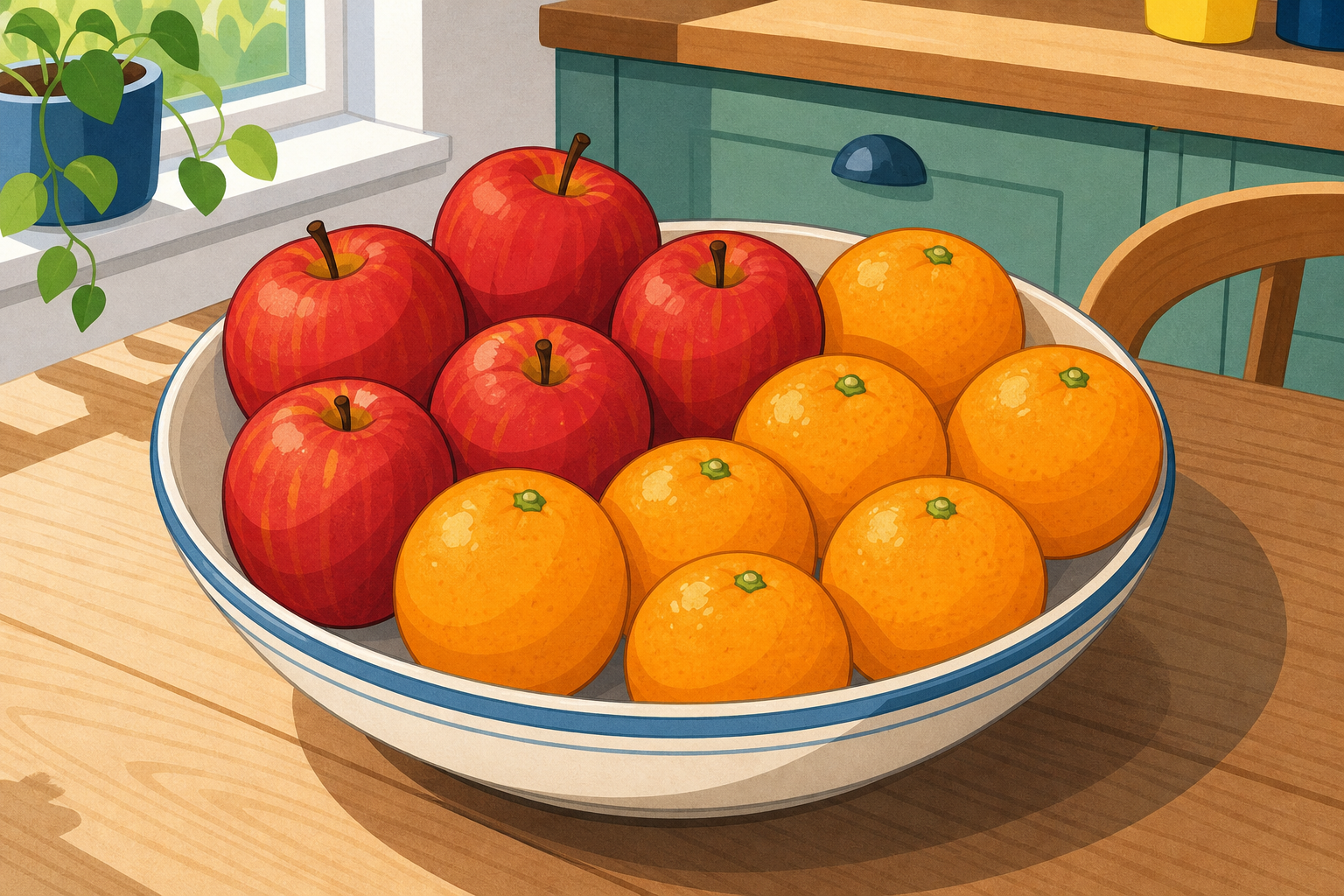
Look at this fruit bowl: there are 4 apples and 6 oranges. How could you describe how many apples there are compared to how many oranges? Could you say it in one short way, instead of counting them all out every time?
Take two or three hands-up answers, not open call-outs. Listen for any pupil who naturally says "for every two apples there are three oranges" or talks about more/fewer, and hold onto that phrasing to revoice in Watch and Notice. Five seconds of quiet think-time first.
Watch two bars: one shows 2 red counters, the other shows 3 blue counters. We say this as 'two to three' and we write it as 2 : 3. That little colon stands for the word 'to'. We can also read the very same comparison as 'for every two reds there are three blues'. Both ways of saying it mean exactly the same thing.
Now there are 4 reds and 6 blues. We read this as 'four to six', or 'for every four reds there are six blues', and we write it 4 : 6. Notice it is the same kind of picture as before, just with more counters in each bar.
This one is very lopsided: 1 red counter for every 5 blue counters. We read it 'one to five' and write it 1 : 5.
Here both bars have 3 counters. We read it 'three to three', written 3 : 3, which means there is the same amount of each.
Walk each example aloud, one at a time, writing the colon form on the board as you say it.
Let's try this together. When I call out a comparison, build the two bars, then read the ratio aloud as 'for every ___ there are ___'. For example, 'five boys to three girls' becomes two bars and the ratio 5 : 3, which we read as 'for every five boys there are three girls'. Remember, 'five to three' and 'for every five there are three' describe the very same comparison.
This round is for talking it through together — pupils take turns at the board and the class agrees or corrects out loud.
Call out comparisons in plain words first (five boys to three girls, two cats to four dogs) and have the pupil at the board build the two bars, then write the colon form underneath. Have the whole class read it aloud as 'for every five boys there are three girls'. Rotate four pupils. Watch for the slip of writing the second number first — point back at which bar is which.
In your maths copy, write each of today's comparisons as a ratio in colon form, one under the other. Under each ratio, write a short sentence: 'for every ___ there are ___'.
Walk the room glancing at the colon placement and the first/second order — this is whole-class copybook practice, not marking. Look for anyone who has swapped the two numbers.
Today we work through these builds together at the board: make 2 : 5, then 3 : 4, then 7 : 2, and finally build a ratio where the second amount is double the first. Read each one aloud as you check it.
This round is the practice bank — pupils take turns at the board, check each answer, and the class confirms before moving on. Keep the board work brisk rather than over-explaining.
Each pupil builds the called ratio with the two bars and presses Check. The last challenge is open: any pair like 2 : 4, 3 : 6 or 4 : 8 works — ask the class to name two different answers that both fit 'second amount double the first'. Watch for pupils reading 7 : 2 as 'two to seven'.
Is the ratio 2 : 3 the same as 3 : 2? One pupil says they mean the same thing. Another says they are different. Who is right, and how would you settle it?
Listen for pupils tying the two numbers back to the two quantities: 2 : 3 is two reds for every three blues, 3 : 2 is three reds for every two blues — different pictures. Revoice the strongest answer: so the order tells you which amount is which, and swapping it changes the comparison. Head off the idea that you can flip a ratio freely the way you might rearrange an addition.
Next we will look at how ratios can be made simpler or scaled up, just like equivalent fractions, so that 4 : 6 and 2 : 3 can be seen as the same comparison.
Keep this brief. A one-line recap of the colon and the 'for every' reading is enough before pupils move to the activity-book page.
You're previewing this lesson. Get full access to this lesson and hundreds more — each one ready to teach, with interactive activities, printable resources and pupil progress tracking built in.