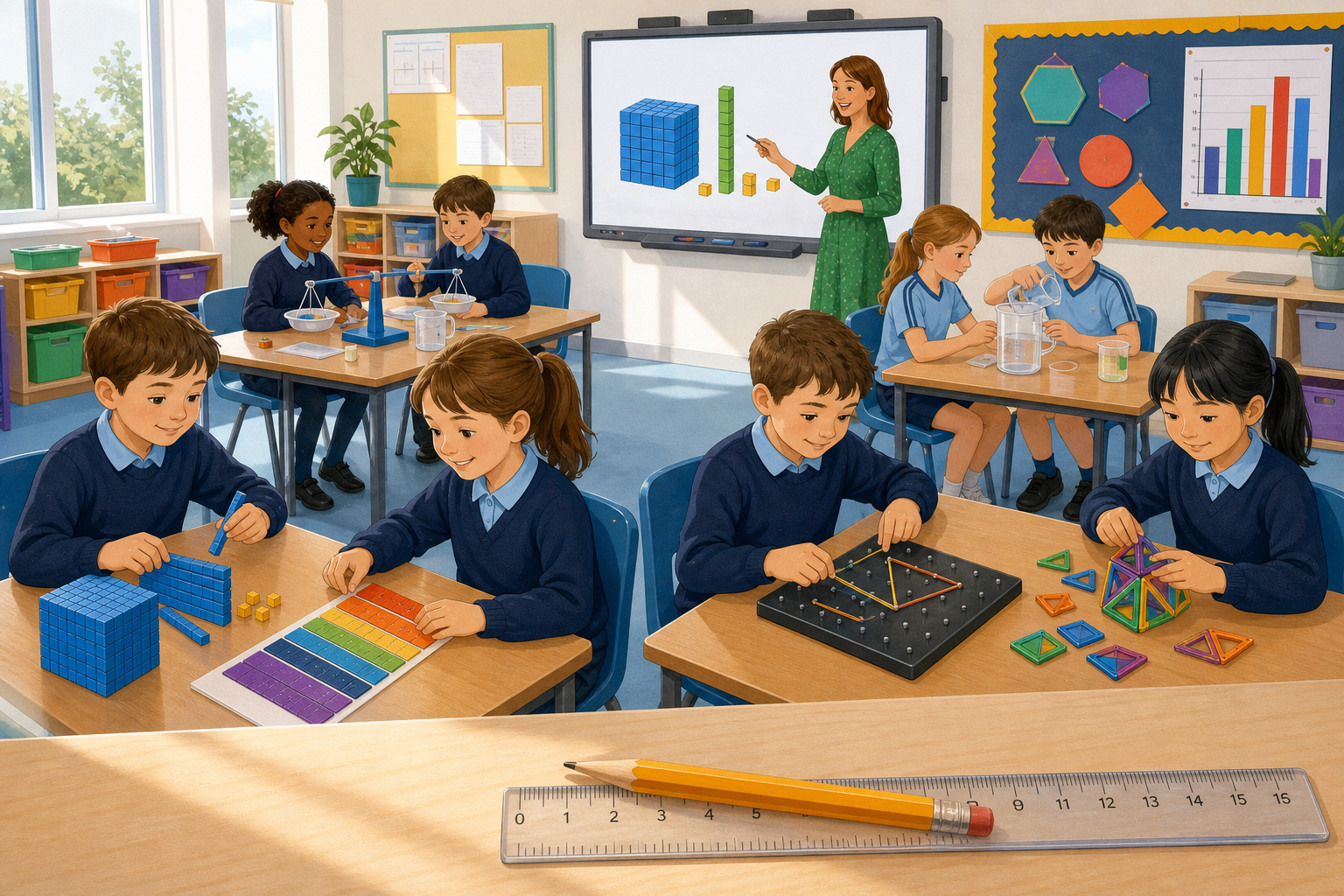
Look at this new pencil held against a ruler. Roughly how long do you think it is? Is it more or less than ten centimetres? Hold up a hand if you think more, and a hand if you think less.
Take three hands-up estimates, not open call-outs. Don't reveal the actual length yet — the lesson is about estimating first, then checking. More or less than ten? is enough to get every pupil committing to a guess.
Watch four objects being measured on the ruler. Each time, notice that the start of the object sits on the zero, and we read the mark at the other end. We start at the zero because there is no length yet at zero. If we started at the 1 instead, we would miss the first centimetre and our measurement would come out one short.
The crayon starts at zero and its other end reaches the 6 mark. It is 6 cm long.
This pencil starts at zero and reaches the 9 mark. It is 9 cm long.
The copybook edge runs from zero past the 10 and stops at the 11 mark. It is 11 cm long.
The rubber starts at zero and its far edge sits on the 4 mark. It is 4 cm long.
Walk each example aloud, one at a time. Each time, point to where the object starts: see how it sits on the zero, not on the 1.
Let's read the length of the object on the ruler together. Before anyone reads the far mark, we'll check the zero is lined up with one end. One pupil at a time will come up and read the object on the board to the nearest centimetre; everyone else watches the board and gets ready to say whether they agree.
This round is for talking it through together — a pupil reads at the board and the rest of the class agrees or corrects out loud.
Call up an individual pupil to read the object currently on the board to the nearest centimetre. Before they read, ask the class: is the zero lined up? If a pupil reads from the 1, that is the teaching moment — the measurement comes out one centimetre short. After each pupil, change the object on the board to a new length (use the widget controls) so the next pupil reads a fresh length. Rotate four pupils across four resets.
Now measure five real objects on your own desk with your own ruler. Work through it in three clear steps:
If five feels like a lot, just do the first three objects — your rubber, your glue stick and your pencil — and order those.
This round is for pupils to measure at their desks with their own rulers — circulate and catch alignment slips on the spot. The class reads aloud and you reconcile any disagreement as you circulate.
The make-or-break error is starting from the 1 instead of the 0; that gives a reading one centimetre short every time. Watch for it as you walk. Keep a small shared bank of 'about 10 cm' objects on the front desk so no pupil stalls choosing one. Fast finishers find which two of their objects differ by the most centimetres, and by how many.
In your maths copy, write each object you just measured — your rubber, your glue stick, the short side of your copybook, your pencil and your near-10-cm object — with your estimate first, then its measured length in centimetres beside it. Put a star beside any estimate that was within 1 cm of the real length.
Walk the room glancing at the estimate-then-measure layout — this is whole-class copybook practice, not marking. Pupils have just measured these objects, so the column has defined entries. Praise close estimates to build the habit of estimating before measuring.
Why do we line the zero up with the end of an object, and not the number 1?
Listen for pupils explaining that the zero is the true start — there is no length yet at zero. Revoice a strong answer: so if we start at the 1, we miss the first centimetre and our measurement comes out short. Head off the idea that you can start anywhere as long as you count the marks.
Next we look more closely at the tiny marks between the centimetres, called millimetres, so we can measure even more carefully.
Keep this brisk. The natural next step is the centimetres-and-millimetres lesson — flag that the ruler has smaller marks the class will use next.
You're previewing this lesson. Get full access to this lesson and hundreds more — each one ready to teach, with interactive activities, printable resources and pupil progress tracking built in.