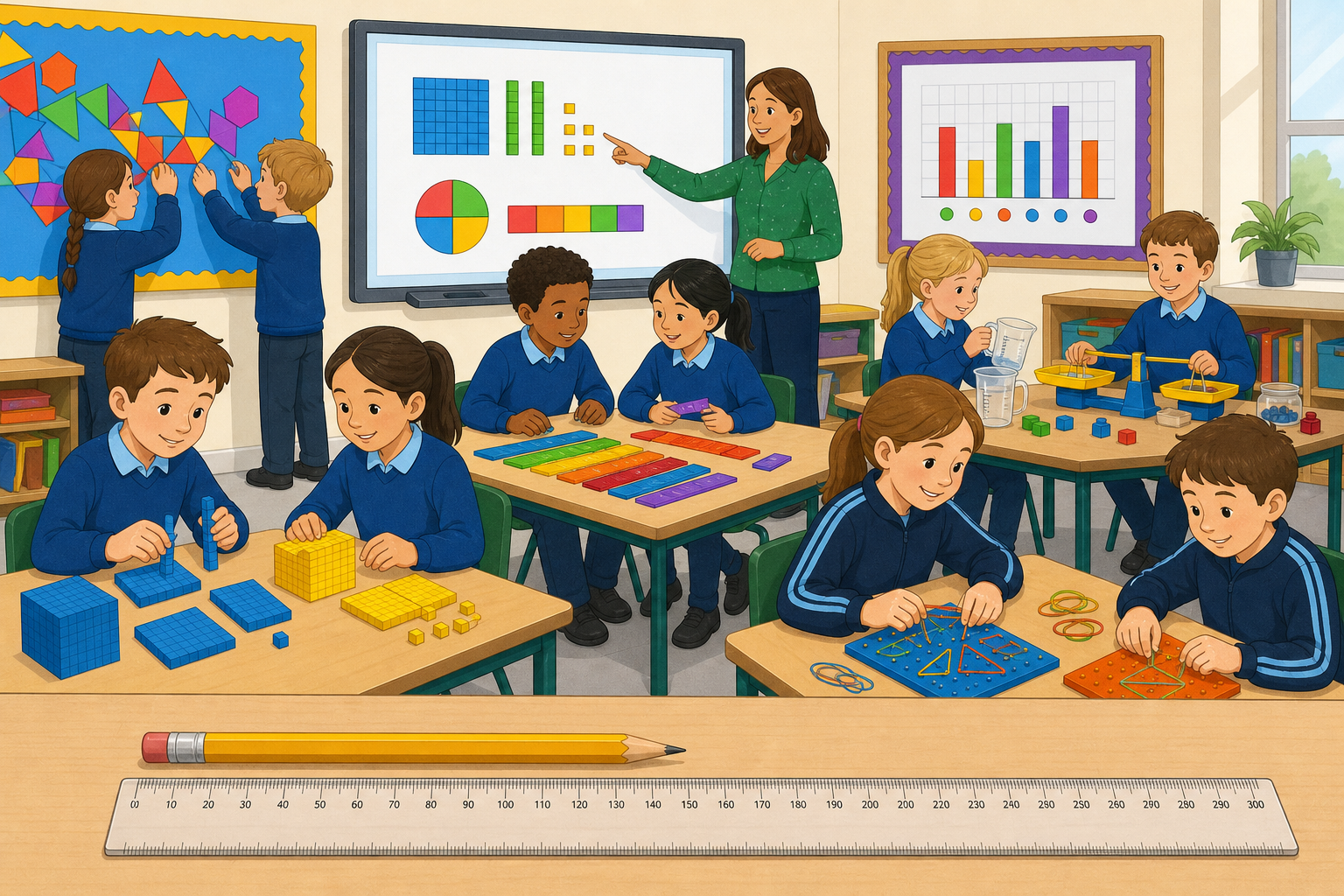
Hold up your pencil and take a good look at it. Roughly how long is it? Have a guess in your head before anyone says a number out loud.
Now look at the little dot of glue on a glue stick, or the rubber on the end of a pencil. Would you measure those tiny things in the same way as you would measure the whole desk?
Hold a pencil beside a demonstration ruler. Take three hands-up estimates for the pencil, not open call-outs. Don't reveal the real length yet — the point is the estimate.
Steer the second question toward the idea that very small things need smaller units. Don't name millimetres yet; let it surface in Watch and Notice.
Watch as I measure four real objects with the ruler at the front. Each time we will do two things: estimate first, then measure.
The most important step is lining the 0 mark right up with one end. Then we read the far end. Some lengths land exactly on a centimetre number, but most land in between, on one of the little millimetre marks.
Notice how the answer for the pencil and the rubber both needed millimetres, because the end fell between two centimetre marks.
Some things are trickier to line up. Watch how I measure a flat hand: I put the zero right at the tip of my thumb and read across to my little finger. For scissors, I close them and lay the zero at the tip of the closed blade, then read along to the end of the handle.
This is a real demonstration at the front with a ruler, not an on-screen widget. Measure each object live so pupils see the zero-alignment.
Common slip to head off: starting the measure from the metal end or the 1, not the 0.
Now it is your turn at your own desk. Take out your ruler. I will name an object on your desk, and you will measure it to the nearest millimetre.
Each time: write down your estimate first, then line up the zero and read the far end. We will say each reading aloud and check we all agree. If you don't have the exact object I name, use any small object on your desk instead.
This round is for pupils to measure at their desks with their own rulers — circulate and catch alignment slips on the spot. The class reads aloud and you reconcile any disagreement as you circulate.
Have pupils write the estimate down before measuring (a quick number in the copy or on the record sheet), so the within-1 cm star-check in the next step has something to compare against. Name one object at a time (pencil, rubber, ruler edge, copybook edge). Pause after each so everyone reads before you call the agreed answer.
In your maths copy (or on your measuring record sheet), make two columns beside each object's name: your estimate first, then the measurement in cm and mm. Now compare the two: put a star next to any estimate that landed within 1 cm of the real measurement.
Walk the room glancing for a clear estimate-then-measure layout — this is whole-class copybook practice, not marking. The estimate column should already be filled from Try It Together, so the star-check compares a written estimate against the written measurement.
The printable measuring record sheet gives ready-made object / estimate / measurement / unit columns if you are using it; otherwise pupils rule the columns themselves. Encourage them to write the unit (cm and mm) every time, not just a bare number.
Time for a measuring challenge at your desk. Estimate each one first, then measure it to the nearest millimetre and record both: your pencil, your rubber, the edge of your copybook, your ruler's width, and your handspan.
Remember the handspan from the front demo: keep your hand flat and put the zero at your thumb tip.
Stretch: when you have finished the five, can you find something on your desk that is exactly 7 cm long?
This round is the practice bank — pupils measure real objects at their desks with their own rulers, recording estimate and measurement on the record sheet or in the copy. Keep the pass-on rhythm brisk; the class confirms each reading aloud at the end.
Run the five items in order, easiest first (pencil) building to the trickier handspan, which was modelled in Watch and Notice. The five core measurements are the work for this slot; the 'find something exactly 7 cm' is a clear stretch-only beat for pupils who finish the five early.
Why do we measure short things like a pencil in centimetres and millimetres, but we would measure the whole room in metres? What makes a good unit for a job?
Listen for pupils saying that tiny things need small units so the reading is exact, and big things would need a very long string of small numbers. Revoice a strong answer: 'so we pick the unit that gives us a sensible, tidy number'.
Head off the idea that one unit is 'better' than another — it depends on the size of the thing being measured.
Next we will measure longer things and decide when to use metres instead of centimetres. We will measure the door, the whiteboard and even the corridor, and choose the sensible unit each time.
For the next lesson, having a metre stick and a few longer objects (door, shelf, corridor stretch) ready helps pupils feel the jump from cm to m.
You're previewing this lesson. Get full access to this lesson and hundreds more — each one ready to teach, with interactive activities, printable resources and pupil progress tracking built in.