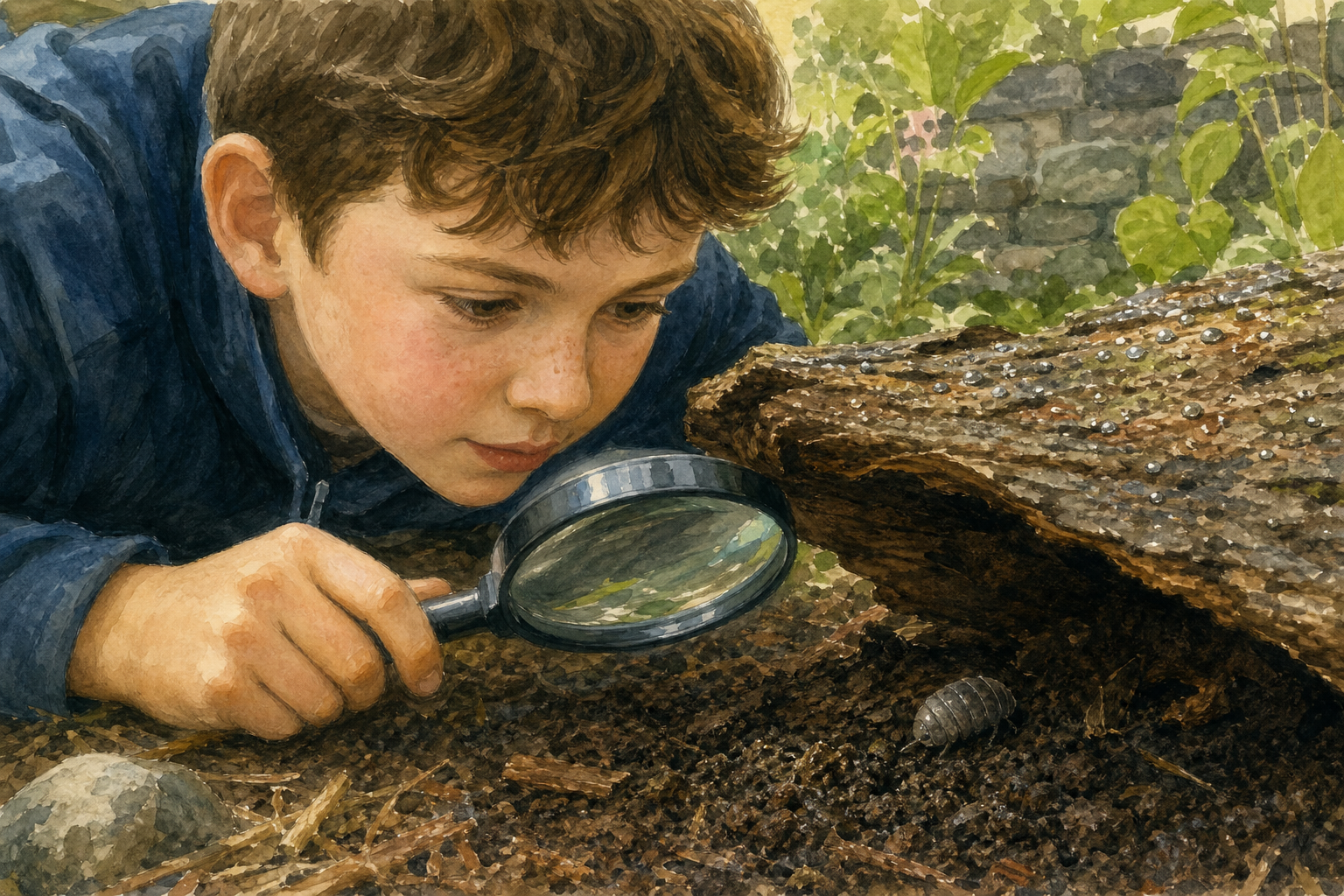
Where do you think you would find a woodlouse: out in the open sunshine on a wall, or in the dark damp under a log? And where would a sun-warmed wall spider rather be? Hands up your guess.
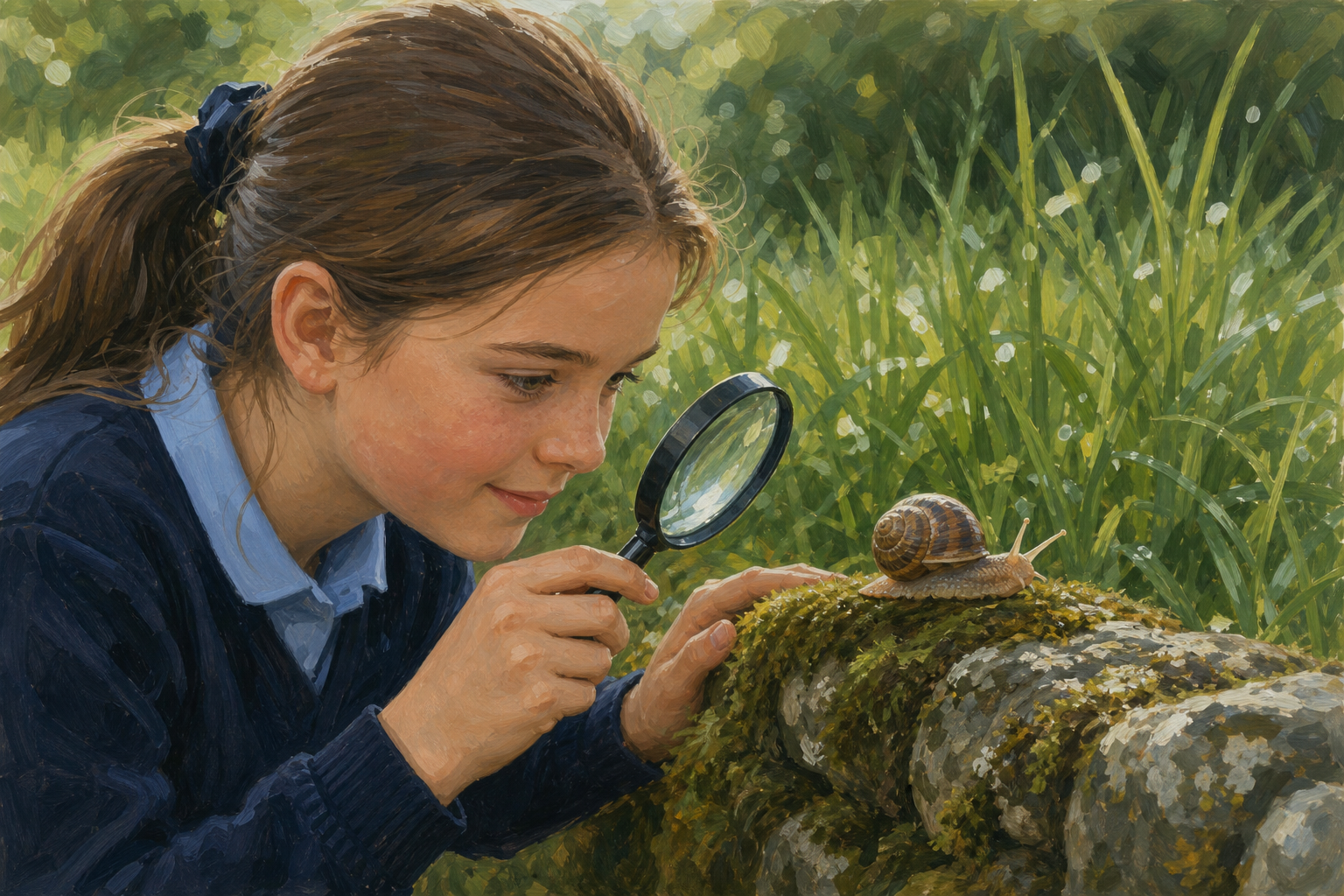
Today we are going to be field ecologists. We will visit a few different little corners of our school grounds and find out which tiny creatures live in each one, and why those creatures choose those exact spots.
Keep this light: a single curiosity question, no apparatus yet. Take two or three guesses, then tell the class their guesses are exactly what scientists call predictions, and we will test them outside.
If a real woodlouse is to hand, you may pass it round in a clear pot, but it is not required to pose the question.
Here is our question for the day: Do different little creatures live in different microhabitats, and why?
A microhabitat is a small place with its own conditions: under a log is dark and damp, the long grass is cool and sheltered, and a sunny wall is warm and dry.
Before we go outside, talk in your group: which creatures do you predict we will find under a log? In the grass? On a wall? Say why you think so.
Run this as quick think-pair-share, display-only. Draw out reasons, not just names: "Why would a slug be under the log and not on the sunny wall?" Steer toward damp/dry, dark/light, cool/warm.
Common misconception: that creatures end up somewhere by chance. Reframe: each creature's body suits a particular place, so we tend to find the same kinds in the same kinds of spot.
Predictions are never wrong, they are the start of the science. Pupils jot their predictions in the Investigation Journal before heading out.
Before we head out, let's learn the three big words for today, then we'll read our minibeast ID sheet together.
| Concept | Why it matters | Example |
|---|---|---|
| Microhabitat — a small place with its own conditions where particular living things live | Different little spots offer different conditions, so different creatures make their homes in each | Under a log is dark, cool and moist; a sunny wall is warm and dry; the long grass is cool and sheltered |
| Adaptation — a body or behaviour feature that suits a creature to where it lives | A creature's features are not random: they help it survive in its own spot | A worm's soft, smooth body lets it slide through soil; a slug's soft, moist body keeps it in the damp shade |
| Suited to its habitat — well matched to a place, so the creature finds the food, shelter and conditions it needs | It explains why we keep finding the same kinds of creature in the same kinds of place | A slug stays in the damp shade under a log because its soft, moist body would dry out on the open sunny wall |
In a moment your group will get a printed minibeast ID sheet to take outside. Use it to name what you find, and look for the one feature on each creature that helps it live where it does.
This Key Concepts table is the children's on-screen content for 6th class. Read it across with the class, point to the Example cells, and give one anchor example for each word. Keep the on-screen reading to the three terms; the full ID sheet is a printed handout groups read at the first stop, so you are not loading eight creatures onto the board on top of the three words.
This is teaching content, provided in full; the teacher prints it, they do not write it.
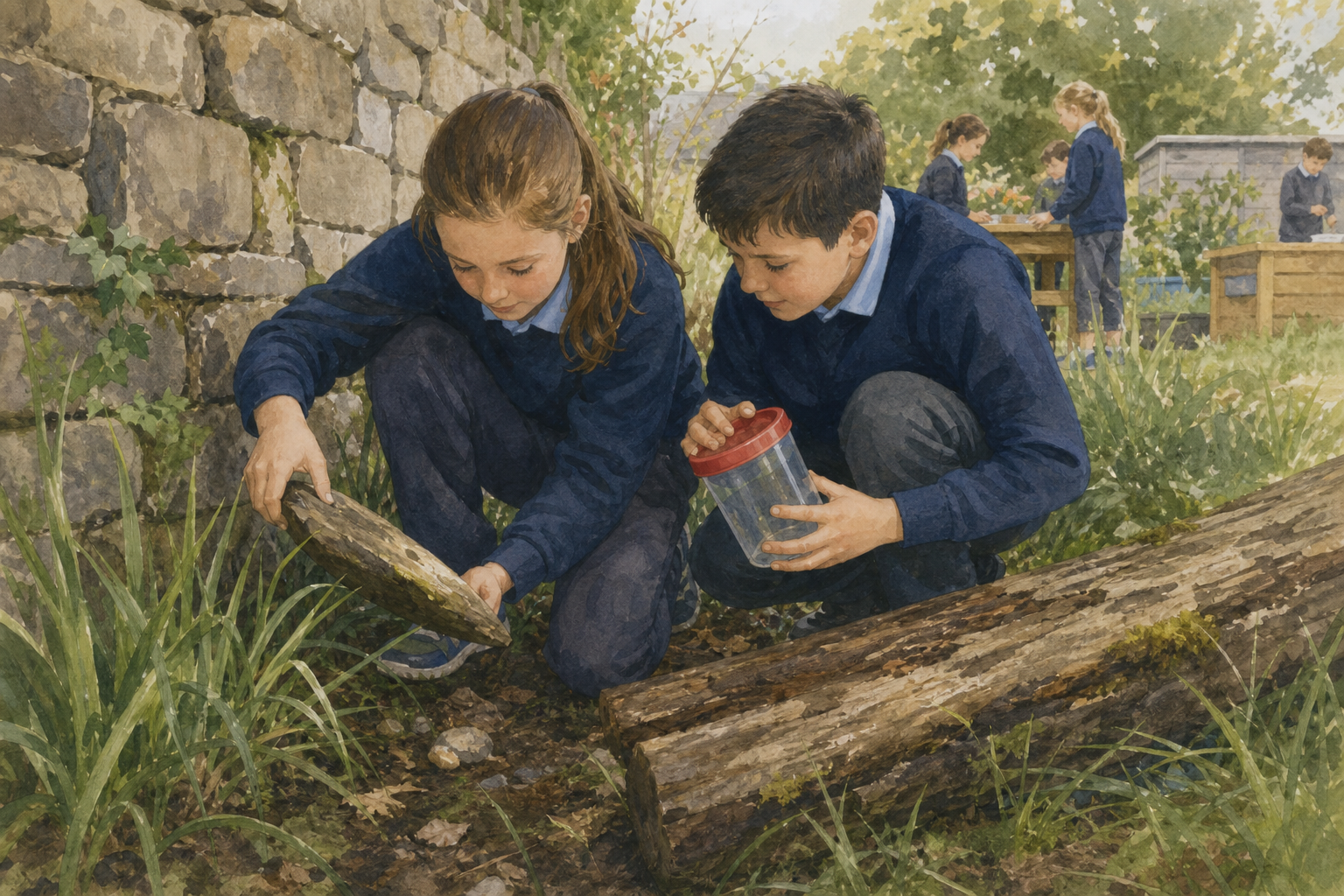
Time to be ecologists. In your group, visit each of our three microhabitats in turn: under a log or stone, in the long grass, and on a wall or fence. Your teacher will point out the exact spots in our grounds and the order to visit them before we go. At each spot, look carefully with your magnifier and use the ID sheet to name what you find.
On your Observation Sheet, record three things for each creature: where you found it (which microhabitat), what it was, and one note about why it might suit that spot (damp, dark, warm, sheltered).
Lift logs gently, look, then lay them back exactly as they were. Every creature goes home where you found it.
Set boundaries and groups. Point out the three exact spots and the order each group will follow. Hand each group a clipboard, magnifier, collection pot and ID sheet. Three stops, a few minutes at each.
If time runs short: drop to two microhabitats, but keep one damp/dark spot (under a log) and one warm/dry spot (a wall) so the damp-vs-dry contrast the whole lesson is built on is preserved.
Safety: mind nettles, brambles and stinging plants; do not handle anything that stings; wash hands on return. Lay logs back to protect the homes.
The Investigation Journal Observation Sheet is the pupil record here.
Back inside, let's sort the creatures we found by their features. On the screen we have our minibeasts, and we will send each one down a yes/no key to find its group.
The questions are Does it have legs? and then How many legs?, sorting our creatures into no legs, 6 legs, 8 legs and many legs. Call out the answers and watch where each creature lands.
Drive the interactive on the IWB in explore mode. Eight creatures appear: worm, slug, snail, woodlouse, spider, ladybird, ant, earwig. The class answers "Does it have legs?" then "How many legs?" to sort into no legs (worm, slug, snail), 6 legs (ladybird, ant, earwig), 8 legs (spider) and many legs (woodlouse). The woodlouse has many short legs, more than eight, so it gets its own group: use this to spark talk about how it does not fit the three common boxes neatly, which is good science thinking.
Fold the whole class in: when one group is calling answers, ask the others "are they right? where will the spider go?" Link sorting back to adaptation: legs help a creature move in its spot.
Let's pool what we found. As a class, we will fill in which creatures turned up in each microhabitat, then talk about why.
Look at the pattern: were the soft, moist creatures mostly in the damp dark spots? Were the dry-loving ones up on the warm wall? What does this tell us about how a creature's features suit it to where it lives?
Display-only science-talk. Take a quick show of hands or call-outs to build the class picture on the board (under a log: woodlice, worms, slugs; grass: ladybirds, ants, snails; wall: spiders).
Close by naming the big idea: living things are suited to where they live. This is exactly how field ecologists work, surveying a site to learn which creatures live where and why, which matters for protecting Irish wildlife.
Today we found that living things are suited to where they live. A creature's body and behaviour, its adaptations, match the conditions of its microhabitat: soft moist bodies in the damp shade, dry-loving bodies up on the warm wall.
Discuss with your class: if you found a brand new creature with a flat body and pincers, which microhabitat would you predict it lives in, and why?
Keep this verbal and quick. The last prompt is a thinking challenge (an earwig-like creature would squeeze under bark or stones), letting pupils apply the adaptation idea to something new.
Homework (hands-on, recorded in the journal): at home or on the way to school, find one small microhabitat (a crack in a wall, under a plant pot, a hedge) and draw or note one creature you spot there and one reason it might suit that spot.
You're previewing this lesson. Get full access to this lesson and hundreds more — each one ready to teach, with interactive activities, printable resources and pupil progress tracking built in.