Mathematics
Beginner
50 mins
Teacher/Student led
+90 XP
What you need:
IWB/Projector/Large Screen
base-ten blocks

Modelling Thousandths with Concrete and Visual Tools

Learn how to relabel base-ten blocks so the flat represents 1, then build and name decimals to thousandths using place-value columns and concrete models.
Teacher Class Feed

Load previous activity

    1 - Getting Started ~4 mins

    Illustration for Getting Started

    The rule today

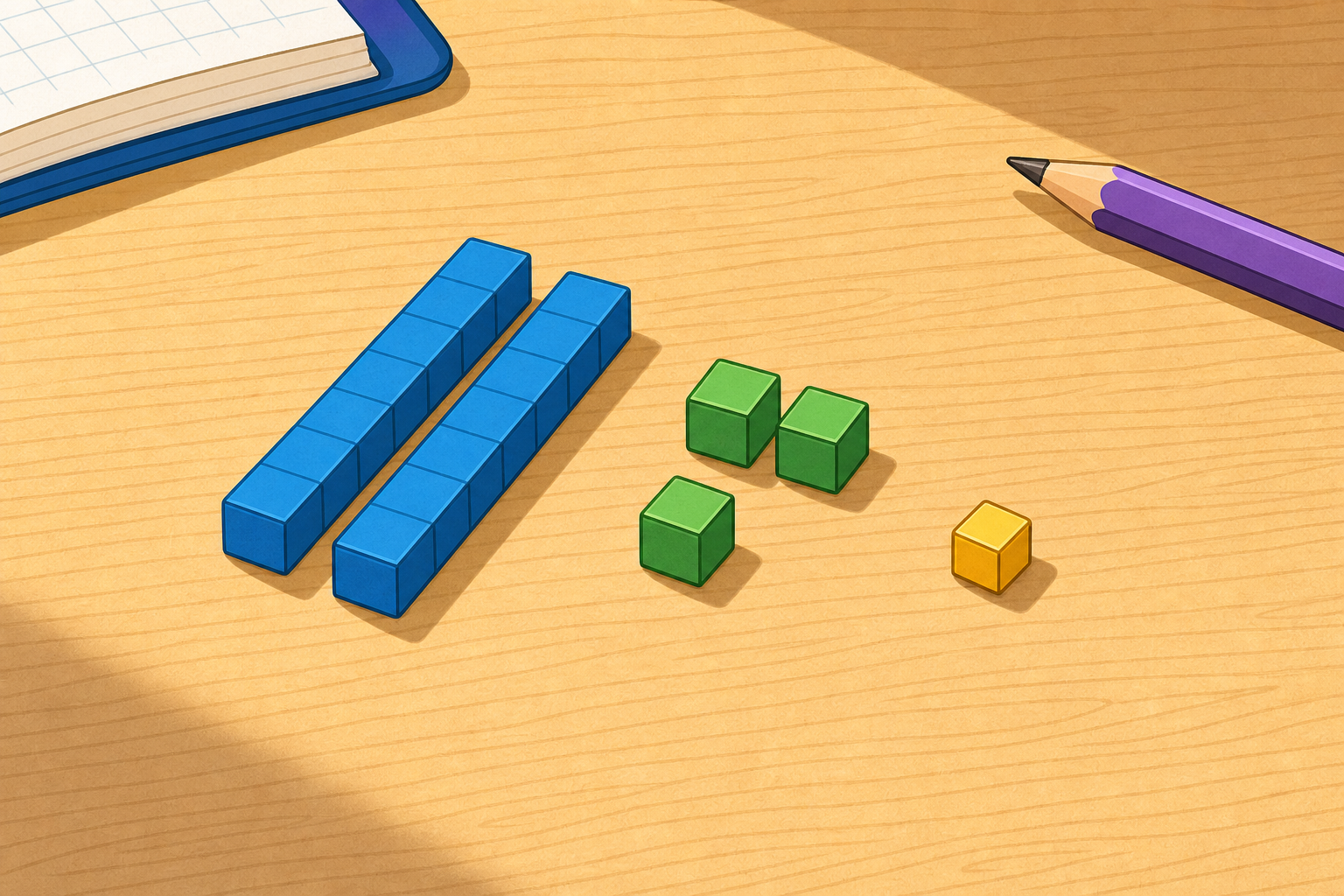
    Here is our new rule for today: the big flat block is now worth just 1, and every block below it is ten times smaller than the one above. So the rod is 0.1, the small cube is 0.01, and the tiniest cube is 0.001. Look at the three sets of relabelled blocks on the board: the first shows 0.2, the second shows 0.03, and the third shows a single tiniest cube. For each one, read it aloud as a decimal.

    2 - Watch and Notice ~8 mins

    Illustration for Watch and Notice

    0.003

    Watch as we build this number with the relabelled blocks. It is just three of the smallest cubes — three thousandths, and nothing else.

    0.034

    Now look carefully. We have three hundredths and four thousandths. The tenths column is empty.

    0.207

    This one has two tenths and seven thousandths, but no hundredths. We put a zero in the hundredths column to keep it open. We call that a holding zero: it shows the column is empty but still counts as a place, so the 7 stays in the thousandths column. If we dropped the zero we would write 0.27, which is a different, bigger number.

    1.045

    Here is a whole flat, then four hundredths and five thousandths. The tenths column is empty again.

    3 - Ten Times Smaller Each Step ~6 mins

    Illustration for Ten Times Smaller Each Step

    Ten thousandths make one hundredth

    Watch the board: when we collect ten of the smallest cubes (ten thousandths) they are exactly the same size as one hundredth cube. So one hundredth is ten thousandths.

    Ten hundredths make one tenth

    Now collect ten hundredth cubes: together they match one tenth rod. So one tenth is ten hundredths.

    Each step down is ten times smaller. To go from one whole all the way to one thousandth we step down three times: ten times, then ten times again, then ten times again. That is 10 × 10 × 10 = 1000, so one thousandth is a thousand times smaller than one whole.

    4 - Try It Together ~9 mins

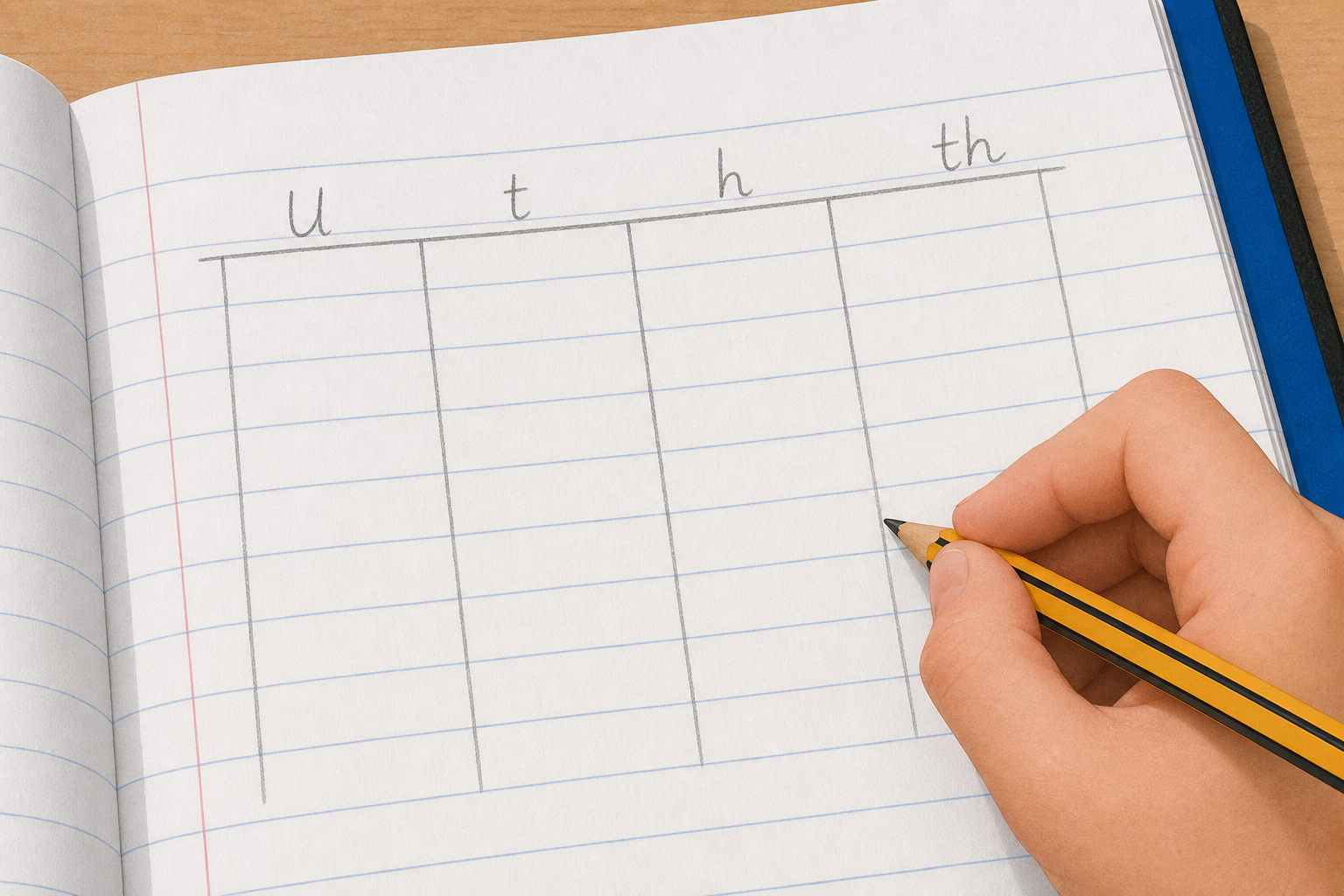
    Now we build some together. When I call a decimal, one pupil comes up and builds it on the place-value mat using the U / t / h / th columns. Everyone else watches the screen and reads the in-words readout aloud with the class before we agree it is right. We will do five or six of these, taking turns at the board.

    Build the decimal on the mat

    5 - Sketch the Columns in Your Copy ~3 mins

    COPYBOOK MOMENT

    Illustration for Sketch the Columns in Your CopyIn your maths copy, sketch the four place-value columns and label them U, t, h, th. Then draw the blocks for each of these decimals, one under the other, and write the decimal in standard form (the normal way we write a number, like 0.207) beside each drawing:

    • 0.003
    • 0.034
    • 0.207
    • 1.045

    6 - Class Challenge ~8 mins

    Today we work through five decimals together: 0.008, then 0.052, 0.306, 1.009, and 2.405. Build each one on the mat and use the Check button to confirm it before we move on. The holding zeros catch people out, so we'll say each one aloud first.

    Build each decimal and check

    7 - What Did We Notice? ~4 mins

    MATHS TALK

    We saw on the board that each step down is ten times smaller. So why is one thousandth a thousand times smaller than one whole? And how many thousandths would you need to make a single tenth?

    8 - What's Next ~3 mins

    What we did today

    • We relabelled the base-ten blocks so the flat is 1, the rod is 0.1, the small cube is 0.01 and the smallest cube is 0.001.
    • We built decimals to thousandths and matched each block to its place-value column.
    • We learned to say the holding zero aloud so 0.207 is never read as 0.27.
    • We saw that each step down is ten times smaller, so a thousandth is a thousand times smaller than a whole.

    Coming up

    Coming up

    Next we put these decimals in order, lining up the decimal points and comparing column by column from the left.

    Pupil practice
    Module 1 · Place Value, Decimals and the Number System Number
    Lesson 3 · Modelling Thousandths with Concrete and Visual Tools
    Download Activity Book page (PDF)
    End of lesson
    123learn · Online learning platform

    Unlock the full learning experience

    You're previewing this lesson. Get full access to this lesson and hundreds more — each one ready to teach, with interactive activities, printable resources and pupil progress tracking built in.

    Hundreds of curriculum-aligned lessons
    Interactive activities in every lesson
    Printable resources & progress tracking
    Copyright Notice
    This lesson is copyright of 123Learn.ie 2017 - 2025. Unauthorised use, copying or distribution is not allowed.
    🍪 Our website uses cookies to make your browsing experience better. By using our website you agree to our use of cookies. Learn more