Mathematics
Beginner
50 mins
Teacher/Student led
+75 XP
What you need:
IWB/Projector/Large Screen
Polydron
Real household solids

Naming and Sorting 2D and 3D Shapes

Explore how to name and sort flat and solid shapes by counting their sides, corners, parallel sides, lines of symmetry, faces, edges and vertices.
Teacher Class Feed

Load previous activity

    1 - Getting Started ~4 mins

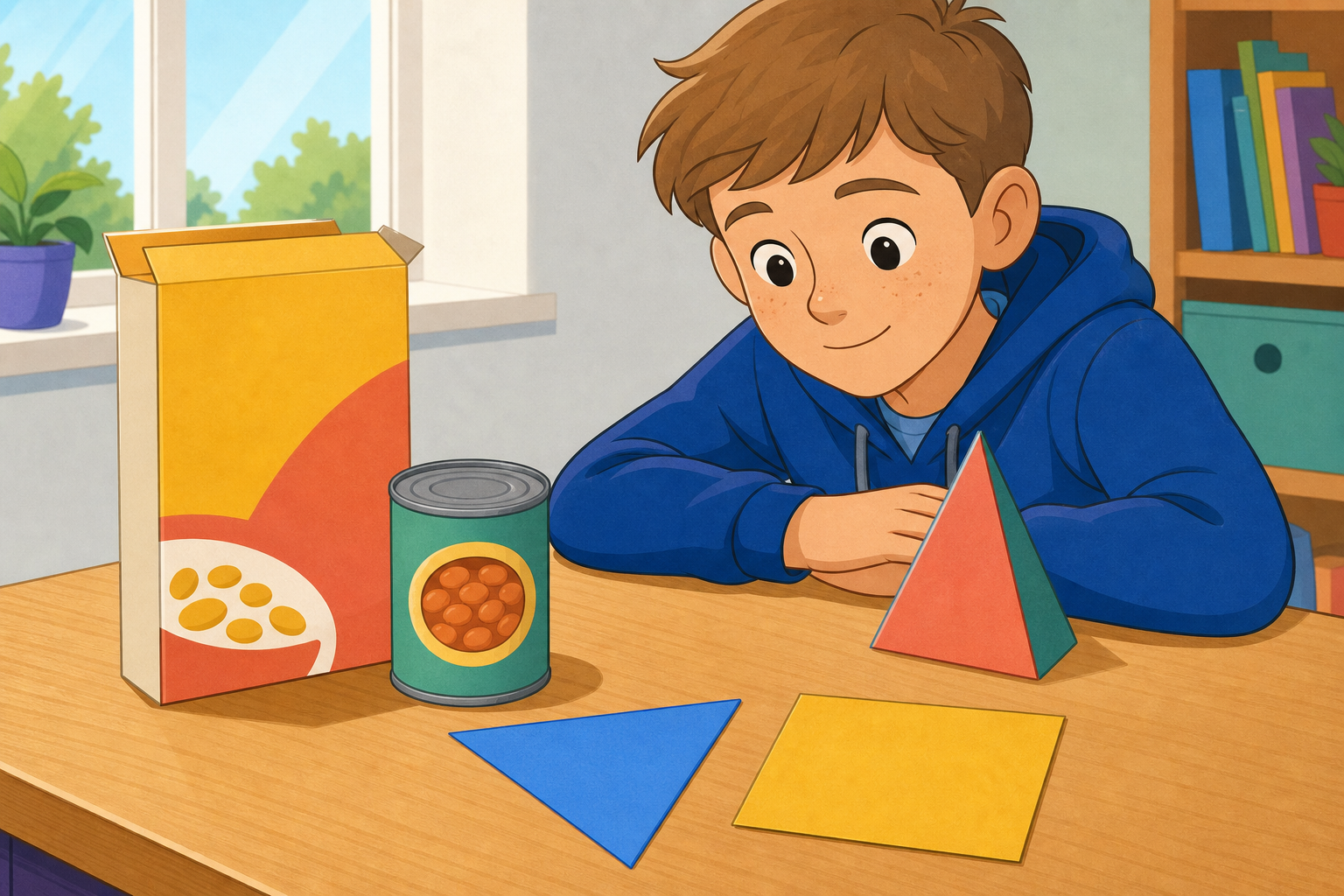
    Look at these together: a flat triangle, a flat square, and three solid shapes shaped like a cereal box, a tin of beans and a triangular chocolate packet. What is the same about them, and what is different? If you had to put them into groups, what would you sort them by?

    2 - Watch and Notice ~9 mins

    Triangle

    Watch as each property is revealed one at a time. First the sides, then the corners (we call a corner a vertex, and more than one are vertices), then the lines of symmetry — these are the fold-lines, the lines you could fold the shape along so both halves match exactly. A triangle has three sides and three vertices.

    Square

    Now the square. Look at the sides, the vertices and the fold-lines. Two of its sides are parallel — that means they run alongside each other and never meet, like the two rails of a train track. A square has four equal sides, four vertices, two pairs of parallel sides and four lines of symmetry.

    Regular hexagon

    This is a regular hexagon — every side is the same length. Notice how many fold-lines it has compared with the trapezium below.

    Trapezium

    The trapezium also has four sides, but they are not all the same. How many fold-lines does it have? Predict before the reveal.

    Before we move on to the solid shapes, name one thing you have spotted so far that tells two four-sided shapes apart.

    Cube

    Now solids. Watch as we count the flat faces (the flat sides you could lay on a table), the edges where two faces meet, and the vertices (the corners). A cube has six faces, twelve edges and eight vertices.

    Triangular prism

    A triangular prism has five faces, nine edges and six vertices — count them as each part lights up.

    Cylinder

    The cylinder bends the rules. The smooth round part wrapping around it is not a flat face — we call it a surface instead. Counting that curved surface and the two flat circles, a cylinder has three surfaces, two edges and no corners at all. Tap each part to count it — that makes the curved surface much easier to spot.

    3 - Try It Together ~8 mins

    Now we try it together. The whole class predicts first, then the teacher brings a pupil up in turn to reveal and check — your job from your seat is to predict and agree, not to come up unless you are called.

    For the flat shape on the board, call out its sides, its vertices, its parallel sides and its lines of symmetry, then a pupil reveals each property to check. Next we look at a solid shape, rotate it on screen, and count its faces, edges and vertices. Count along with the rotating shape on screen — and if your group has a box or polydron solid, count round that too.

    Reveal the properties

    Count faces, edges and vertices

    4 - Sketch a Square and a Cube in Your Copy ~2 mins

    COPYBOOK MOMENT

    In your maths copy, sketch a square on the left and a cube on the right. Beside the square, write its counts: sides, vertices, pairs of parallel sides, and lines of symmetry. Beside the cube, write its counts: faces, edges and vertices. Put them side by side so you can compare the 2D shape with the 3D shape at a glance.

    5 - Class Challenge ~11 mins

    Today we sort a mix of shapes into groups. First we sort just the flat shapes by how many sides they have. Then we sort just the solids by how many faces they have. Next we group the flat shapes by how many lines of symmetry they have, and the solids by how many vertices they have.

    The tricky one

    One tricky one to finish: find ALL the 3D shapes that have twice as many edges as faces.

    Sort the shapes

    6 - What Did We Notice? ~3 mins

    MATHS TALK

    A square, a rhombus and a trapezium all have four sides. So which property tells them apart? And of our three 3D counts — faces, edges and vertices — which one is hard to apply to a sphere or a cylinder?

    7 - What's Next ~3 mins

    Today we learned

    • Flat (2D) shapes are sorted by sides, vertices, parallel sides and lines of symmetry.
    • Solid (3D) shapes are sorted by faces, edges and vertices.
    • Shapes with the same number of sides can still be different — symmetry and parallel sides tell them apart.

    Coming up

    Coming up

    Next we take the solids apart and lay them flat. We will discover how a flat shape called a net folds up into a cube or a cuboid, with no gaps and no overlaps.

    Pupil practice
    Module 6 · 2D and 3D Shape, Angles, Symmetry Shape & Space
    Lesson 73 · Naming and Sorting 2D and 3D Shapes
    Download Activity Book page (PDF)
    End of lesson
    123learn · Online learning platform

    Unlock the full learning experience

    You're previewing this lesson. Get full access to this lesson and hundreds more — each one ready to teach, with interactive activities, printable resources and pupil progress tracking built in.

    Hundreds of curriculum-aligned lessons
    Interactive activities in every lesson
    Printable resources & progress tracking
    Copyright Notice
    This lesson is copyright of 123Learn.ie 2017 - 2025. Unauthorised use, copying or distribution is not allowed.
    🍪 Our website uses cookies to make your browsing experience better. By using our website you agree to our use of cookies. Learn more
