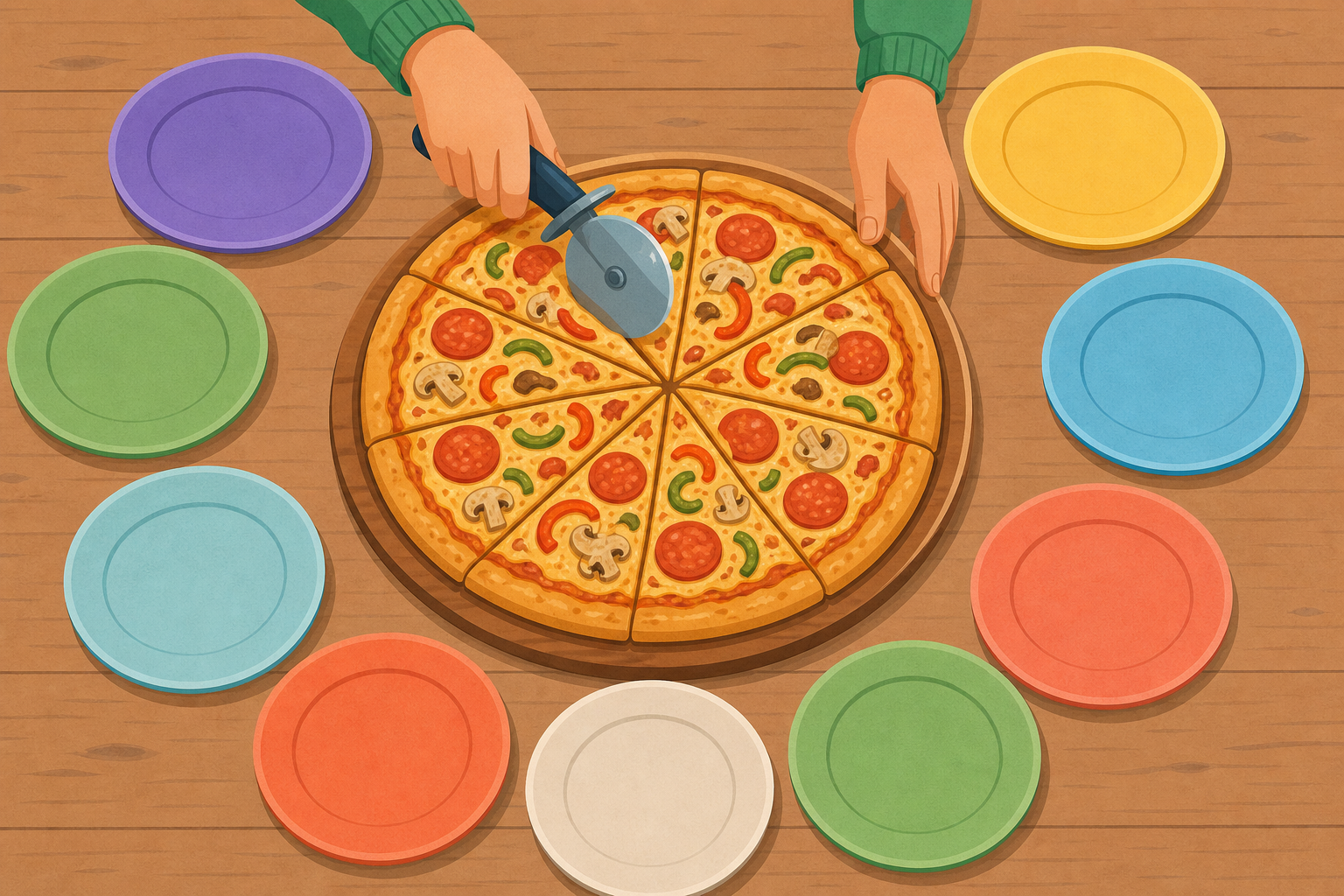
Imagine one big pizza shared fairly between the ten of us sitting at a table. Everyone gets exactly the same amount, with nothing left over.
How much of the whole pizza does each person get? And if everyone put their slice back together, how much pizza would we have again?
Take three hands-up answers, not open call-outs. Give a few seconds of quiet think-time first.
Listen for pupils saying 'a tenth' or 'one out of ten' — revoice either as one tenth. The second question is the seed for the whole lesson: putting the ten slices back makes one whole again.
Watch the fraction strips. The top strip is one whole. Underneath it sits a strip cut into ten equal parts, and beside that, a strip cut into two equal parts.
Look how the ten little parts line up exactly along the one whole strip. Nothing sticks out and there are no gaps. Ten tenths make one whole, just like ten units make one ten.
Now compare. The same one whole is split into just two parts this time. Which parts are bigger, the halves or the tenths? Why do you think that is?
Point along the ten-tenths strip as the class counts the parts aloud — one tenth, two tenths, three tenths... all the way to ten.
On the halves contrast, draw out that more parts means smaller parts: cutting one whole into ten gives smaller pieces than cutting it into two. Don't rush past this — it heads off the common belief that ten always means bigger.
Today we explore tenths on the strips together. We will shade some tenths and read each one aloud as a fraction. As we shade, watch how close we are getting to one whole strip.
This round is for talking it through together — pupils take turns at the board and the class agrees or corrects out loud.
Call a tenths fraction (e.g. shade four tenths); a pupil comes up and shades; the class names it as 4/10. Then ask the watching rows: how many more tenths would reach one whole? Take two hands-up answers and revoice the reasoning. Rotate four pupils across the slot so each round has a fresh shading plus the class question.
Keep returning to the lined-up whole strip above so pupils can see how far each shaded amount is from a full whole.
In your maths copy, draw a long strip and divide it into ten equal parts. You will sketch and label exactly these two fractions:
For each one, shade the right number of parts out of ten and write the fraction neatly below your strip.
Walk the room glancing at whether the ten parts are roughly equal and whether the count of shaded parts matches the label — this is whole-class copybook practice, not marking. No individual grading.
Today we work through these together on the strips: shade three tenths, then shade seven tenths, then shade exactly half as a reference point, and finally the tricky one — shade more than half but less than seven tenths.
This round is the practice bank — pupils take turns at the board, check each answer, and the class confirms before moving on. Keep the board work brisk rather than over-explaining.
The half-shading round (5/10) is the reference point for the last challenge. The final challenge is the low-threshold, high-ceiling one: more than half but less than seven tenths means six tenths is the only fit on this strip. Let the class reason out why five tenths is half and seven tenths is too many before checking.
Where else have you seen one whole made up of ten equal parts? Think about money, sport, or things you measure at home.
Listen for pupils naming everyday tens — ten 10c coins in a euro, ten years in a decade, ten centimetres marked along a ruler. Revoice a strong answer: so ten of those equal parts rebuild one whole, just like our ten tenths.
This bridges tenths to the decimal place value coming next.
Next we use these same ten parts to read and write our first decimals, like 0.3 and 0.7.
Keep this brief. The link to decimals (each tenth becomes the first place after the decimal point) is the hook into the next lesson.
You're previewing this lesson. Get full access to this lesson and hundreds more — each one ready to teach, with interactive activities, printable resources and pupil progress tracking built in.