Mathematics
Intermediate
50 mins
Teacher/Student led
+80 XP
What you need:
IWB/Projector/Large Screen

Perimeter of Regular and Irregular Shapes

Find the perimeter of shapes by adding all side lengths. Use multiplication shortcuts for regular shapes and work out missing sides on compound shapes.
Teacher Class Feed

Load previous activity

    1 - Getting Started ~4 mins

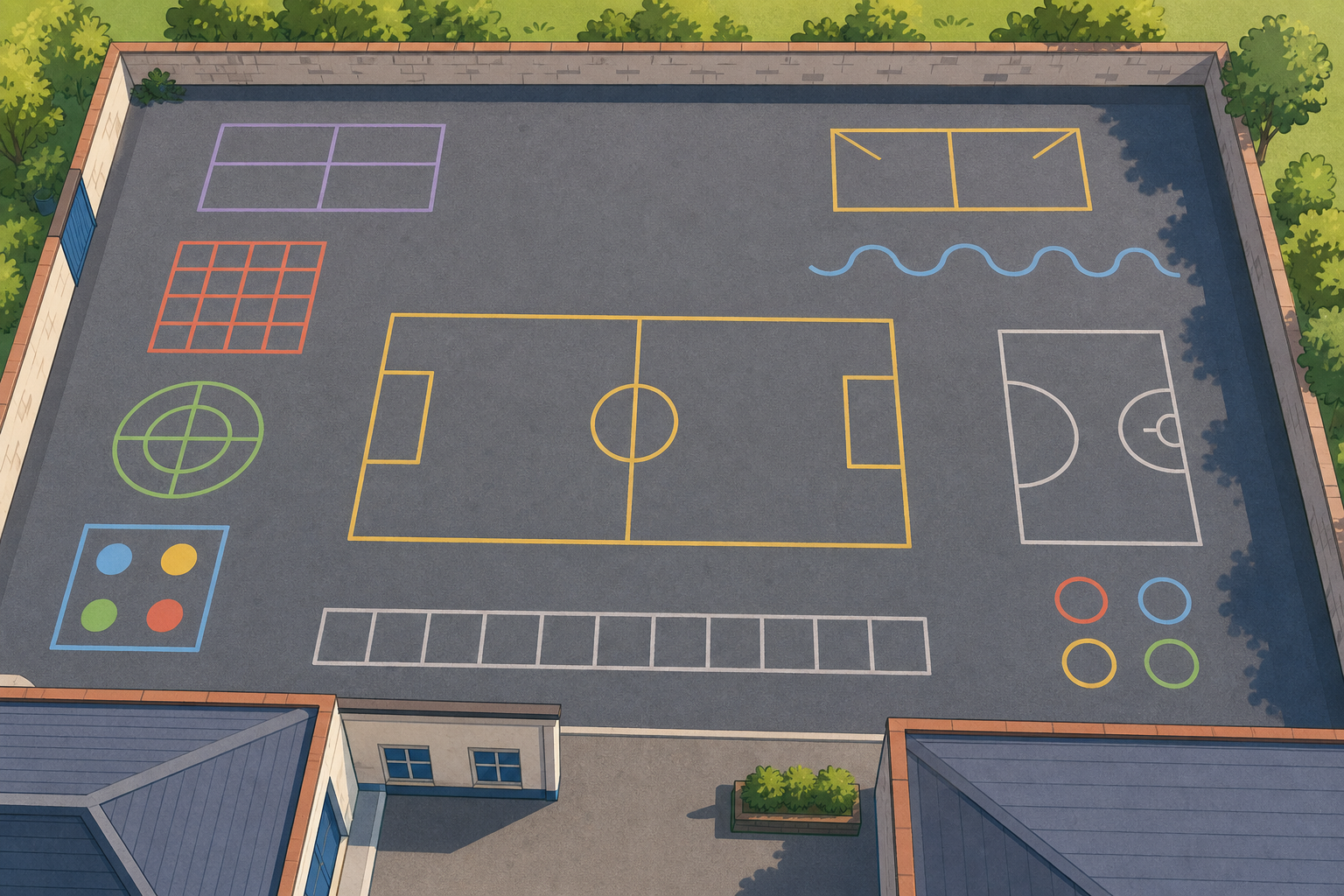
    Illustration for Getting StartedPicture the school yard from above. The caretaker wants to put a new fence all the way around the edge of it. Before any fencing can be ordered, somebody has to work out how much fence is needed.

    Key point

    How would you figure out exactly how far it is all the way around the yard?

    2 - Watch and Notice ~9 mins

    Illustration for Watch and NoticeThe real yard would be measured in metres, but the diagrams on the board use centimetres so the shapes stay small and easy to read. The thinking is exactly the same either way.

    Rectangle: 4.5 cm by 2.5 cm

    Watch as we measure all four sides and add them. Two sides are 4.5 cm and two sides are 2.5 cm. Notice that opposite sides match, so we could double instead of writing every side out.

    Regular pentagon: side 3.2 cm

    This shape has five equal sides, each 3.2 cm. When every side is the same, adding the same number five times is the same as multiplying by 5.

    L-shape with a missing side

    Look at this L-shape. Most sides are labelled, but the top edge has no number on it. Here is how we find it: the top edge stretches the whole way across, so it must equal the two shorter sections along the bottom added together. If the bottom is made of a 5 cm piece and a 3 cm piece, the top must be 5 + 3 = 8 cm. Once we know that hidden side, we can add every side once around the shape for the perimeter.

    3 - Try It Together ~10 mins

    Let's measure each side of this irregular shape on the board together, then add them all up to find the perimeter. The side lengths are shown on the labelled shape, so we read each one straight off the picture. First, count how many sides the shape has so we know how many numbers to expect, then we'll go round one side at a time, saying each length out loud before we add it on.

    Total every side

    4 - Sketch the Shapes in Your Copy ~3 mins

    COPYBOOK MOMENT

    In your maths copy, sketch each shape from the lesson, label every side with its length, and write the perimeter sum underneath each one. If you used a multiply shortcut for any repeated sides, circle it.

    5 - Class Challenge ~8 mins

    Today we work through these perimeter problems together, getting trickier as we go:

    • Find the perimeter of a regular hexagon with each side 4 cm.
    • Find the perimeter of an L-shape from its labelled sides.
    • Find the perimeter of an L-shape that has one side missing — work out the missing side first.
    • Find the perimeter of a regular pentagon with each side 6 cm.
    • Stretch: the perimeter of a square is 24 cm. How long is each side?

    Work out the perimeter of each shape, then solve the reverse square puzzle.

    1. A regular hexagon has each side 4 cm. What is its perimeter?
    2. An L-shape has sides of 6 cm, 4 cm, 3 cm, 2 cm, 3 cm and 2 cm going around it. What is its perimeter?
    3. An L-shape has a bottom edge of 5 cm, then 4 cm up, then 2 cm across, then 4 cm up to the top. The top edge is not labelled. The left side is 8 cm. Work out the missing top edge first, then find the perimeter.
    4. A regular pentagon has each side 6 cm. What is its perimeter?
    5. The perimeter of a square is 24 cm. How long is each side?

    Ways to start:

    • Count how many sides the shape has before you start adding.
    • If sides repeat, can you multiply instead of adding each one?

    Stretch:

    • The perimeter of a square is 24 cm — what one calculation gives you the side length?
    Answers & strategies (teacher)
    1. A regular hexagon has each side 4 cm. What is its perimeter? — 24 cm
    2. An L-shape has sides of 6 cm, 4 cm, 3 cm, 2 cm, 3 cm and 2 cm going around it. What is its perimeter? — 20 cm
    3. An L-shape has a bottom edge of 5 cm, then 4 cm up, then 2 cm across, then 4 cm up to the top. The top edge is not labelled. The left side is 8 cm. Work out the missing top edge first, then find the perimeter. — The top edge is 5 − 2 = 3 cm, so the perimeter is 5 + 4 + 2 + 4 + 3 + 8 = 26 cm
    4. A regular pentagon has each side 6 cm. What is its perimeter? — 30 cm
    5. The perimeter of a square is 24 cm. How long is each side? — 6 cm
    • Regular hexagon, side 4 cm: 4 × 6 = 24 cm.
    • L-shape: add every labelled side once around the shape.
    • Missing-side L-shape: deduce the unlabelled side from the matching sides, then add the full perimeter.
    • Square stretch: 24 ÷ 4 = 6 cm per side.

    6 - What Did We Notice? ~3 mins

    MATHS TALK

    When can we multiply instead of adding all the way round a shape? And when does that shortcut stop working?

    7 - What's Next ~3 mins

    Today you learned to

    • Find the perimeter by adding every side once around a shape
    • Use a multiply shortcut when sides repeat, like in a regular shape
    • Work out a missing side before completing a perimeter
    Note

    The L-shape we worked on is an irregular polygon, and it is also a compound shape, two rectangles joined together. You will meet that word, compound, in the next lesson.

    Coming up

    Next we move from the distance around a shape to the surface inside it: finding the area of rectangles and compound shapes.

    Pupil practice
    Module 5 · Measures: Length, Area, Volume, Mass and Capacity Measures
    Lesson 48 · Perimeter of Regular and Irregular Shapes
    Download Activity Book page (PDF)
    End of lesson
    123learn · Online learning platform

    Unlock the full learning experience

    You're previewing this lesson. Get full access to this lesson and hundreds more — each one ready to teach, with interactive activities, printable resources and pupil progress tracking built in.

    Hundreds of curriculum-aligned lessons
    Interactive activities in every lesson
    Printable resources & progress tracking
    Copyright Notice
    This lesson is copyright of 123Learn.ie 2017 - 2025. Unauthorised use, copying or distribution is not allowed.
    🍪 Our website uses cookies to make your browsing experience better. By using our website you agree to our use of cookies. Learn more
