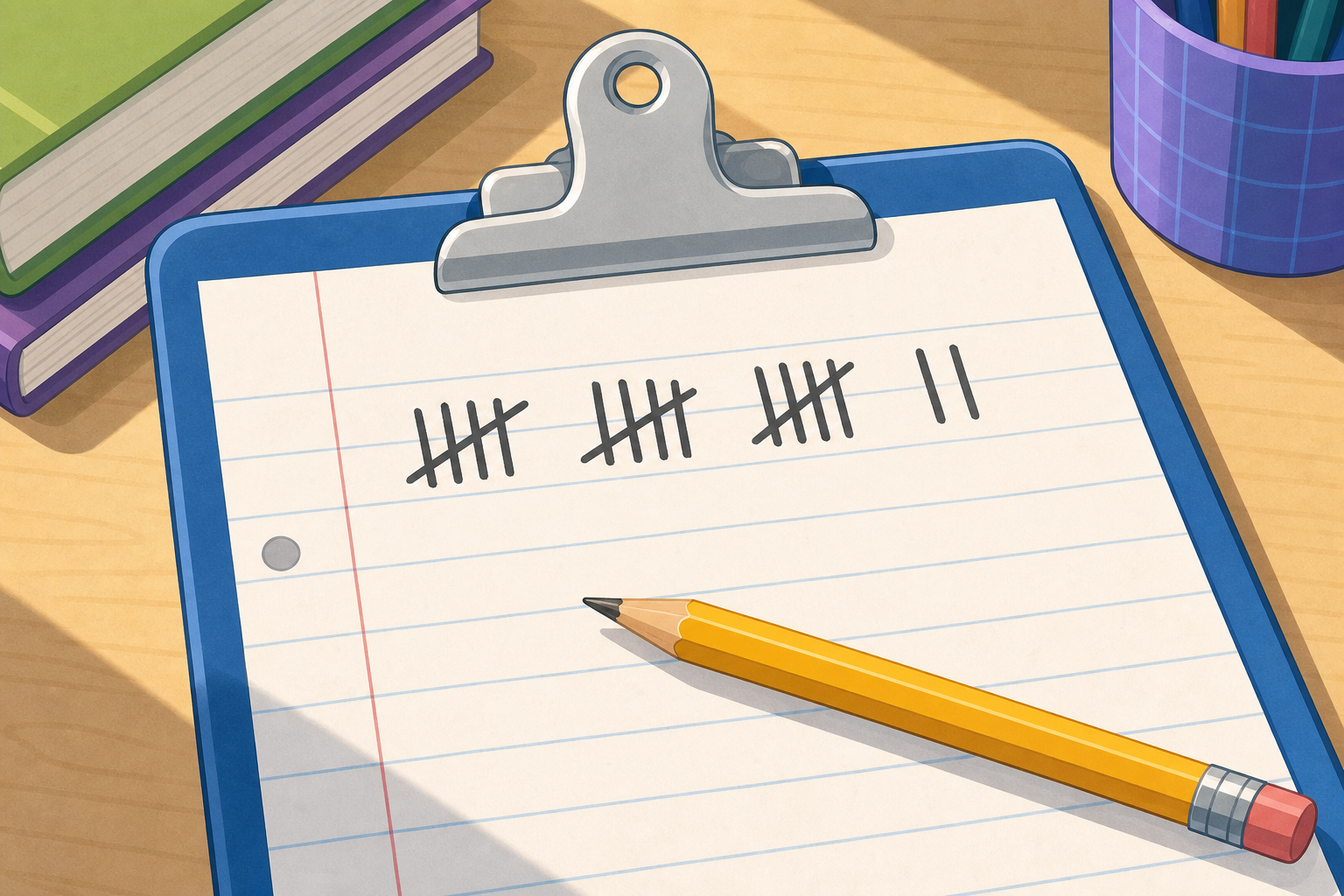
Here is a tally someone made on a clipboard. Count the marks: three full gates of five, then two more single strokes. How many is that altogether? And here are three questions a class might want to answer: "How do we get to school?", "What is your favourite colour?", "Will it rain tomorrow?" Which of these three could we actually answer by counting?
Take three hands-up answers for the tally count (the answer is 17). Then put the three questions to the class. Steer the talk toward which question we can settle by counting — the rain question is a prediction, not a count. Keep this brief; the sorting work happens in the next step.
Watch as we set up a tally for this question. The categories are Walk, Cycle, Bus and Car. Each child adds one mark to their row, and every fifth mark crosses the other four as a gate. Notice how the gates let us read the total fast.
Watch as the tally becomes a frequency table: Walk 12, Cycle 5, Bus 8, Car 3. The gates make 12 instantly readable as two gates plus two.
This next picture is just a sneak-peek of what our data will turn into in a later lesson. You do not need to work it out now — just notice that every child becomes one little picture.
Here is a tally with six single strokes and no gate. Watch how much slower it is to count when nobody grouped in fives. This is why we cross every fifth mark.
Point at each gate as the class chants five, ten, fifteen and then the spare strokes. Emphasise the fifth-mark crossing as the whole trick — without it, the tally is just a row of strokes.
Model the gate-mark slowly: draw four strokes, then say one, two, three, four, GATE as the diagonal fifth closes the gate. For pupils who struggle with the crossing, keep that drawn pattern visible on the board as a prompt card, and have them say the rhythm aloud with you.
For the pictogram snapshot, say: same data, one icon per child — this is the shape the answer will take later. Do not dwell; the pictogram is a preview only.
For the no-gate non-example, time the class counting six loose strokes versus reading a gate — the contrast lands the rule.
Today we draft a brand-new question together: "What is your favourite playground game?" First we name the categories — call them out and we will write a row for each. Then individual pupils come to the board to add a tally mark in turn, and the whole class watches each fifth mark cross the four before it. The frequency column on the right fills in as we go.
Try Together: pupils take turns at the board and the class agrees or corrects out loud.
Hold the class to a tight category set (three to five named games) before any tallying starts — a question with too many categories never reads cleanly. Insist the diagonal lands on every fifth mark, not the sixth. Revoice a strong contribution: so each gate is worth exactly five. Watch for pupils who write a fifth straight stroke instead of crossing — catch it on the board the moment it happens.
Everyone writes this one in your own maths copy — nobody comes to the board for this part. Write your own question at the top, then list its categories, one per row. Draw a tally frame with a row for each category and add gate-marks as you imagine the votes coming in. Then, in a column to the right, convert each row's tally into a frequency (the total count) for that category.
Copybook moment: the board is paused and every pupil writes in their own copy at the same time. Walk the room glancing at two things only: the fifth-mark crossing on each gate, and that the frequency number matches the marks. No marking and no board turn-taking — this is whole-class copybook practice, not assessment.
Today we do some real counting together. First we find a good spot to watch from — the classroom window is perfect. Then we pick a question that fits what we can see, like "What colour are the cars going by?" or "What colour jumpers are people wearing?" We tally what we see in fives for a couple of minutes, then bring our count back to the board, fill it into the tally chart, and read off the frequency for each group together.
Run this as a brief at-the-window count from pupils' seats — nobody leaves the room. Give the class about two minutes to tally one question (car colours, jumper colours, vehicle types) onto a chosen set of three or four categories, then call it and move to the board.
On the board, enter each category's count into the tally-chart and read the frequency aloud as a class. As a quick check, deliberately enter one count wrong (say one too many for one colour), ask the class to compare the board count against their own tally, and correct it together. This keeps the read-back active without leaving seats.
If the view is poor, drop the window count and just read the Walk/Cycle/Bus/Car chart on the board, asking pupils to call the frequency for each row.
What makes a question one we can answer with data, and one we cannot? And why does counting in fives help us read a tally so fast?
Listen for pupils naming the difference between a countable question (settled by tallying into categories) and an opinion or a prediction. Revoice: so a data question is one where we can sort every answer into a clear box and count it.
On the fives point, draw out that a gate of five is read in one glance, so a tally with gates is far faster than a row of loose strokes — link it back to the no-gate non-example from Watch and Notice.
Later in this unit we take a frequency table like the ones we built today and turn it into a bar chart, so the answer to our question becomes a picture anyone can read at a glance.
Keep this short. The tally-to-frequency skill from today is the input for the bar-chart lesson later in this unit, so leave the class confident that they can read a tally fast.
You're previewing this lesson. Get full access to this lesson and hundreds more — each one ready to teach, with interactive activities, printable resources and pupil progress tracking built in.