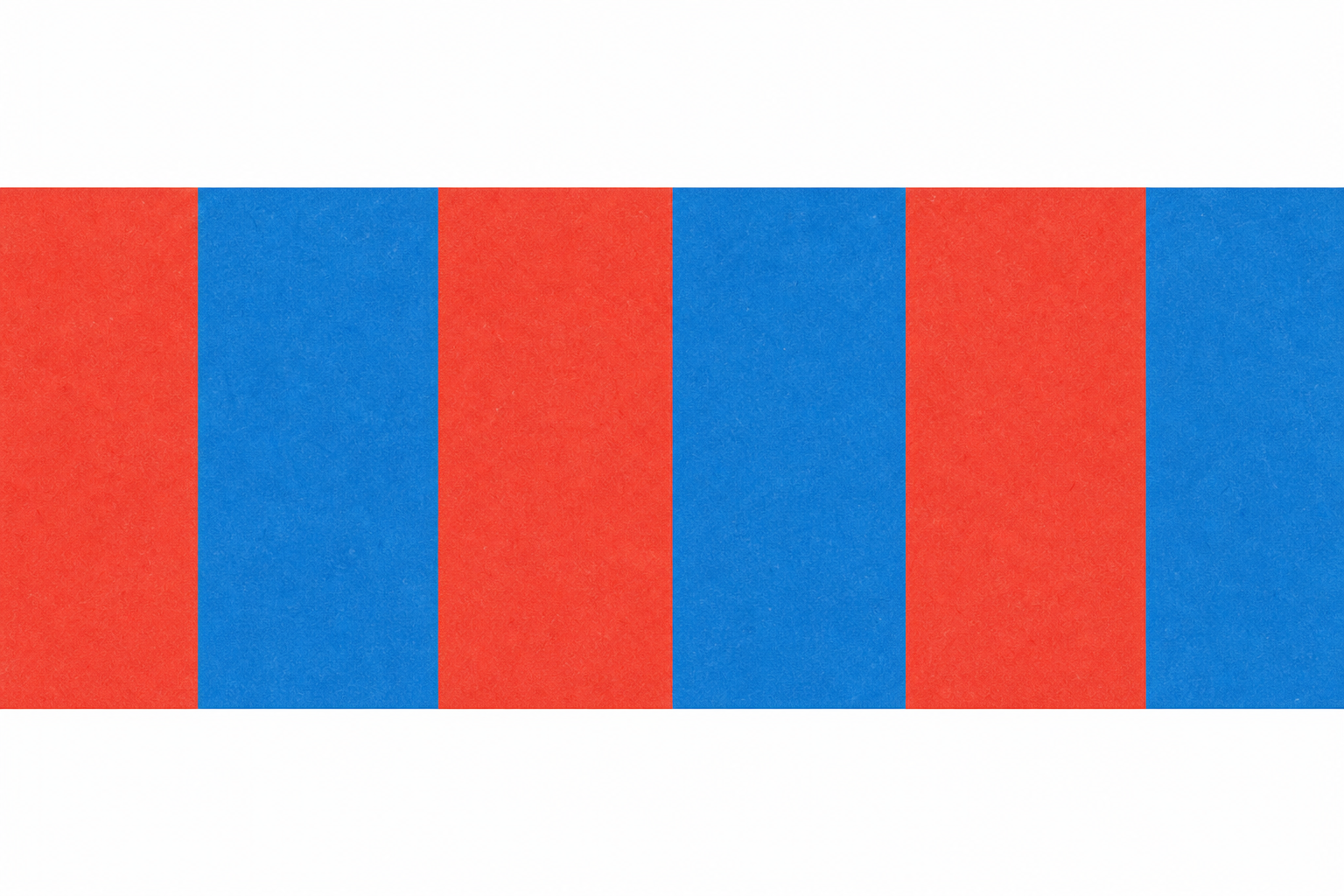
Look at this border running along the top of the board: red, blue, red, blue, red, blue. What colour do you think comes next? And here is the tricky part: which little part keeps coming back again and again?
Take two or three hands-up answers for the next colour, then ask the second question and pause. The goal is for someone to spot the red, blue unit that repeats — revoice it as so the part that keeps coming back is red then blue.
Watch these blocks. The part that keeps coming back is triangle then square. We call that the repeating unit, and once we know it we can keep the pattern going forever.
This time the unit is longer: triangle, triangle, square. Look carefully where one unit ends and the next one begins.
Here the unit has three different shapes: triangle, hexagon, square. Notice how it repeats neatly all the way along.
Walk each example one at a time.
Let's build some repeating patterns together. I'll call out a unit, like triangle, hexagon, hexagon, and one of you will come up and lay it three times. Then we'll check together that every repeat matches.
This round is for talking it through together — pupils take turns at the board and the class agrees or corrects out loud.
Call a unit, send one pupil to lay three full repeats, then ask the class does every repeat match? before moving on. Rotate four pupils across the prompts. Watch for a unit that gets cut short or restarted in the wrong place — pause and have the class point to where one unit ends and the next begins.
In your maths copy, draw a repeating pattern with a unit of three shapes. Then draw a box around one full unit and write how many units you drew altogether.
Walk the room, glance for a clean three-shape unit and a correct box around exactly one repeat — no individual marking, this is whole-class copybook practice.
Let's work through a few of these together. First we'll continue a two-shape pattern. Then a longer pattern with two squares in it. Next we'll find a shape that is hidden in a gap. And last, we'll work out what the 10th shape would be, without drawing all ten.
Here is the trick for the 10th shape: two shapes make one unit, so five whole units take us to the 10th shape. The 10th shape is the second shape of the unit, so it is a square.
This round is the practice bank — pupils take turns at the board, check each answer, and the class confirms before moving on. Keep the board work brisk rather than over-explaining.
For the gap and the 10th-shape prompts, ask which shape sits there, and how do you know? before the check. For the 10th shape, bracket the units along the line so the class can see two shapes make one unit and five whole units reach the 10th place — let pupils count units rather than redraw all ten.
How does finding the repeating unit let you say what sits much further along the pattern, without drawing every shape in between? Remember the trick we used: count in whole units, not single shapes — five units of two shapes took us all the way to the 10th place.
Listen for pupils naming the unit as the key — once you know it, you can count units instead of single shapes. Revoice a strong answer: so you skip ahead in whole units, not one shape at a time. Head off any pupil who still wants to draw all ten shapes to find the 10th.
Next we look at counting patterns and multiples on the hundred square, where the numbers that come up when we count in fives or tens make their own patterns.
Keep this brief. Link the unit idea forward: counting in fives is itself a repeating step.
You're previewing this lesson. Get full access to this lesson and hundreds more — each one ready to teach, with interactive activities, printable resources and pupil progress tracking built in.