Mathematics
Advanced
50 mins
Teacher/Student led
+80 XP
What you need:
IWB/Projector/Large Screen
Metre stick

Scale Drawings and Scale Maps: Small Drawings of Big Things

Learn how scale ratios link tiny drawings to real-world sizes. Convert between paper lengths and actual measurements using scales like 1:100, then sketch plans of real objects and spaces.
Teacher Class Feed

Load previous activity

    1 - Getting Started ~4 mins

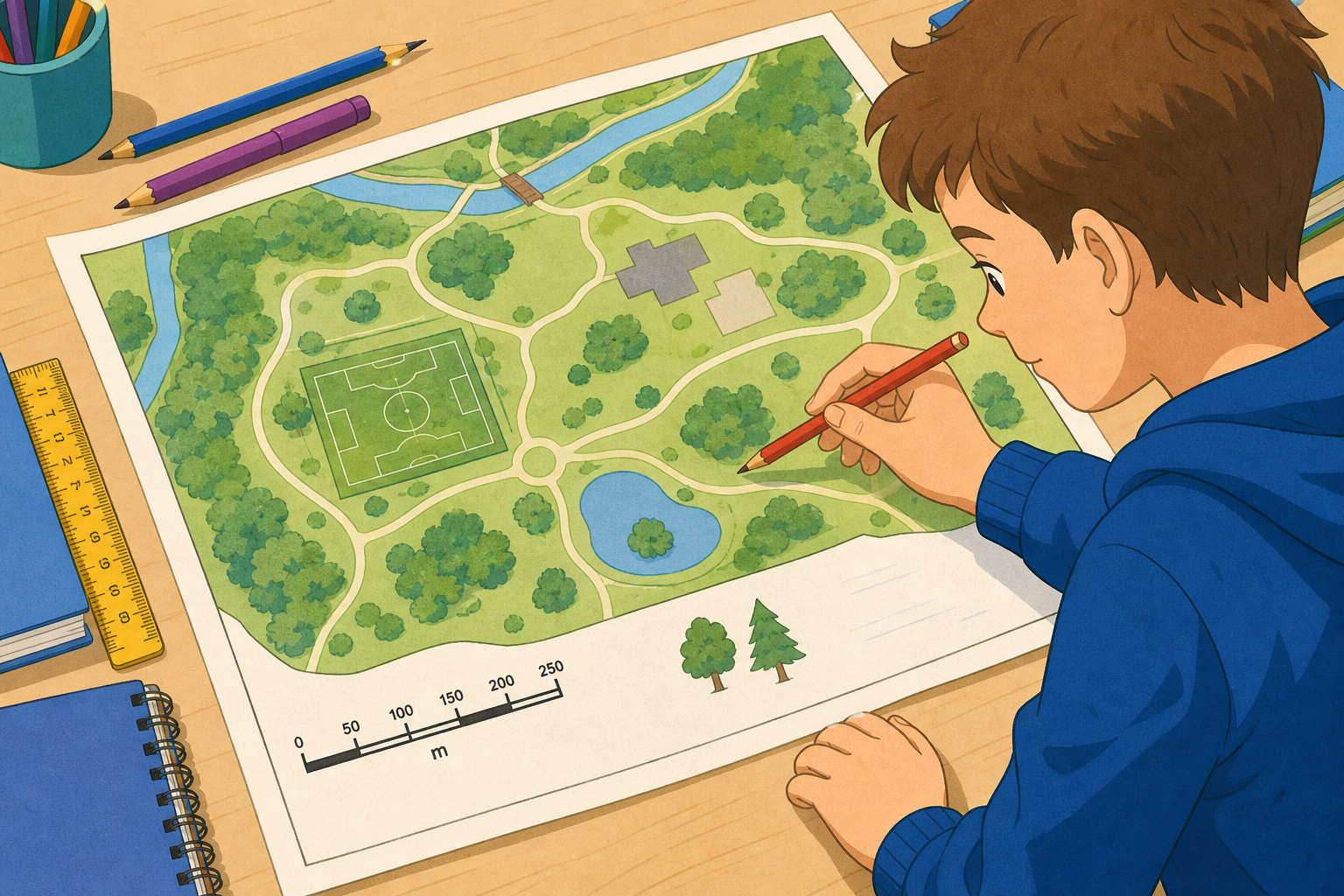
    Look at this map of a local park. Down in the corner there is a little scale bar. A scale bar is a small ruler-like marker on a map that shows how much real distance a short paper length stands for. Two trees are drawn close together on the paper, but in real life they might be far apart. How could that tiny scale bar tell us the real distance between the two trees without ever walking it?
    2 - Watch and Notice ~7 mins

    Let's start with a classroom plan

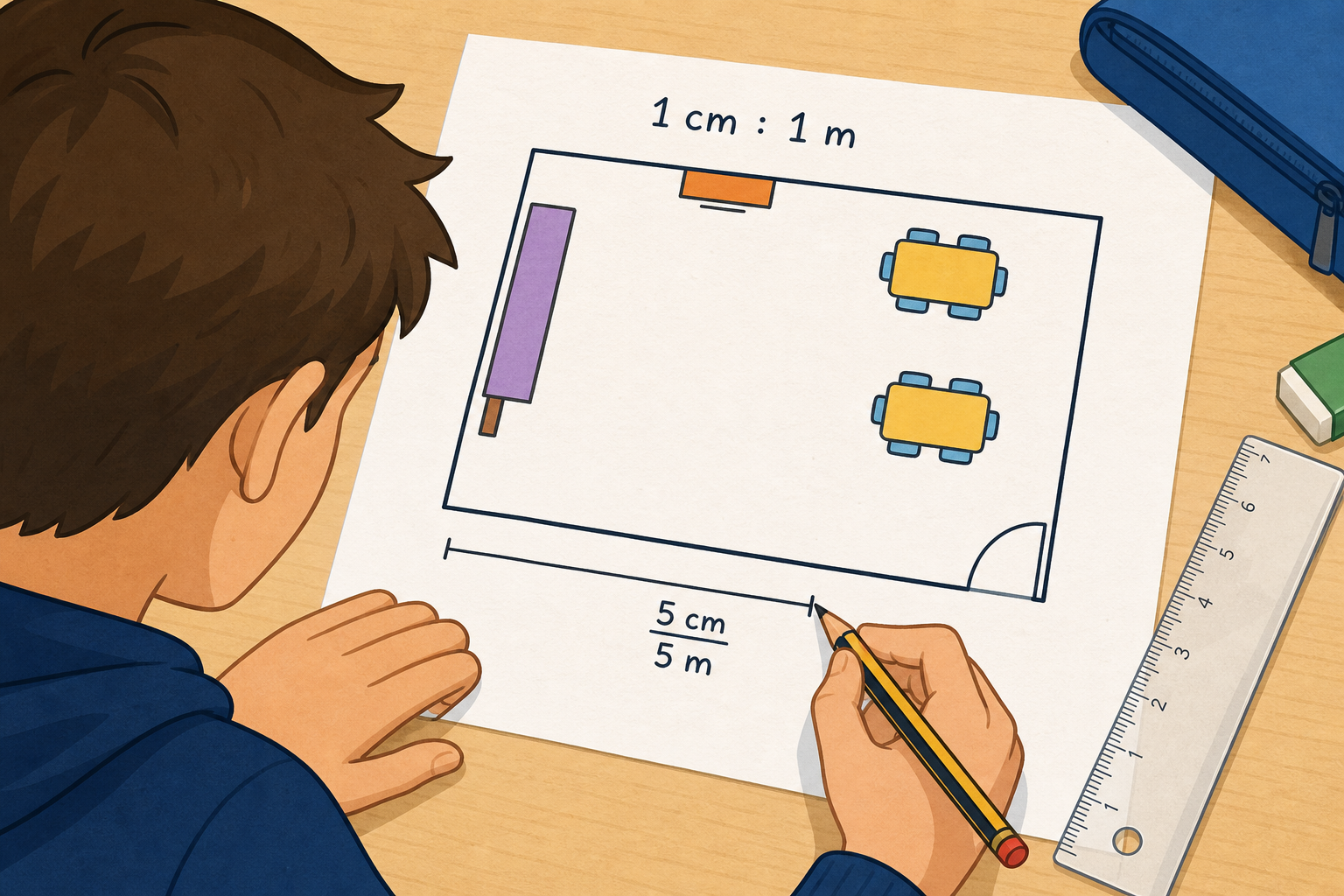
    Watch as we sketch it at one to one hundred. The scale 1:100 means one cm on the page stands for 100 cm, which is one metre, on the ground. The plan is 5 cm by 3 cm, so the real classroom is 5 m by 3 m.

    Now a treasure map

    Here one cm on the page stands for 10 m. Ten metres is 1,000 cm, so this is the same idea as a colon ratio of 1:1,000. A route that runs four squares long means 4 × 10 = 40 m of real walking.

    Here's a real Ordnance Survey map

    The rule

    This map is drawn at 1:50,000, so one cm on the map stands for 50,000 cm, which is half a kilometre, on the ground. The numbers are huge, but the rule never changes: paper length × scale number = real length. Before we check together, can anyone tell me how far 2 cm on this map would be in real life?

    3 - Try It Together ~8 mins

    Today we work through this together: convert each wall of a real classroom into a plan at 1:100. We measure a wall in real life, divide by the scale, and write the paper length. Then we sketch the plan on the board as a class.

    Classroom plan at 1:100, Wall A (the 6 m wall)

    4 - Sketch a Scale Plan in Your Copy ~3 mins

    COPYBOOK MOMENT

    In your maths copy, sketch a scale plan of the classroom we just worked through at 1:100 — one cm on the page stands for 100 cm, which is one metre, in real life. Label each side in both paper units (cm) and real units (m), and write the scale (1:100) clearly above your drawing.

    5 - Class Challenge ~9 mins

    Going outside

    Groups of four or five, one metre stick, copybook and pencil per group. Work wherever your school has a long wall — corridor, hall, covered area, or the classroom itself. Before the lesson, choose one long wall for each group to measure.

    Materials

    • metre stick
    • copybook
    • pencil

    Plan

    1. Measure the long wall in metres with the metre stick. Write the real length in your copy. Change the real length to centimetres, then divide by 100 to find the paper length at 1:100. Write it down. Sketch a plan of the wall, labelling it in both paper units (cm) and real units (m), with the scale (1:100) written above. Back at your seat, read a labelled scale plan the other way: multiply each paper length by 100 to find the real length.
    If you can’t go out: indoor alternative

    If you cannot use a corridor or hall wall, run the same measure-divide-draw task on the longest classroom wall instead.

    6 - What Did We Notice? ~2 mins

    MATHS TALK

    Why do mapmakers use scale at all? What would go wrong if we tried to draw every map at full size?

    7 - What's Next ~3 mins

    Key Takeaways

    • A scale ratio such as 1:100 links a paper length to a real length: one paper unit stands for that many real units.
    • A verbal scale like '1 cm = 10 m' is the same idea as a colon ratio (1:1,000) once both lengths are in the same unit.
    • Real to paper: match the units, then divide by the scale number.
    • Paper to real: multiply the paper length by the scale number.
    • Every line on a scale drawing should carry both its paper length and its real length.

    Coming Up

    Coming up

    Next we turn our data-handling skills to drawing and reading bar charts, turning a tally of real class data into a chart we can read at a glance.

    Pupil practice
    Module 7 · Data, Chance and the Co-ordinate Plane Data & Chance
    Lesson 88 · Scale Drawings and Scale Maps: Small Drawings of Big Things
    Download Activity Book page (PDF)
    End of lesson
    123learn · Online learning platform

    Unlock the full learning experience

    You're previewing this lesson. Get full access to this lesson and hundreds more — each one ready to teach, with interactive activities, printable resources and pupil progress tracking built in.

    Hundreds of curriculum-aligned lessons
    Interactive activities in every lesson
    Printable resources & progress tracking
    Copyright Notice
    This lesson is copyright of 123Learn.ie 2017 - 2025. Unauthorised use, copying or distribution is not allowed.
    🍪 Our website uses cookies to make your browsing experience better. By using our website you agree to our use of cookies. Learn more
