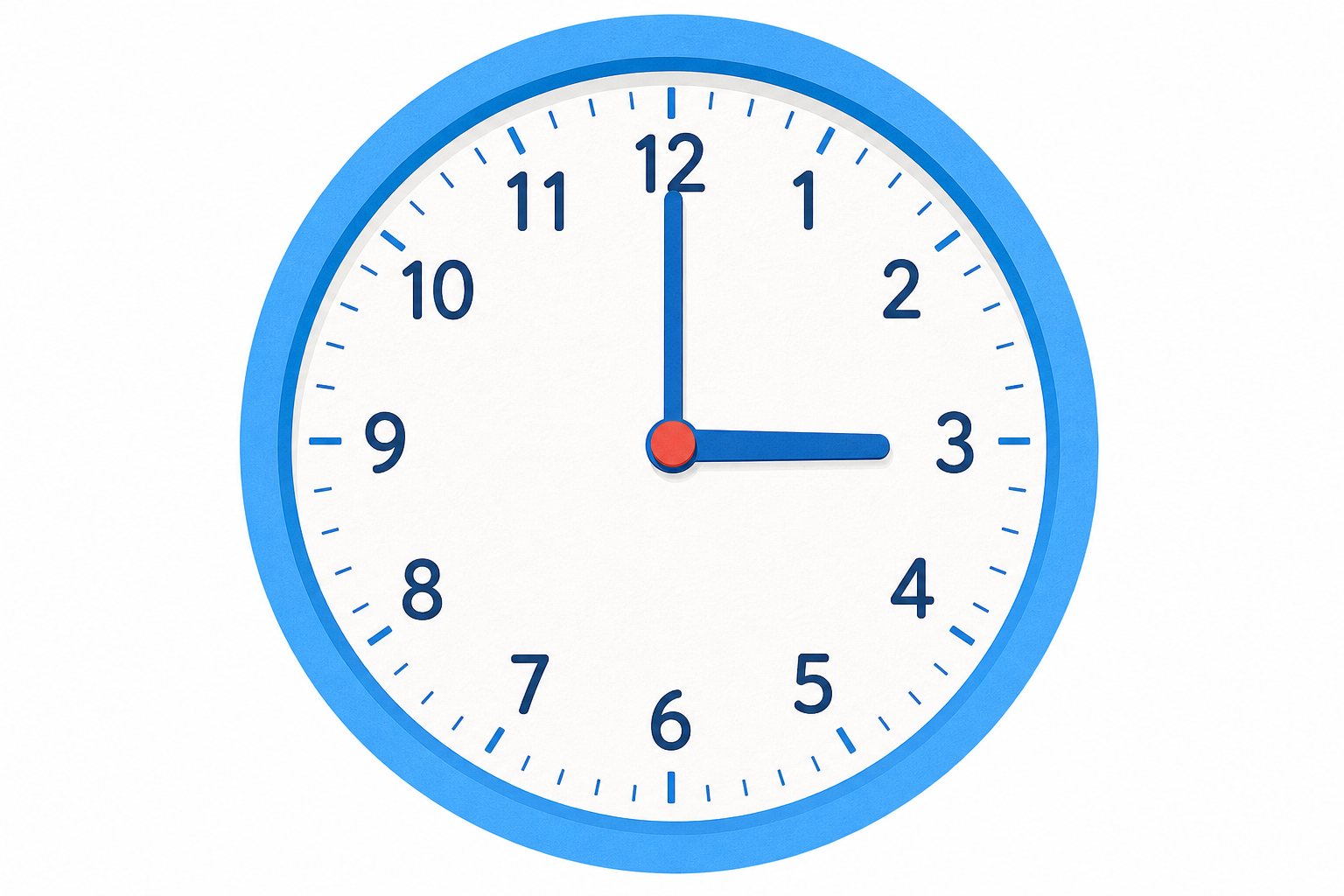
Look at the big clock on the board. It is showing 3 o'clock right now. The two hands are doing very different jobs. One of them is telling you the hour, and one of them is telling you the minutes.
Hands up: which hand do you think moves the fastest around the clock face, and which one tells us the hour?
Display a clock face showing 3 o'clock as pupils settle. Take three hands-up answers, not open call-outs. Give five seconds of quiet think-time before any hands go up.
You are listening for the idea that the long hand moves fast (a full lap in an hour) and the short hand moves slowly and tells the hour. Don't confirm yet — that is what Watch and Notice unpacks.
Watch the clock. The long hand points straight up to the 12 and the short hand sits right on the 2. When the long hand is straight up, we say o'clock, and the short hand tells us which hour.
Quick check: which number is the long hand pointing at?
Now the long hand has swung halfway round and points straight down to the 6. The short hand has crept halfway between the 4 and the 5. This is half past 4.
Quick check: is the short hand exactly on the 4, or in between two numbers?
This time the long hand has travelled a quarter of the way round the face, from the 12 to the 3. A quarter means one of four equal parts, so the long hand has gone one part of the way round. The short hand has only just moved past the 6. This is quarter past 6.
Quick check: how far round has the long hand gone, one part or all four?
Here the long hand is on the 9, near the top again, with only a quarter of the face left to go. The short hand is nearly at the 9. This is quarter to 9, because the short hand is heading to the 9.
Quick check: which hour is the short hand reaching towards?
Walk each clock aloud, one at a time, pointing at the long hand first, then the short hand. After each clock, take the on-screen Quick check question with two hands-up answers so the room stays with you rather than watching four in a row in silence.
The quarter to case is the one pupils most often misread — they say the hour the short hand has just left, not the one it is reaching.
No-IWB fallback: if the digital tool is unavailable, set each of these four times on a geared demonstration clock and hold it up, or show pre-set printed clock faces in the same order.
Today we work through these landmark times together on the board: 7 o'clock, half past 10, quarter past 3, and quarter to 5. We re-set the same clock for each time, dragging the hands to show it, then check the short hand and the long hand are both in the right place before we move to the next time.
This round is for talking it through together — pupils take turns at the board and the class agrees or corrects out loud. The same explore clock is re-dragged for all four times, so reset it between each.
Call a landmark time, then send one pupil to the board to drag the hands. Before they finish, ask the class aloud: 'where should the long hand point? where should the short hand sit?'
Rotate four pupils across the four times. Watch for the half-past slip where pupils leave the short hand exactly on the hour number instead of halfway to the next.
No-IWB fallback: pupils set a geared demonstration clock at the front, or each shows the called time on a printed clock face with split-pin hands.
In your maths copy, draw four blank clock faces. Show a different time on each one: o'clock, half past, quarter past and quarter to. Underneath each clock, write the time in words.
Walk the room glancing at the hands — is the long hand straight up for o'clock, straight down for half past, on the 3 for quarter past, on the 9 for quarter to? This is whole-class copybook practice, not marking.
Printable support: for pupils who find drawing an even clock face hard, hand out a printed blank clock face (numerals already on it) so they only need to add the hands and write the time underneath.
Now we work through these times one at a time on the board: 5 o'clock, half past 8, quarter past 11, and quarter to 2. For each one, set the hands.
Check before we move on: is the short hand exactly on the number, or has it moved past it?
This round is the practice bank — pupils take turns at the board, check each answer, and the class confirms before moving on. Keep the board work brisk rather than over-explaining.
For each time, ask aloud the check question now shown on screen: 'is the short hand exactly on the number, or has it moved past it?' The half-past and quarter-to cases are where the short hand sits between numbers. Press Check after each so the class sees the ✓.
No-IWB fallback: call each time and have pupils set it on a geared demonstration clock or a printed clock face, with the class confirming yes or no.
How does the short hand tell us the hour, even when the long hand is pointing somewhere else? Think about quarter to 2 — the short hand was nearly at the 2, but not on it.
Listen for pupils who name the short hand as creeping between numbers rather than jumping. Revoice a strong answer: 'so the short hand is on its way to the next hour, and where it sits tells us how far through the hour we are'.
Head off the quarter-to misconception: at quarter to 2 the short hand is almost at the 2, so we say the hour it is heading to, not the one it has just left.
Next we will read the clock more closely, counting round the face in fives to tell the time at every five-minute mark.
Pupils now move to the Activity Book page for 10–15 minutes of pencil-and-paper practice while you circulate.
You're previewing this lesson. Get full access to this lesson and hundreds more — each one ready to teach, with interactive activities, printable resources and pupil progress tracking built in.