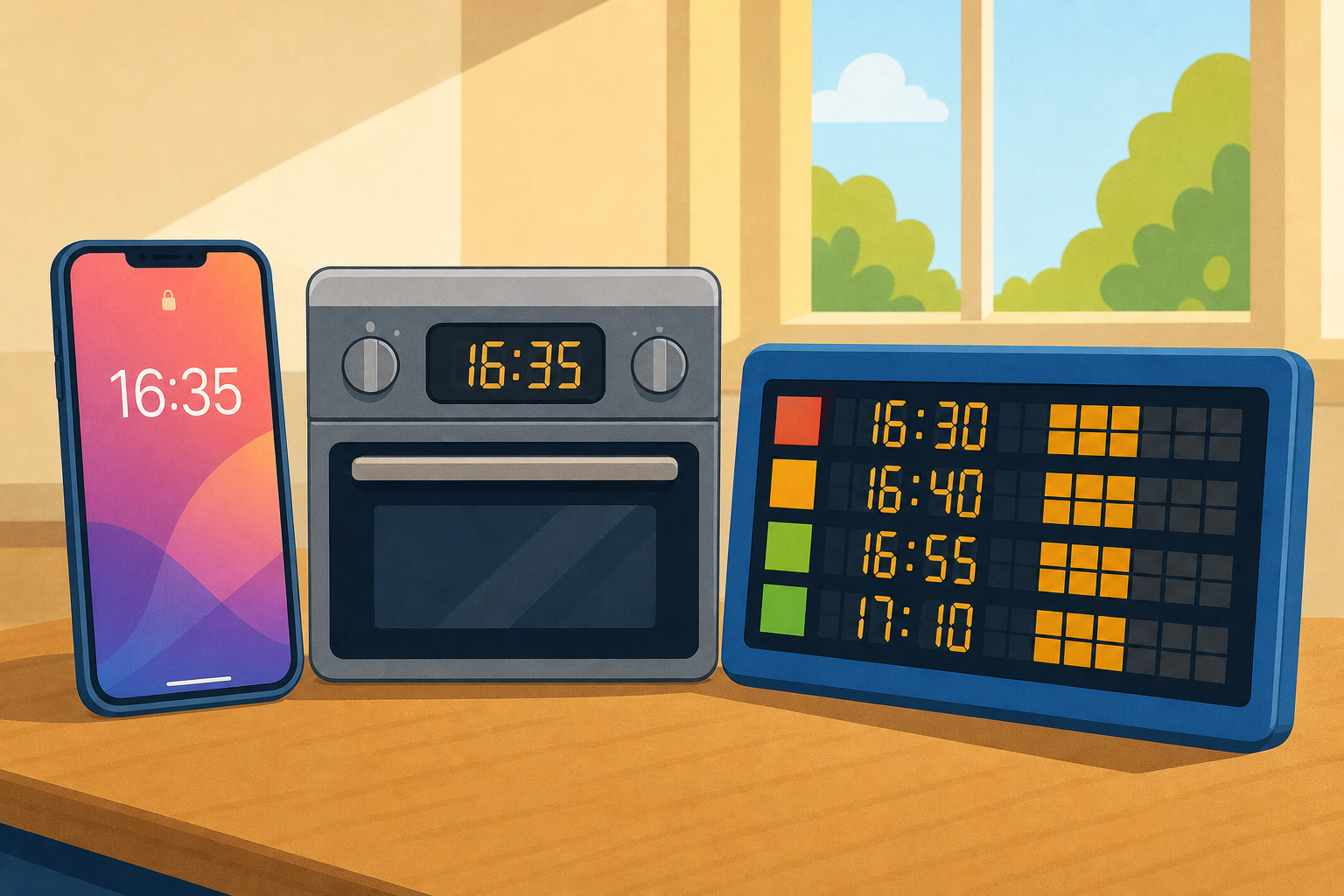
A phone, an oven and a bus screen all show times in a way that might look a little strange. One of them reads 17:30. What time of day do you think that is? Is it morning, afternoon or evening?

Talk it out: how could you check whether 17:30 is breakfast time or teatime?
Take two or three hands-up answers; don't confirm yet. Listen for pupils who already know to subtract 12 (17 take 12 is 5, so it's 5 in the afternoon) and revoice that as the idea the whole lesson builds toward.
Watch the clock show 9 o'clock in the morning. On the 24-hour clock this is 09:00. Morning hours stay exactly the same.
Now watch the same clock show 3 o'clock in the afternoon. Here we add 12: 3 + 12 = 15, so this is 15:00. After midday the hours keep counting on instead of starting again at 1.
Watch the clock show half past two in the afternoon. We add 12 to the hour: 2 + 12 = 14, and the minutes stay as :30, so this is 14:30. The minutes never change, only the hour.
Walk the three clocks one at a time. For the first, point to the digital readout and say nine in the morning stays nine — 09:00. For the second, point to the hands at 3 and to the readout showing 15:00, and say the rule aloud: afternoon and evening hours add 12, morning hours stay the same. For the third, stress that only the hour changes: 2 becomes 14, but the half-past stays half-past — 14:30. Link 12:00 noon and 00:00 midnight on the face: the count rolls over to 0 at midnight.
Today we find the matching 24-hour time for everyday times together. The 24-hour partner just means the matching 24-hour time, not a person you team up with.
We will work through these three times together. For each one, we set the hands and then decide what it looks like on the 24-hour clock:
This round is for talking it through together — pupils take turns at the board and the class agrees or corrects out loud.
Name each time in words (ten in the morning, then half past four in the afternoon, then six in the evening), have one pupil set the hands, then ask the class to predict the 24-hour readout before the digital display confirms it. Watch for pupils adding 12 to morning times by mistake — head it off by asking morning or afternoon? first. The half-past four example reminds them the minutes stay the same and only the hour changes.
In your maths copy, rule a two-column table. On the left write the 12-hour time; on the right write its 24-hour partner. Fill in these four:
Remember: morning times stay the same, and afternoon or evening times add 12.
Walk the room glancing at the right-hand column — watch for pupils adding 12 to 8 a.m. by mistake. This is whole-class copybook practice, not marking.
Today we work through these 24-hour times together: 07:00, 13:00, 18:30 and 21:00. For each one, decide whether it is a morning time that stays the same or an afternoon time where 12 was added, then set the clock to match.
To go from a 24-hour time back to a p.m. time, we take 12 off the hour. For example, 18:30 is in the evening, so 18 − 12 = 6, which is half past six in the evening (6:30 p.m.). The minutes stay as :30.
This round is the practice bank — pupils take turns at the board, check each answer, and the class confirms before moving on. Keep the board work brisk rather than over-explaining.
For each target, ask is this a morning time that stays the same, or an afternoon time where we take 12 off? before a pupil sets the hands. 13:00 catches people out (one o'clock, not three) and 18:30 needs 18 take 12 = 6, half past six in the evening. Let the on-screen Check confirm each one — use the ✓ as part of your narration (yes, that's it).
Why do timetables and phones often use the 24-hour clock instead of a.m. and p.m.? What mix-up does it stop from happening?
Listen for pupils naming the a.m./p.m. confusion — you could turn up twelve hours early or late. Revoice a strong answer: so 7:30 could be breakfast or teatime, but 19:30 can only mean one thing. Connect back to the bus screen from the hook.
Next we look at the units of time and how seconds, minutes, hours, days and weeks pack neatly into one another.
Recap the add-12 and take-12 rules with one quick example each before moving on.
You're previewing this lesson. Get full access to this lesson and hundreds more — each one ready to teach, with interactive activities, printable resources and pupil progress tracking built in.