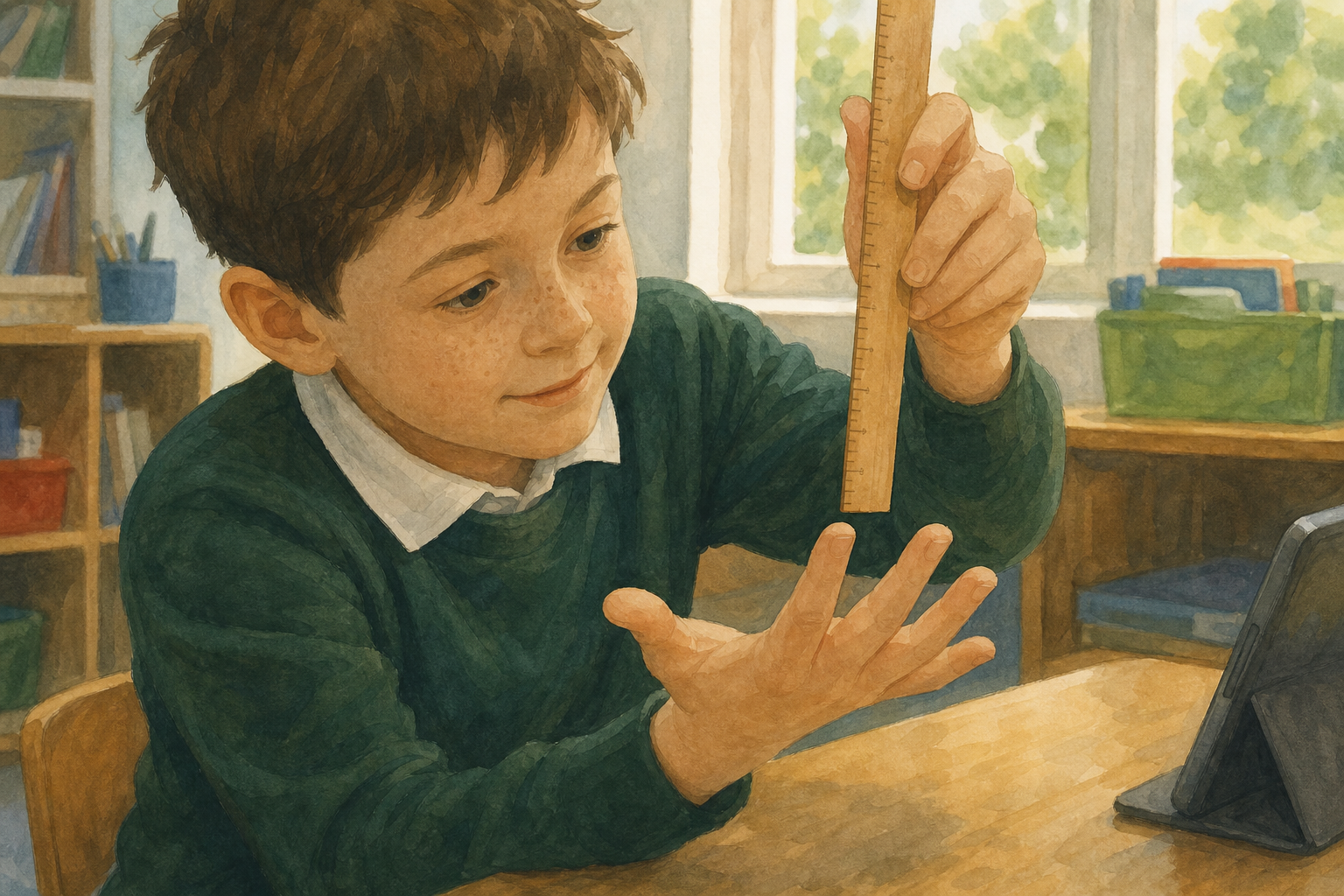
Hold out your hand, ready to catch. I am going to drop a ruler between your fingers with no warning. Do you think you can catch it before it hits the ground?
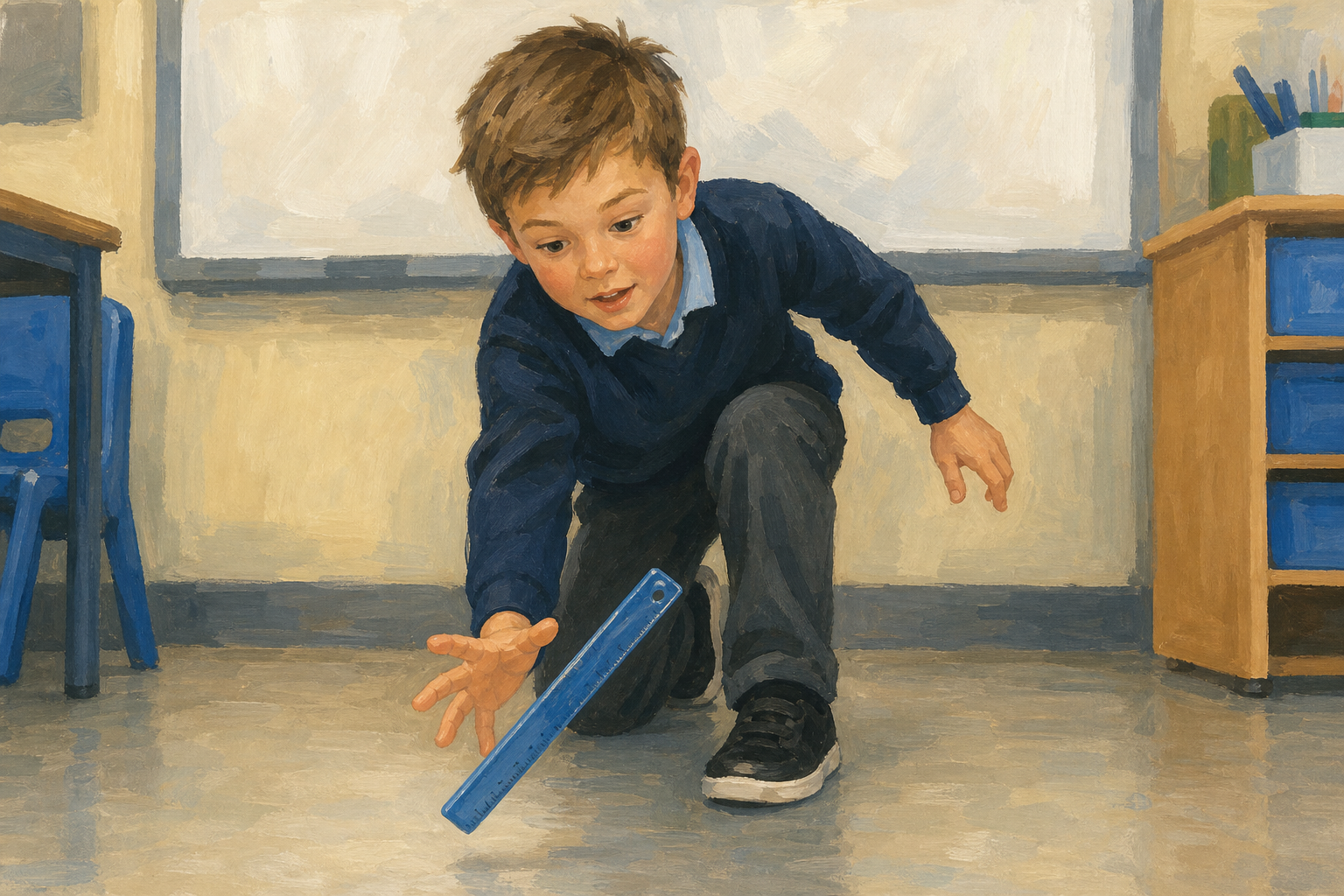
How quickly can your body react to something it sees? Hands up your guess: do you think you will catch the ruler near the top, near the middle, or not at all?
Keep this light. Drop a ruler once between one volunteer's fingers to spark the wonder, then take a few quick guesses. How fast can your body react to what it sees?
Do not explain the method or set up the test yet. Have one ruler in hand for the demonstration drop.
When the ruler falls, your eyes see it move. They send a message racing along your nerves to your brain. Your brain decides "close your fingers!" and sends a message back to your hand. All of that happens in less than a second. That tiny gap is your reaction time.
Some reactions are so fast your body acts before your brain has even thought about it, like pulling your hand back from a hot pan. These are called reflexes, and they happen automatically to protect you.
| Concept | Why it matters | Example |
|---|---|---|
| Stimulus — something your senses pick up | Your brain reacts only once your senses notice it | The falling ruler your eyes spot |
| Reaction time — the gap between spotting it and reacting | A faster reaction lets you catch or stop sooner | Catch the ruler lower down for a quicker time |
| Reflex — a reaction so fast you do not think about it | Reflexes protect you before you can decide | Blinking when something flies near your eye |
This table is the children's on-screen content. Reveal it one row at a time, reading each row aloud and pointing at the body as you go: eyes see, message to brain, brain decides, message to hand. The full definitions are in the prose above, so the table cells are kept short as quick cues.
Head off a common mix-up: a slower catch does not mean someone is bad at it. Reaction times vary and they get faster with practice and full attention. Note for yourself: the hot-pan reflex is actually so fast because the signal travels through the spinal cord, not all the way to the brain to decide. Keep this simple for the class: the body just acts automatically to protect itself.
Let's watch one full test together before your group runs your own. I will think out loud at every step so you can do the same.
I wonder how far the ruler will fall before I can catch it. I predict it will fall about the middle before my fingers snap shut. Now I rest my hand at the bottom of the ruler, a partner lets go with no warning, and I catch it. I observed that I caught it near the 15 cm mark. So I think my reaction was quick, but a lower catch would have been even quicker.
Demonstrate the full cycle in front of the class with a volunteer dropping for you: predict out loud, catch, read the centimetre mark where your top finger gripped, then say a conclusion. Model all four beats: I predict... I test... I observed... I think... so groups copy the whole pattern, not just the catch.
Show how to hold the ruler so the 0 cm end is at the bottom, between the catcher's open fingers, without touching it.
Also model finding the group's figure: catch three times, read the three centimetre marks aloud (for example 16, 12, 14), and show that the middle value is 14 (the one between the smallest and largest). The group reports just one middle value for each condition. Keep it to the middle of three, not adding and dividing.
The whole class will test the same one thing: catching with your eyes ready against catching while a partner is distracting you by talking. Predict which one will give a faster catch and say why.
In your group, each person has three turns catching with eyes ready, then three turns while being distracted. Read the centimetre mark where the top finger grips and write each one on your Investigation Journal page. Keep everything else the same: the same ruler, the same dropper, the same starting position. For each condition, find the middle value of your three catches the way we modelled, ready to share one figure per condition.
The whole class tests the same single comparison (eyes ready vs distracted) so that everyone's data can be pooled fairly on one chart. Groups of three or four work well: one catches, one drops, one reads and records, then they swap.
Circulate while groups set up. Remind droppers to give no warning and to release cleanly. For each condition, each catcher finds the middle value of their three catches (the one between the smallest and largest). To get one group figure per condition, take the middle value of the catchers' middle values, or simply share each person's. Keep the dropper, ruler and start position the same so it stays fair.
Let's gather everyone's results so we can compare across the whole class. Because every group tested the same two conditions, we can add them together. We will type the class middle value for eyes ready and the class middle value for distracted into the table on the board, then turn it into a bar chart.
The shorter the bar, the faster the reaction. Look at the two bars together: which condition gave the lower catch distances across the class?
Drive the data-recorder on the IWB. Two columns appear: Condition and Catch distance (cm). Collect one middle value per condition from each group as you go round, then enter just two rows for the class: Eyes ready and Distracted, using the middle (or roughly typical) value across the groups for each. Tap to show the bar chart.
Each row becomes one bar. Ask the class to read the chart: which bar is shorter? what does a short bar tell us about reaction time?
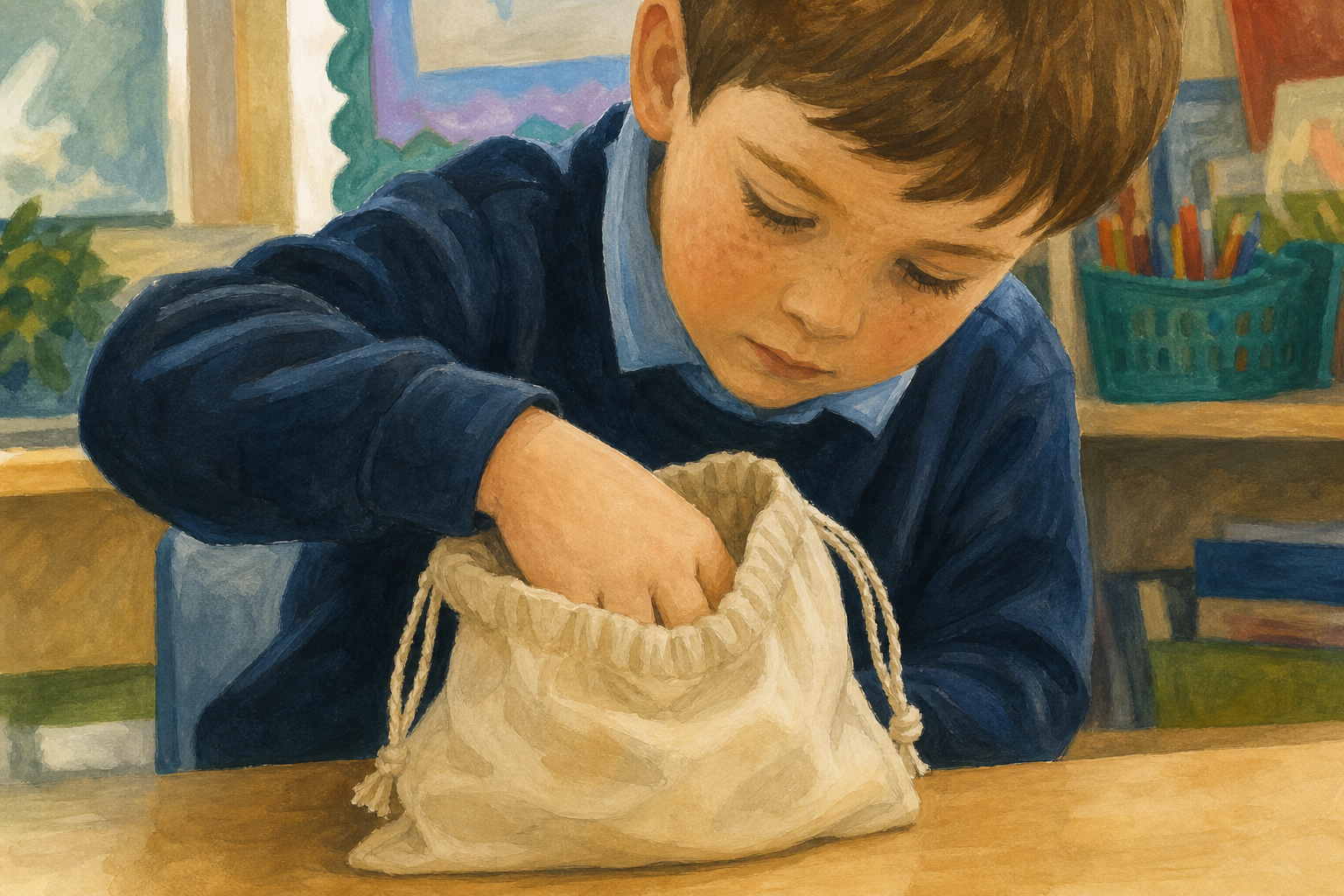
Your brain also reacts to touch. Without looking, reach into the feely-bag and feel the object with your fingers only. What do you think it is? Say what it feels like first: hard or soft, smooth or rough, round or pointy. Then say your guess before you pull it out to check.
How does your brain work out what something is using only touch?
Have each group's feely-bag holding 3 or 4 safe everyday objects (a conker, a smooth pebble, a wooden block, a sponge). Pupils take turns: feel, describe, guess, then reveal. Keep it brief and observational.
Draw out that the brain takes in information from touch, not just sight, and reacts by naming the object. This is the second sense test alongside the ruler catch.
Let's talk about what the class results showed. Look back at the chart. Which condition gave the faster catches? Did being distracted slow people down?
Why does a quick reaction time matter for safety? Think about catching a glass before it falls, or stopping at a red light while cycling.
Display-only science-talk. Revoice pupil findings against the chart. Most classes find distraction slows reactions. That is a real result.
Connect to Irish life: reaction-time research helps make roads and sport safer, which is why drivers are warned not to use phones at the wheel.
Today you found out how your brain reacts to what your senses pick up:
Quick recap to close. Ask one pupil to name the stimulus in the ruler test and one to give an example of a reflex.
Hands-on homework: ask the children to try the touch-only game at home with an adult, feeling three objects in a bag, and to note one in their journal.
You're previewing this lesson. Get full access to this lesson and hundreds more — each one ready to teach, with interactive activities, printable resources and pupil progress tracking built in.