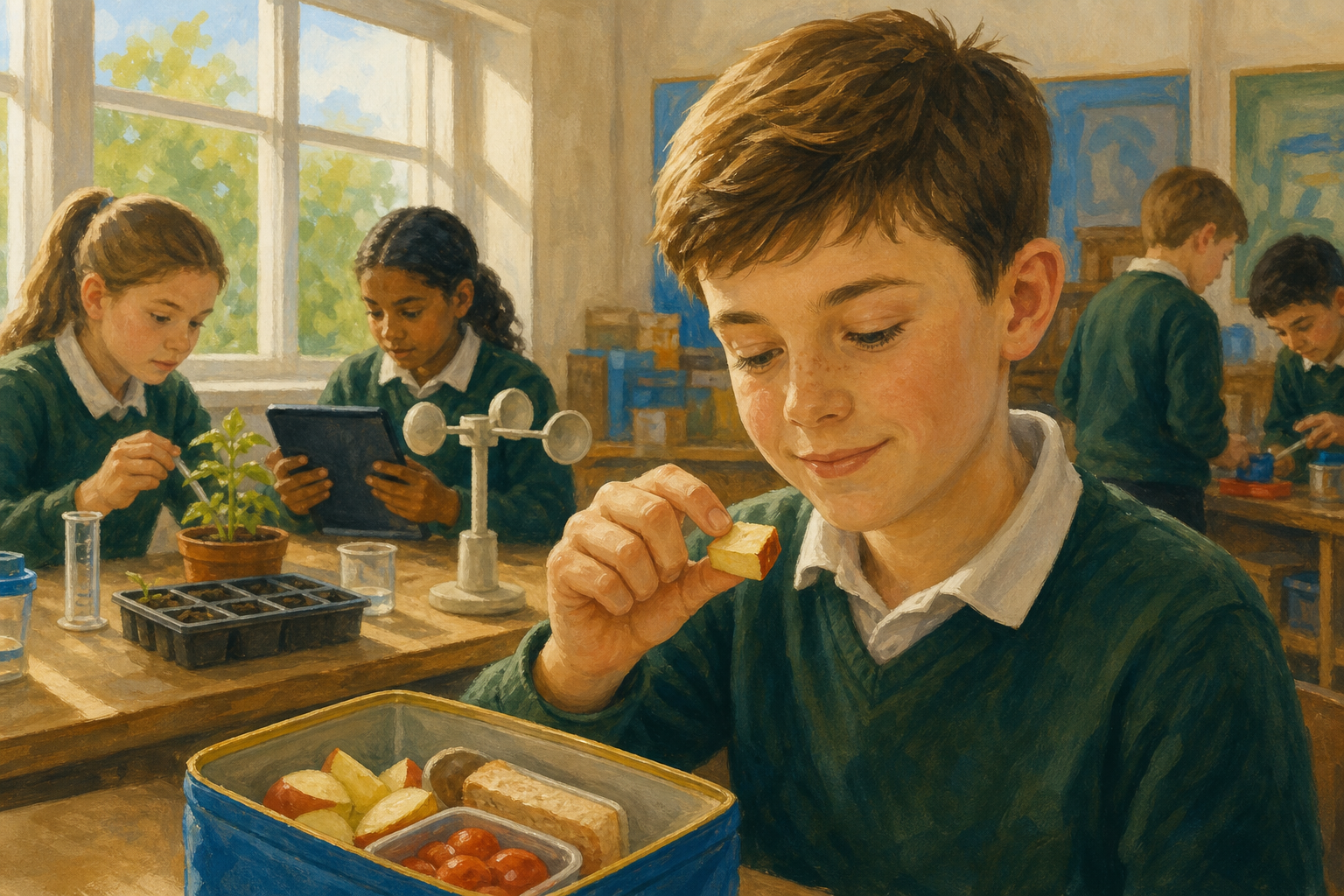
When you swallow a bite of your lunch, where does it go next? And how does your body push it along, even when you are lying down or doing a handstand? Today we are going to follow a piece of food on its long journey through the body.
Hands up: how long do you think the whole food tube inside you is, if you stretched it out? Make a guess before we find out.
Keep this light. Pose the question and take a few guesses about the length of the gut (it is several metres in an adult). Don't reveal the answer yet, the gut rope in the next step does that.
Ask 'How does food keep moving even when you lie down?' to plant the idea of peristalsis without naming it.
Food takes a one-way journey through your body. Here are the two big ideas we will explore today, and the job each part does along the way.
| Concept | Why it matters | Example |
|---|---|---|
| Digestive system — the team of body parts that breaks food down on a one-way journey so your body can use it | Your body cannot use a whole sandwich, it has to break the food into tiny pieces it can soak up | A bite of apple goes mouth, then food pipe, then stomach, then small intestine, then large intestine |
| Peristalsis — the squeezing waves of muscle that push food along the gut | This is why you can still swallow when you lie down, the muscles squeeze the food onward, gravity is not needed | Squeezing a soft ball along a stretchy tights tube pushes it from one end to the other |
The parts of the journey, in order, with a quick word for the job each one does:
| Part | Its job |
|---|---|
| 1. Mouth | Chew |
| 2. Food pipe (oesophagus) | Squeeze down |
| 3. Stomach | Mash |
| 4. Small intestine | Soak up the goodness |
| 5. Large intestine | Take the water out |
You will read the fuller job on each organ card when you build the gut rope.
These tables are the pupils' on-screen content. Read the concept table carefully, then run quickly down the short jobs table (one verb each) so pupils get the shape of the journey without being front-loaded. The fuller detail lives on the printed organ cards pupils read on the floor in the next step. Head off the common idea that food falls down by gravity: peristalsis squeezes it along, so it works upside down too.
Model the thinking aloud as a think-aloud demonstration before pupils do their own: 'I wonder how food gets all the way down. I predict it gets squeezed, like toothpaste. Let me test it by squeezing this ball through the tights tube. I observed the ball moved even when I tipped the tube upwards. So I think the gut muscles squeeze food along, gravity is not the boss.'
The printed organ cards carry the one-line job for each part (mouth: teeth chew the food and saliva softens it; food pipe: peristalsis squeezes it down; stomach: churned and mashed into a soupy mush; small intestine: the goodness/nutrients are soaked up; large intestine: water is soaked out of the leftover waste), so pupils can describe what happens at each part without guessing.
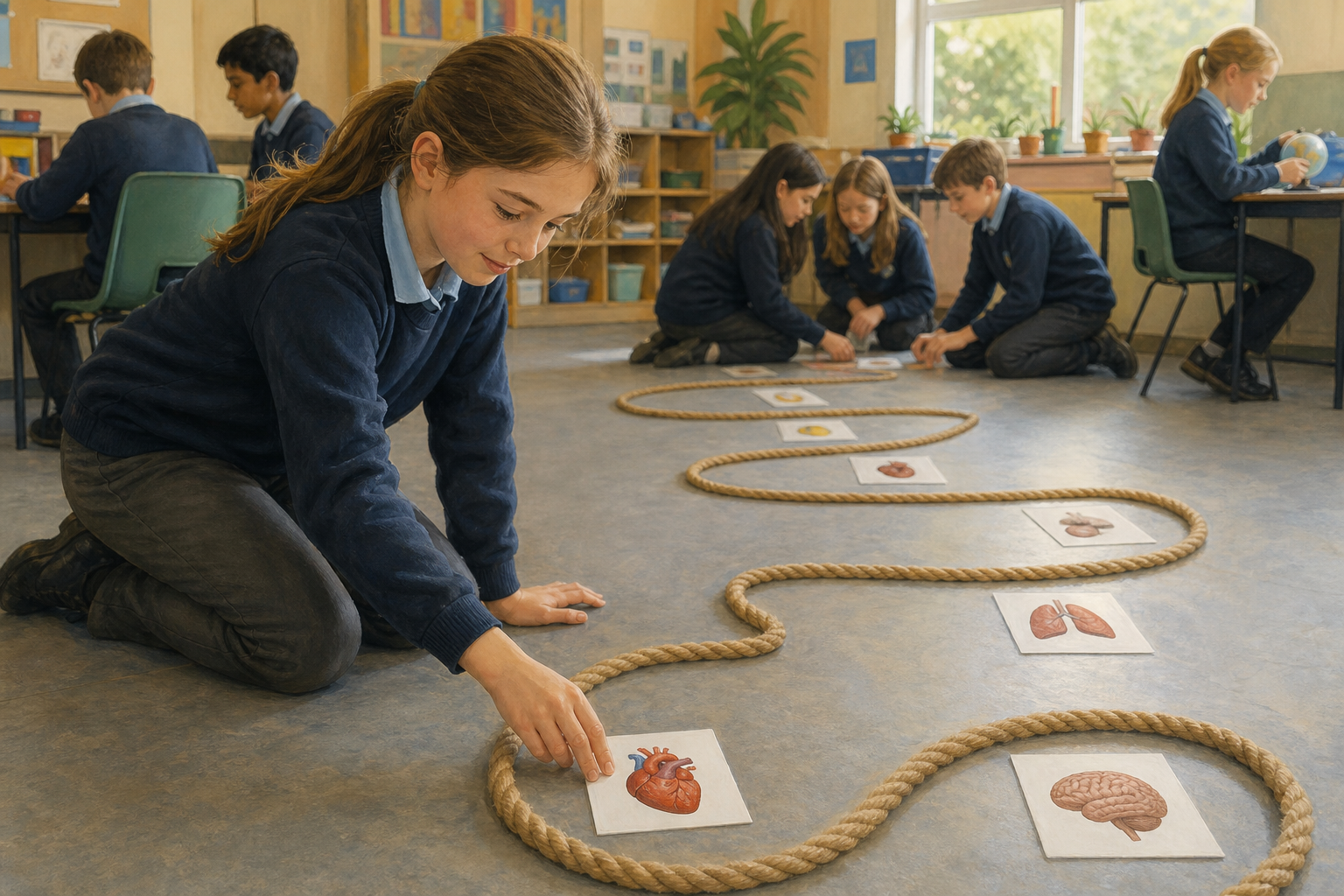
Now let's build the journey on the floor. We will stretch a long rope across the room, that rope is your gut, all stretched out straight. In your groups, place each organ card along the rope in the right order, starting at the mouth and ending at the large intestine.
Your group has two jobs. First, before you check the order, make a quick prediction together: which part do you think the food spends the most TIME in? Think about which part has the biggest job to do. (Hint: the stomach mashes food into a soupy mush, and the small intestine is very long and folded.) Say your prediction out loud, then test your idea as you place the cards and read each job.
As you place each card, read the job written on it and say out loud what happens to the food there: where is it chewed, where is it mashed, where does the body soak up the goodness?
Second, whether your group has its own rope or you all share one class rope, every group still does the squeezing test: push the soft ball through the tights tube to show peristalsis, then tip the tube upward and squeeze again to show the food still moves even when it is not falling down.
This runs as parallel group work (groups of 4–5), each group with its own rope, card set and peristalsis prop. Decide before the lesson: a 5m rope laid straight per group needs real floor space, so count your likely groups against your cleared floor area first. If 6–7 groups each need a straight 5m rope and the room won't take it, run one shared whole-class gut-rope build instead and still give each group a tights tube and ball so every group does the peristalsis demo. The pupil-facing description now names the peristalsis demo as a group job in both routes, so no group is left idle during a shared build.
Before: push back desks to clear as much floor as you can; print the provided organ cards (one set per group). Each card carries the part name and its one-line job.
Tights fallback: keep two or three spare tights legs (or long socks) in your kit so any group without one is covered; a tube of stretchy fabric works just as well.
Drive the science-talk as groups work: 'What happens to food in the stomach? Why is the small intestine so long and folded?' Look for groups ordering by the job each part does, not by guesswork. The expected answer to the prediction is the small intestine, because food spends the longest time there being soaked up; accept and praise reasoned predictions even if the guess differs.
Differentiation: give a struggling group the first and last cards already placed.
You already have the order right from the floor, so this is not about ordering again. The five cards (mouth, food pipe, stomach, small intestine, large intestine) appear with arrows linking them. The new challenge: for each link, explain why does this part come AFTER the one before it? What job did the part before do that has to happen first?
There is more than one good way to answer, so don't worry about getting the exact words right. Any sensible reason counts. Before we confirm each card, call out the job of that part and a reason it follows the one before. We will say it out loud together as the arrows light up.
Drive the interactive on the IWB as a reasoning check, not a fresh re-build, so pupils don't feel they are repeating the floor task. The five cards are mouth, food pipe, stomach, small intestine, large intestine, joined left to right by arrows labelled 'food moves to'. For each arrow ask 'why does this part come AFTER the one before it? What job had to happen first?' (e.g. food must be chewed in the mouth before it can be squeezed down the food pipe; it must be mashed in the stomach before the small intestine can soak up the goodness). This makes pupils justify the order rather than just rebuild it. Keep it low-stakes: reassure pupils that several reasons are fine and accept any sensible answer, so the harder reasoning question does not feel like a test. Fold in pupils not at the board with 'are they right? what would you say comes next and why?'
Let's talk about what we found. Where did your group think the food got mashed up? Where does the body take in the goodness from the food?
And here is the big one: how does food keep moving when you lie down or stand on your head? What did the ball in the tube show us?
Then, in your Investigation Journal, draw the journey of food and label each part in order, with an arrow showing which way the food moves.
Start with a short display-only discussion. Revoice pupil ideas and tie them back to peristalsis: the gut muscles squeeze food along, so gravity is not needed. Confirm the one-way order: mouth, food pipe, stomach, small intestine, large intestine.
Then direct pupils to their Investigation Journal drawing (this is the DrawingRecord): draw the journey of food, label each part in order, and add an arrow showing the direction of travel.
Great work following food on its journey today. Here is what we learned:
Quick recap, read the bullets with the class. Optional home task: ask an adult what they had for dinner and trace its journey through the body in your head. Pack the ropes and tights away safely.
You're previewing this lesson. Get full access to this lesson and hundreds more — each one ready to teach, with interactive activities, printable resources and pupil progress tracking built in.