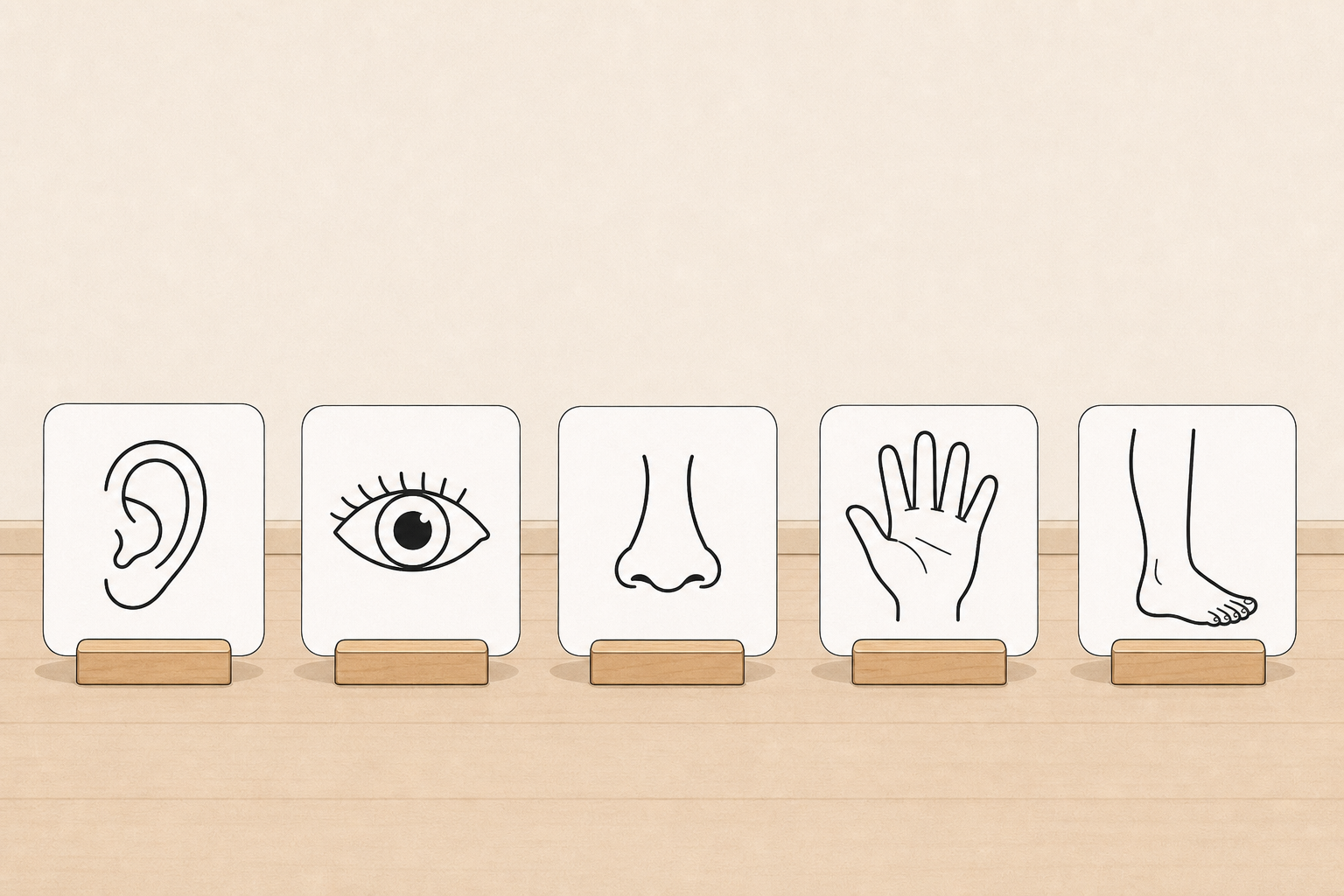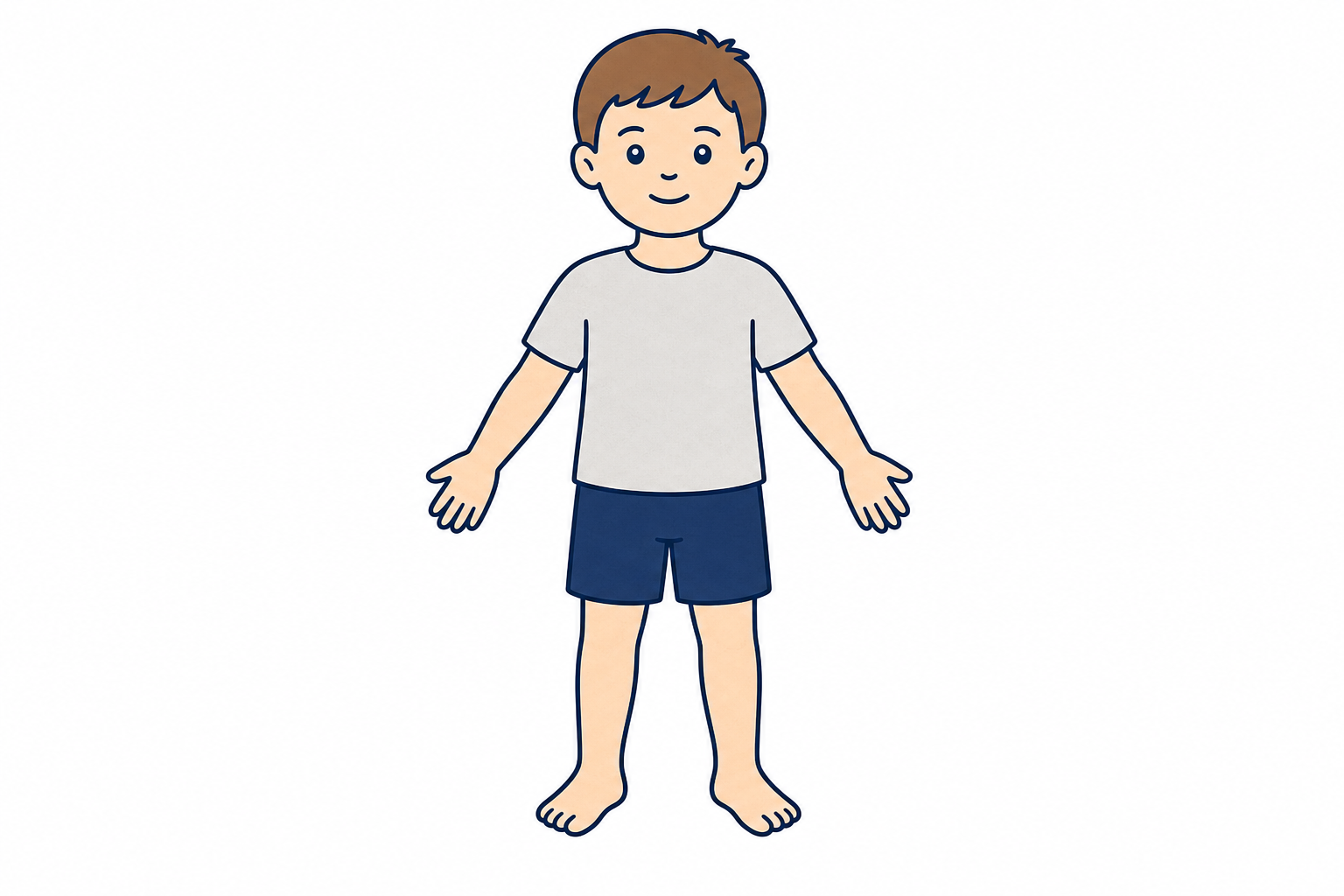
Let's play a little game with our bodies! When I say a job, you do it. Ready? Listen with your ears. Walk on the spot with your legs. Wave with your hands. Sniff a flower with your nose.
Now I wonder... which part of our body did the listening? Which part did the walking? Every part of our body has an important job to do. Today we are going to find out the jobs our body parts do!
Keep this light and playful. Lead the class in the four actions, doing each one yourself first so they copy you. After each action ask "which body part did that job?" and let them call out.
This is just the curiosity hook. The picture cards and sorting come out in the next steps.
Let's go around our action carousel. At each stop, we will mime a job with our bodies and notice which part is doing the work.
First, let's listen for a tiny sound. Which part helps us? Our ears! Now let's walk like we are going to the park. Which part helps us? Our legs! Let's look closely at something far away. That is our eyes doing their job. Let's smell a lovely dinner. That is our nose. And let's hold a pencil. That is our hands.
Run this as short bursts, not one long sitting. Call out one job at a time and let the class mime it together. After each mime, ask "which body part did the job?" and point to that part on your own body.
Pass the small mirror around as you go so a few children can watch their own eyes blink or their nose wrinkle, spotting the body part doing the work in their own reflection.
Watch for children who say the wrong part (e.g. "we walk with our hands"). Gently guide: "let's try walking with our hands... no! It is our legs that do walking."
This step models the noticing the children will need for the sorting that follows.
Every body part has an important job. Our ears help us hear sounds. Our legs help us walk and run. Our eyes help us see. Our nose helps us smell. Our hands help us hold and touch things.
When we put a job with the right body part, we say why it goes there. The walking job goes with our legs because our legs do the walking!
This table is teacher-facing. Read each row aloud to the class and point to the matching part on your own body as you go. Use the Example cell as your script.
| Concept | Why it matters | Example |
|---|---|---|
| Ears do hearing — our ears are the part that lets sounds in | Hearing helps us listen to our teacher, our friends and music | Cover your ears and the room goes quiet — uncover them and you hear again |
| Legs do walking — our legs carry us along when we move | Walking lets us go to the yard, to the door and home again | March on the spot and feel your legs doing the work |
| Nose does smelling — our nose lets us smell what is around us | Smelling tells us about dinner, flowers and fresh rain | Sniff near an orange peel and your nose tells you it smells lovely |
| Eyes do seeing — our eyes let us look at the world | Seeing helps us read, draw and find our things | Close your eyes and you cannot see the board — open them and you can |
Misconception to head off: some children mix up the part and the job. Keep linking them: "the job is hearing, the part is ears."
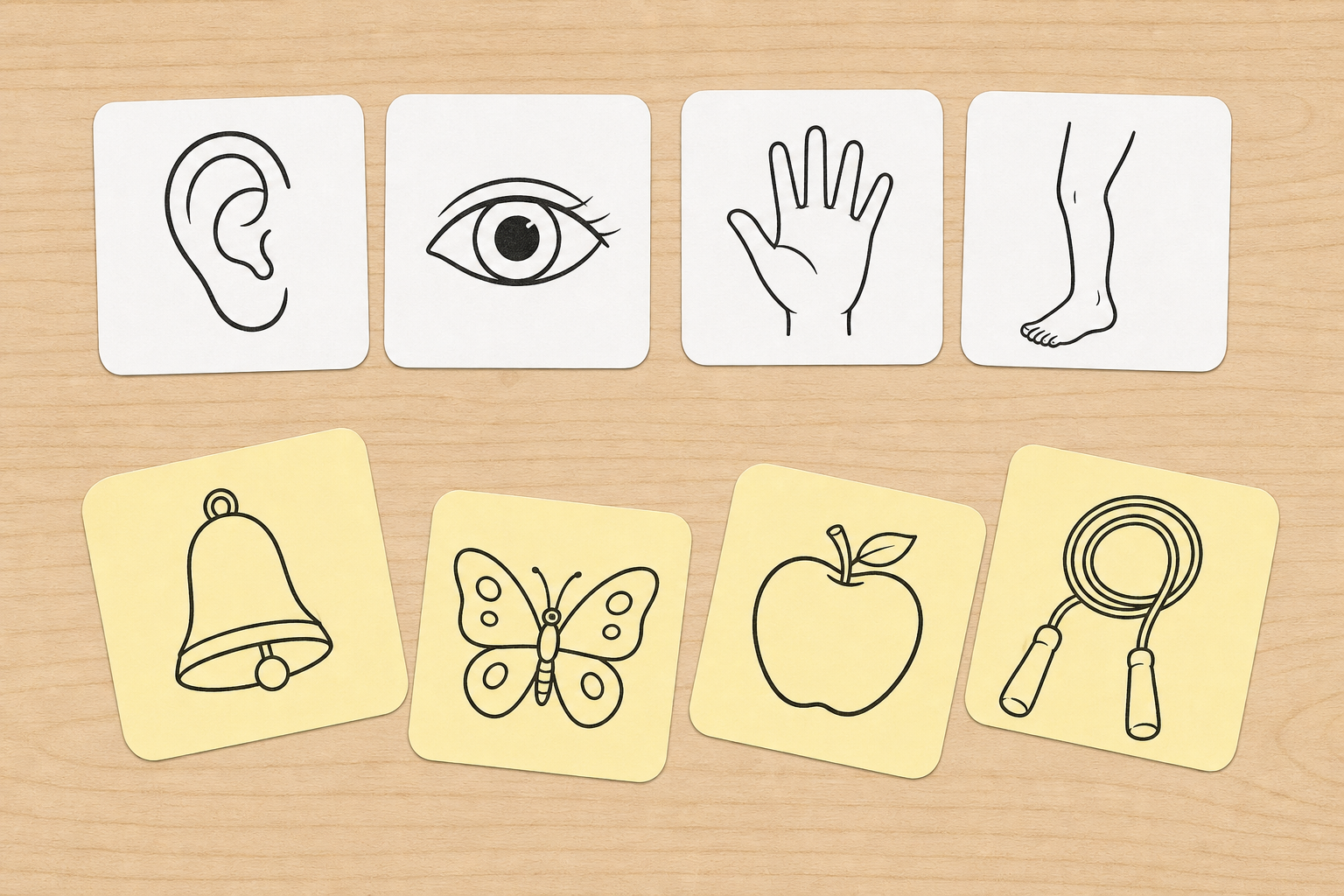
In a moment your teacher will give your group its own set of picture cards, so wait until they are on your table before you start. You will have body-part picture cards (ears, legs, eyes, nose, hands) and job picture cards (a child listening, a child walking, a child looking, a child smelling, a child holding a pencil).
When the cards are in front of you, let's pick up a job card, look at it, and ask: which body part does this job? Then we place it next to the right body-part card. Every time, we say the reason out loud: "The walking card goes with the legs, because legs do walking."
Set up the groups first: split the class into groups of 4–5 children seated around their tables (so roughly 5–6 groups for a typical class). Give each group a set of body-part cards and a shuffled stack of job cards before you begin, so no child is left waiting with nothing to touch.
Model one first: hold up the walking card, think aloud "I see a child walking. Which part does walking? Legs! So this card goes with the legs card, because legs do walking."
Then let groups sort the rest, taking turns. Insist on the reason out loud each time — that is the new skill this year. Move between groups and ask "why does it go there?"
Record the sort (last 3–4 minutes of this step): hand each child their Investigation Journal SortingGrid page. This is the class's own science scrapbook — the page shows the five body parts down the side with a space beside each one. Guide the whole class together: "draw or place a small mark for the listening job beside the ears... now the walking job beside the legs." Children draw a simple line or tick to show which job goes with which part. Walk them through one row aloud, then let them finish their own page while you check.
Let's gather and talk about what we found out. Pick any one card from your group's sorted set, hold it up, and tell us: which body part does it, and why?
I wonder... do people who do special jobs train their body parts? A footballer trains their legs to run fast and kick. A dancer trains their legs and arms to move just right. They work hard so their body parts do their jobs really well!
This is a display-only, oral show-and-tell. Children pick any one card from their group's set and share what they sorted. Revoice the key idea: "every body part has an important job, and we can say why."
For the "who helps us?" thread, talk briefly about a sportsperson and a dancer training their body parts. Keep it short and joyful. Do not ask children to write anything.
Today we found out that every part of our body does an important job. Our ears hear, our legs walk, our eyes see, our nose smells, and our hands hold. We sorted the job cards to the right body part and said why each one belongs there.
Next time you walk to the yard or listen to a story, you can think: which body part is doing its job right now?
Quick oral close. Ask one or two children to name a body part and its job. Praise the children for saying their reasons out loud during the sort.
Tidy: gather the cards safely into their sets for next time, and collect the Investigation Journal pages.
You're previewing this lesson. Get full access to this lesson and hundreds more — each one ready to teach, with interactive activities, printable resources and pupil progress tracking built in.