STE
Beginner
75 mins
Teacher/Student led
+95 XP

What you need:
IWB/Projector/Large Screen

The Systems of the Human Body

Discover how your body's organs team up into five systems—Breathing, Circulation, Digestion, Movement and Control—each with its own vital job. Sort organ cards, check answers together, and explore how the teams depend on each other to keep you alive.

Teacher Class Feed

Load previous activity

    1 - Getting Started ~5 mins

    Illustration for Getting StartedPut your hand flat on the middle of your chest and stay very still. Can you feel anything? Now run on the spot for a few seconds and feel again. Something inside you is working hard, even when you do nothing at all. Your body is full of parts that never stop, all day and all night. Today we are going to find out how all those parts team up to keep you alive.
    2 - Meet the Body's Teams ~10 mins

    Illustration for Meet the Body's TeamsDoctors and biologists spend their whole lives finding out how the body works so they can keep us healthy. They have learned that your body is not one machine. It is a set of teams, and each team has a job. We call each team a system.

    Here are the five teams we will sort today, and the job each one does. Read each row together as your teacher points to it.

    The team (system)The job it doesOrgans on the team
    BreathingTakes oxygen from the air into the body and pushes out air we don't needlungs, windpipe (the tube you breathe through)
    CirculationCarries oxygen and food in the blood to every part of the bodyheart, blood vessels (the little pipes the blood travels in)
    DigestionBreaks down the food we eat so the body can use itstomach, small intestine (a long tube where food is broken down), liver
    MovementHolds us up and lets us movebones (skeleton), muscles
    ControlSends messages and decides what the body should dobrain, nerves

    3 - Sort the Organs Onto the Team Mats ~18 mins

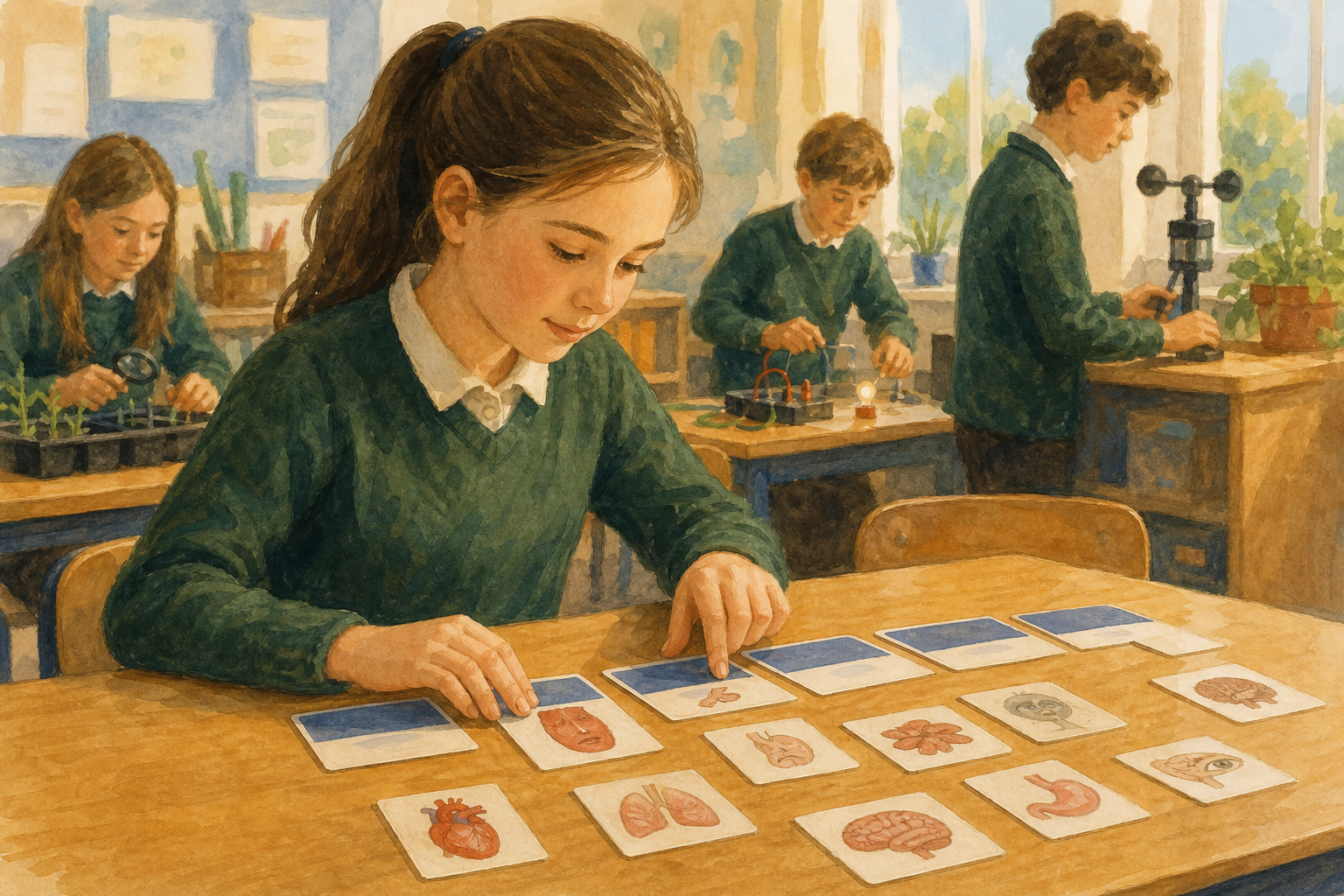
    Now it is your group's turn. You have a pile of organ cut-out cards and five team-mats: Breathing, Circulation, Digestion, Movement and Control.

    Tip

    Before you place a card, ask your group: What job does this organ do? Which team's job is that? Then put it on the right mat. Talk it over together. If two of you disagree, say why you think what you think before you decide.

    When every card is placed, set to one side the one card your group found hardest or argued about most, so you can watch out for it on the board. Then check your mats against the table on the screen.

    4 - Check It on the Board ~8 mins

    Let's check our sorting together. On the screen we have the same eleven organs and the same five teams. We will send each organ down to its team one at a time. One group says where they put their card and why. Everyone else has a job too: decide in your head whether you agree before the card lands, and put your thumb up if your group placed it the same way. We will start with the organs that groups found hardest.

    Sort the organs into their teams

    5 - Pass the Job Along ~7 mins

    Illustration for Pass the Job AlongThe teams don't work alone. They depend on each other. Let's see how. We will line our five mats up in a row and pass one job along the line.

    It starts when you take a breath. Follow it: the Breathing team takes oxygen from the air into the body, then the Circulation team carries that oxygen in the blood to your legs, and then the Movement team uses the oxygen to run. And the Control team is in charge of the whole thing, telling the others to speed up when you run.

    Talk it over

    Here's a question to talk out together, and there's no wrong guess: what would happen to the running if one team stopped doing its job? Turn and tell a neighbour what you think.

    6 - Record the Teams and Their Organs ~10 mins

    Now record what you found out on your Investigation Journal page. The page has five boxes already printed on it, one for each team: Breathing, Circulation, Digestion, Movement and Control. This is just like your team-mats, so you are grouping organs by the job their team does.

    Work through these one at a time:

    1. In each team's box, write the organs that belong to that team. For example, write lungs and windpipe in the Breathing box.
    2. When all your organs are in their boxes, draw one arrow between two of the boxes to show how those teams help each other, like an arrow from the Breathing box to the Circulation box to show oxygen being passed along.
    3. Write a few words on your arrow to say what is being passed (for example, oxygen).
    Tip

    The science is in which box each organ lands in and in your arrow, so don't worry about neat handwriting.

    7 - What You Covered ~5 mins

    Let's look back at what we found out today:

    • Your body is a set of teams called systems, and each team has one big job.
    • We sorted the organs by the job their team does, not by where they sit in the body.
    • The five teams we met are Breathing, Circulation, Digestion, Movement and Control.
    • The teams depend on one another: the Breathing team takes in oxygen, the Circulation team delivers it, and the Movement team uses it to run.
    • Doctors and biologists study how these teams work together so they can keep people healthy.
    Pupil practice · Investigation Journal
    Module 1 · Living Things: the Human Body, Nutrition and Classifying
    Lesson 1 · The Systems of the Human Body
    Download Investigation Journal sheet (PDF)
    End of lesson
    123learn · Online learning platform

    Unlock the full learning experience

    You're previewing this lesson. Get full access to this lesson and hundreds more — each one ready to teach, with interactive activities, printable resources and pupil progress tracking built in.

    Hundreds of curriculum-aligned lessons
    Interactive activities in every lesson
    Printable resources & progress tracking
    Copyright Notice
    This lesson is copyright of 123Learn.ie 2017 - 2025. Unauthorised use, copying or distribution is not allowed.
    🍪 Our website uses cookies to make your browsing experience better. By using our website you agree to our use of cookies. Learn more