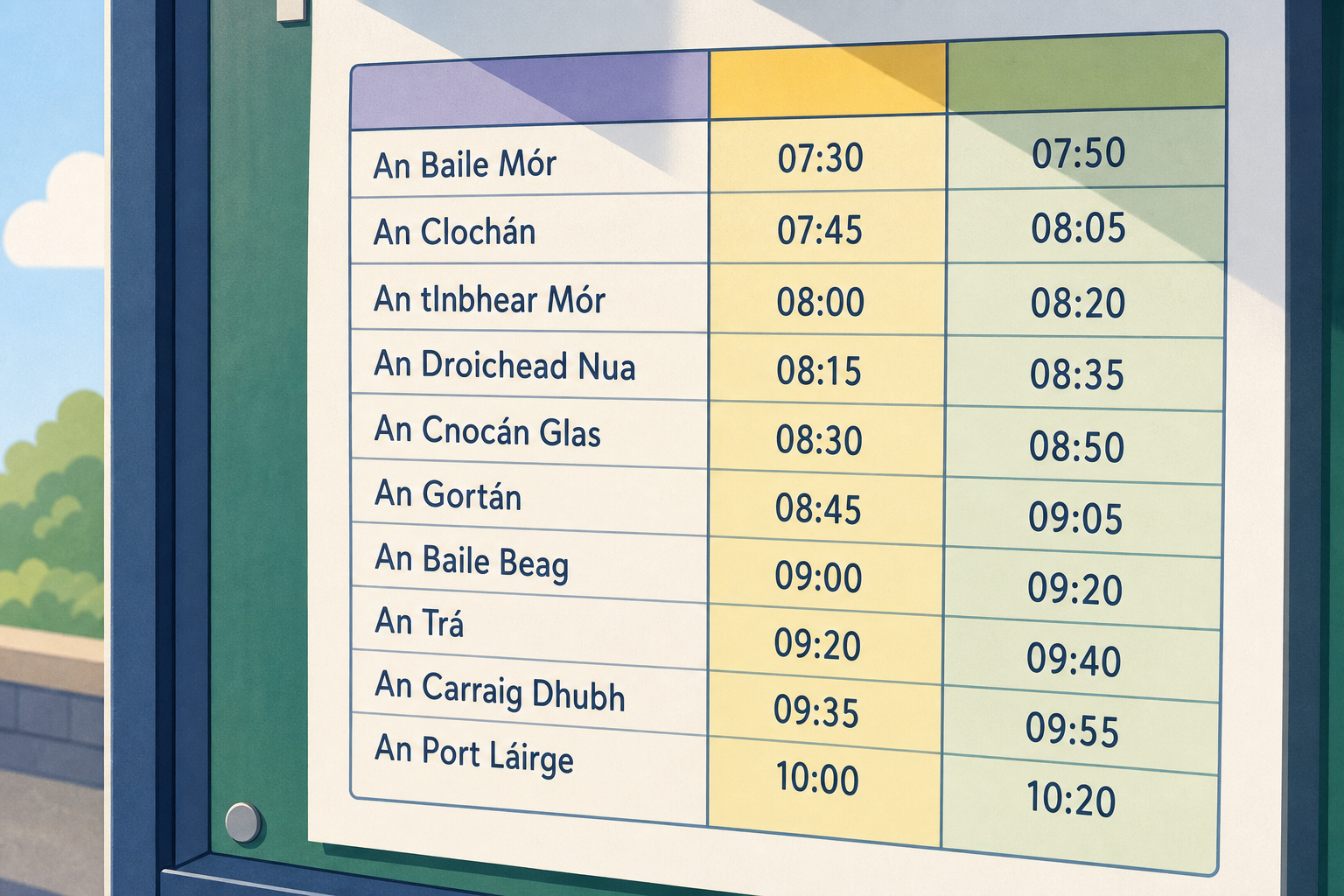
Here is a Dublin to Cork bus timetable. The times are written the 24-hour way, so 13:55 means just before 2 o'clock in the afternoon. Look down the list of buses leaving Dublin this morning. Which bus would get you to Cork before 2 o'clock in the afternoon? Have a good look before any hands go up.
Display the timetable as pupils settle. Remind the class the times are in 24-hour notation, so 13:55 reads as just before 2pm. Give about ten seconds of quiet look-time, then take two or three hands-up answers. Don't resolve it yet — that's what Watch and Notice does. Listen for whether pupils are reading the arrival column, not the departure one.

Watch as we read along one row to find when a bus leaves Dublin, then down to the same bus's arrival at Cork. The row tells us the place; the column tells us which bus.
Watch as we count on from the departure time to the arrival time to find how long one journey lasts. We count up to the next whole hour first, then on by hours, then to the finish.
Watch as we compare three buses. The one with the shortest journey duration is the fastest, even if it isn't the first to leave.
Walk each example aloud, one at a time.

The Earth is always turning. That means different parts of the world face the sun at different moments, so their clocks do not all read the same. When it is afternoon here, the other side of the world has already had its night.
If you travel east, you move towards where the sun has already risen, so the clock there is ahead of ours. If you travel west, the clock there is behind ours.
Let's work it out for 15:00 in Dublin. New York is 5 hours behind, so we count back 5 hours from 15:00: that gives 10:00 in New York. Sydney is 11 hours ahead, so we count on 11 hours from 15:00. Counting on past midnight, 15:00 + 11 hours lands on 02:00 the next day in Sydney.
Draw a simple circle for the Earth with Dublin on one side and Sydney on the other to show why the two places face the sun at different moments. Walk the two worked shifts on the board: count back 5 hours from 15:00 for New York (10:00), then count on 11 hours from 15:00 for Sydney, slowing down at midnight so the class sees it crosses into the next day to reach 02:00. Stress: east = ahead, west = behind. This is the on-screen model pupils will reproduce in the copybook moment, so use the same 15:00 anchor.
Today we work through the timetable together: which bus, how long does it take, and would I make my connection? We'll read the row, read the column, then count on to find each journey duration before we agree the answer.
This round is for talking it through together — pupils take turns at the board and the class agrees or corrects out loud.
Bring an individual pupil to the board to tap the departure cell and the arrival cell; the class reads the elapsed time off the tool and agrees or corrects. Rotate three or four pupils. Watch for pupils reading the wrong column when they move down a row — remind them the column number stays fixed. Revoice a strong answer: so the bus leaves at 09:30 and arrives at 12:40, that's 3 hours 10 minutes.
In your maths copy, copy three rows of the timetable and beside each one write its journey duration. Then write the local time in New York and Sydney when it is 15:00 in Dublin.
Remember: New York is 5 hours behind Dublin, and Sydney is 11 hours ahead. Counting on for Sydney crosses into the next day.
Walk the room glancing at how pupils have counted on for each duration and whether they shifted the clock the right way for each city — this is whole-class copybook practice, not marking. Watch for the next-day crossing: 15:00 + 11 h = 02:00 the next day, so head off pupils who write 26:00. (For your own information: real Dublin–Sydney offsets vary 9–11 hours through the year with daylight saving; the fixed 11 hours is a fair primary simplification.)
Today we plan some real journeys: find the fastest service and work out the total travel time when there is a connection to catch. Then, on the board together, a time-zone stretch — there is a video call at 17:00 Dublin time, so what time is it for a cousin in Sydney? Count on 11 hours from 17:00, and watch as it crosses past midnight into the early morning of the next day.
This round is the practice bank — pupils take turns at the board, check each timetable answer on screen, and the class confirms before moving on. Keep the board work brisk rather than over-explaining.
The on-screen widget handles the journey-duration challenges; pupils predict the duration before the pupil checks. The Sydney stretch is a teacher-led board calculation, not an on-screen check: count on 11 hours from 17:00 with the class, and head off the trap of forgetting it crosses into the next day (17:00 + 11 h = 04:00 the next day). Use the on-screen check on the timetable answers as part of your narration: yes — that's it.
Why is it a different time of day in Sydney when it is the afternoon here? One pupil says the sun is in the same place everywhere at once. Another says different parts of the world have different times. Who is right, and how would you settle it?
Listen for pupils connecting the time shift to the Earth turning — different places face the sun at different moments. Revoice: so when it is afternoon here, Sydney has already had its night and is into the next day. Don't expect a full explanation of rotation; the goal is that they accept the clock genuinely reads differently across zones, not that everywhere shares one clock.
Next we look at converting between units of time, working out how many minutes are in a number of hours and how many hours in a number of days.
Recap the count-on method for durations once more before moving on. Cross-curricular bridge: this links to geography work on the wider world and the position of countries east and west of Ireland.
You're previewing this lesson. Get full access to this lesson and hundreds more — each one ready to teach, with interactive activities, printable resources and pupil progress tracking built in.