Hands up: what is the biggest number you have ever seen written down? A price in a shop window, the number of people at a match, the distance to the moon?
Call out a few and we will write them up on the board together. Some of these numbers are huge, but every one of them is built the same way, out of the same handful of columns you already know.
Take three hands-up answers, not open call-outs. Write each suggested number on the IWB and slot it into a quick place-value frame so the columns spread out under it.
If a pupil offers a number with millions, that is brilliant: name the column and tell them we will see how it lives in the same frame as the smaller numbers today.
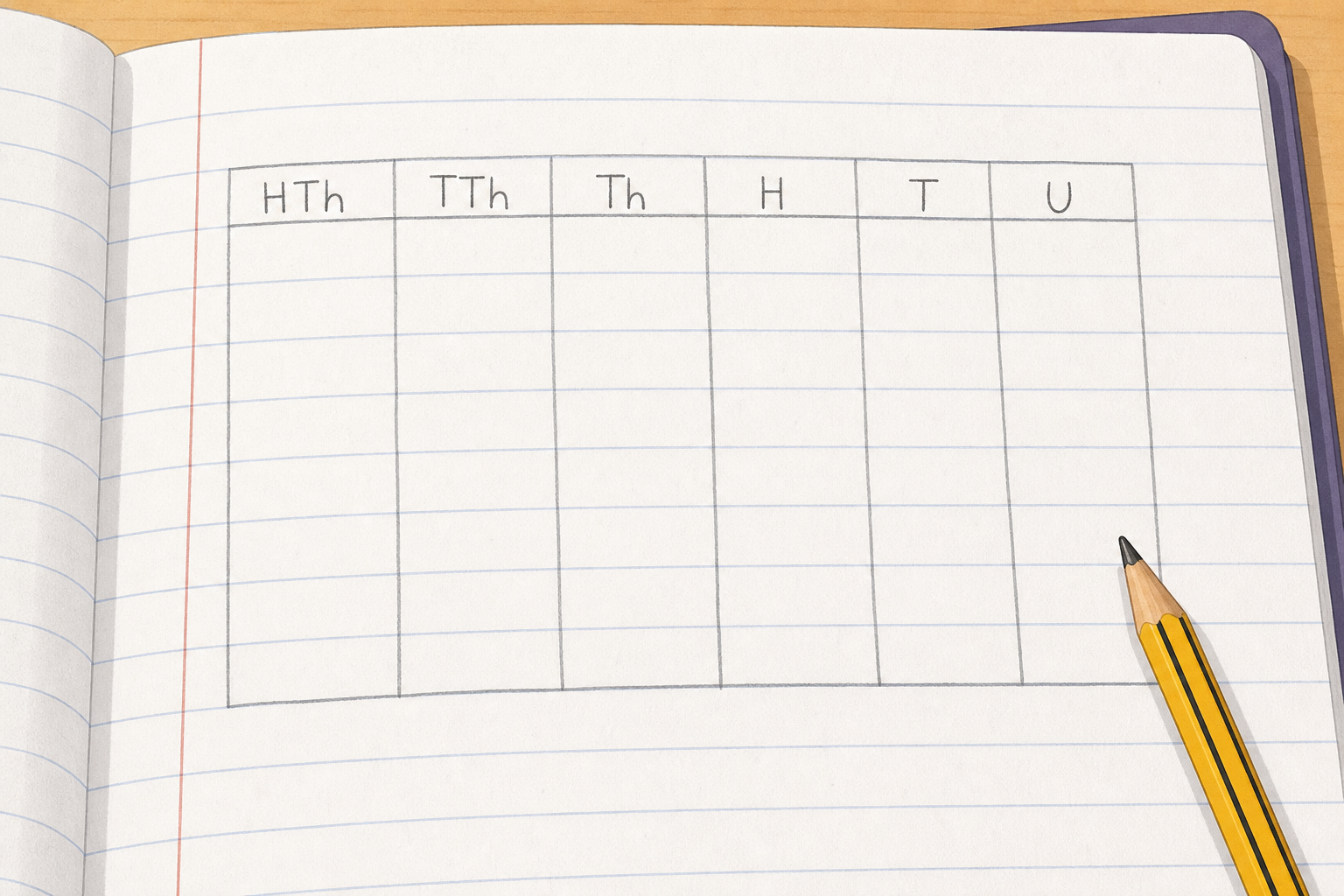
Here is our place-value mat with six columns: HTh, TTh, Th, H, T and U. Every number we look at today sits inside this same mat, just filling more or fewer columns.
Watch as we build this number with place-value blocks. Look hard at the hundreds column. What do you notice sitting there? Turn to the class: who can tell me what that zero is doing?
Now the four right-hand columns are filled right up, and the ten-thousands column beside them is still empty. What do you think happens to this number if we add just one more? Watch the empty TTh column.
This time the ten-thousands column has a digit in it. We have not used the ten-thousands column before today. Who can read this whole number aloud for us?
Now the columns reach all the way to hundred-thousands. The biggest numbers you called out at the start live in this same mat, just with more columns filled.
Walk each example aloud, one at a time, starting from the smaller numbers so the column structure builds upward. Between examples, take a quick hands-up answer or turn-and-name so the watching class has a voice, then revoice the best one before moving on.
Keep returning to the base-ten rule: each column to the left is worth ten of the column on its right.
We will use the same six-column mat we just saw, with the columns HTh, TTh, Th, H, T, U. Today we work through these numbers together: 3,072, then 70,309, then 105,008, then 800,070.
The zeros catch people out, so before each builder finishes, the whole class reads the number aloud together. Then whoever is at the board checks their build against what we said, and the rest of us agree or correct.
This round is for talking it through together — a pupil builds at the board while the whole class reads each number aloud, then agrees or corrects out loud.
Call one number at a time: 3,072 → 70,309 → 105,008 → 800,070. Each one has at least one zero acting as a placeholder. Have the class read each number aloud before the builder finishes, then check digit by digit against the columns.
Watch for pupils who drop a zero and slide the other digits over — that is the misconception to head off. Revoice: so the zero holds the column open and keeps every other digit in its place.
In your maths copy, sketch the six place-value columns and label them HTh, TTh, Th, H, T, U. Then write each of these numbers into the columns, one under the other, and read each one aloud after you write it:
Walk the room glancing at column labels and digit alignment — no marking, this is whole-class copybook practice. Look for any pupil writing a zero in the wrong column or skipping it entirely.
Now we build a fresh set on the mat, each one a little trickier than the last: 8,004, then 60,030, then 200,109, then 700,005.
Before each one is built, we will ask: what is tricky about this one? Then a pupil builds it and we check together.
This round is the practice bank — pupils take turns at the board, check each answer, and the class confirms before moving on. Keep the board work brisk rather than over-explaining.
Give each target a quick 'what is tricky about this one?' before the builder starts:
Let the strongest pupils predict the column count before building; everyone enters by reading the number aloud.
Each column to the left is worth ten times the one before it. What do you think would happen if the rule was 'five times' instead of 'ten times'? How would our numbers change?
Listen for pupils naming the ten-times jump as the engine of the whole system. Revoice a strong answer: so because each column is ten times the last, ten of one column always rolls over into one of the next.
The 'five times' what-if is a thinking prompt, not a question with one right answer — accept any reasoning that shows pupils grasp the ten-times rule by imagining it changed. Head off the idea that the digits themselves change; it is the column values that would.
Next we take that same partitioning idea one step further. Instead of splitting one whole into tens and units, we will split one whole into ten equal parts and meet our first decimals: tenths.
Keep this brisk. The whole-number place-value frame built today is the launch pad for decimals next lesson, where the same ten-times rule runs to the right of the units column.
You're previewing this lesson. Get full access to this lesson and hundreds more — each one ready to teach, with interactive activities, printable resources and pupil progress tracking built in.