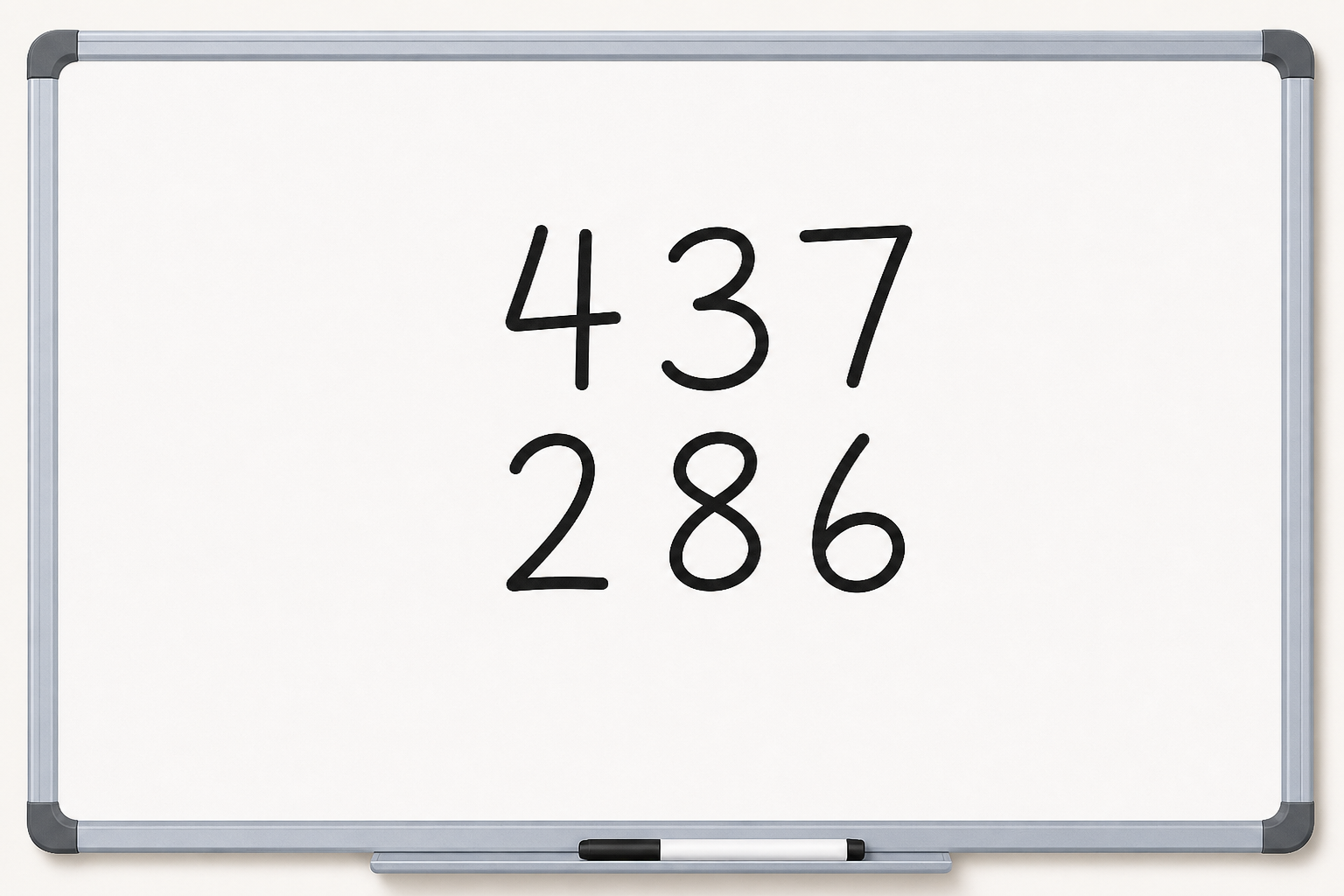
Here is a worked attempt on the board: a club adds 156 raffle tickets to 138 more, so someone has written 156 + 138. When we add the units, 6 and 8, we get 14. But 14 is too big to fit in one box! When a column makes ten or more, we trade the ten and move it to the next column to the left — that move is called carrying, or regrouping. So where will our extra ten go?
Write 156 + 138 stacked on the board. Take two or three hands-up answers, not open call-outs. Listen for any pupil who already knows the word 'carry'. Don't reveal the full method yet — just surface the puzzle of where the extra ten goes, now that the word 'carry' has been named on screen.
We stack the numbers and start from the right. The units, 6 and 8, make 14. Now look closely at what 14 really is: it is 1 ten and 4 units. The 4 units stay in the units column, so we write 4 underneath. The 1 ten cannot stay in the units column, because it is worth a whole ten — so it moves one step to the left, into the tens column, where tens live. That little 1 we write above the tens is our carry. That is why a carry always moves to the left, never to the right.
This time two columns make ten or more. Watch where each carry lands.
Here a trade happens right across a zero in the tens column. Look carefully.
Two trades in a row. Watch each carry move one column to the left.
Work each example aloud, one at a time, always starting from the units column on the right. Between examples, pose a quick question to the whole class and take two hands-up answers before moving on, so the back rows stay with you.
The carry always moves one column to the left, never to the right.
Now we work this addition through together on the board: 264 + 158. We will stack the numbers, add from the right, and say out loud where a column makes ten or more and which way the carry moves. Once we have agreed that one, we will try a second together: 372 + 249.
This round is for talking it through together — pupils take turns at the board and the class agrees or corrects out loud. The interactive carries 264 + 158; once that is agreed, retype the addends to 372 + 249 in the same widget for the second pair.
Call a pupil up to stack the first addition; the class checks the columns line up before any adding starts. Work the units, then the tens, then the hundreds, pausing at each carry. Revoice a strong answer: 'so 12 tens is one hundred and two tens — the hundred carries left.' Watch for pupils who try to carry to the right or who forget to add the carry into the next column.
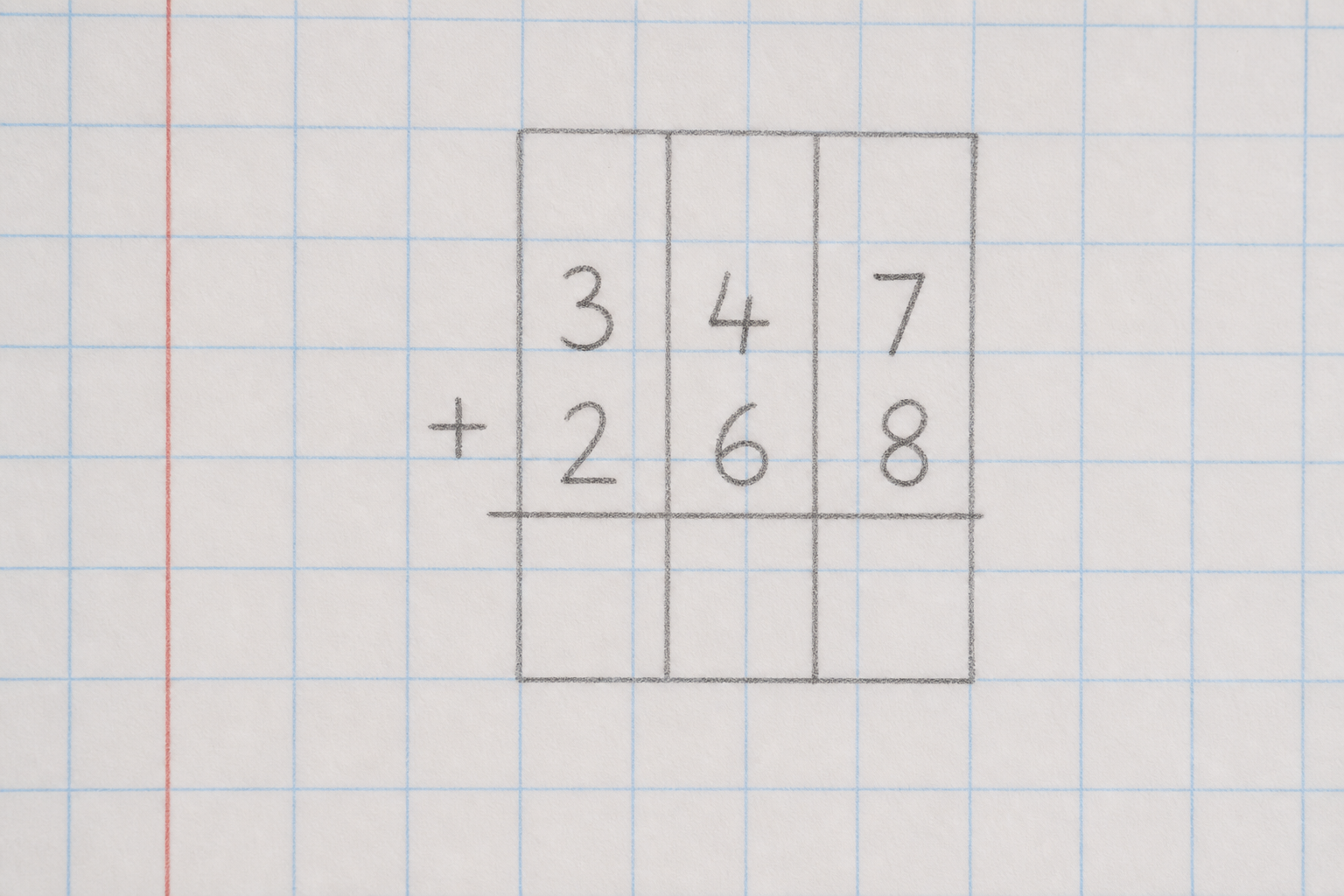
In your maths copy, or on your printed squared-paper sheet, set out this addition in columns, carry where a column makes ten or more, and read your answer aloud when you finish:
Keep your units, tens and hundreds lined up neatly underneath each other, and write your carry above the next column to the left.
This is the on-paper beat, so pupils write rather than watch. Pupils with a maths copybook rule their own columns; any pupil without a copybook uses the printable squared-paper column-frame sheet (see Before the Lesson), so every pupil has a paper surface. Walk the room, glance for column alignment and a carry written above the next column to the left — no individual marking, this is whole-class copybook practice, not assessment.
Now we solve some club and GAA additions at the board. Before each answer is confirmed, give me a thumbs up if you think that one needs a trade. We'll begin with an easy warm-up that needs no trade at all: a club sold 143 raffle tickets, then 126 more. Next come the ones that do need a trade, each a little harder. First, two collections of cans: 235 and 187. After that, a sponsored walk where the club covered 318 metres, then another 296 metres. And finally, 467 and 358 cones set out at the hurling skills stall. We'll stack and add each one, and check where the trades happen.
This round is the practice bank — pupils take turns at the board, check each answer, and the class confirms before moving on. Keep the board work brisk rather than over-explaining.
The first item (143 + 126) is a deliberate no-trade warm-up, so frame it as a gentle start, not the first rung of a hard ladder. Before each of the others, ask the class to thumbs up if they think it needs a trade. Ask before the last one: which of these needs two trades? The 467 + 358 stall problem is the stretch — two carries in a row. Confirm each answer with the on-screen Check before the next pupil comes up.
Why must the carry go into the next column to the left and never the right? What would happen to our answer if we put it in the wrong place?
Listen for pupils explaining that ten units make one ten, so the carry belongs where the tens live — to the left. Revoice a strong answer: 'the carry is worth more, so it moves to a column worth more.' Head off the idea that the carry is just a 'leftover' with no value.
Next we take the very same trading rule and stretch it to four-digit numbers, where trades can carry all the way along to the thousands.
Close by reminding pupils that four-digit addition is the same job, just one column wider.
You're previewing this lesson. Get full access to this lesson and hundreds more — each one ready to teach, with interactive activities, printable resources and pupil progress tracking built in.